Two Means - Unknown, Unequal Variance quiz #1 Flashcards

Two Means - Unknown, Unequal Variance quiz #1
Control buttons has been changed to "navigation" mode.
1/10
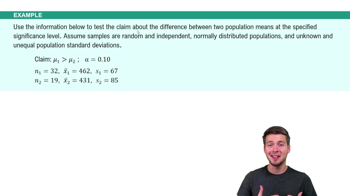
  • When examining the difference between two independent groups with unknown and unequal variances, what is the formula for the test statistic (t) used in hypothesis testing for the difference in means?
    The test statistic (t) for the difference between two independent means with unknown and unequal variances is: t = (x̄₁ - x̄₂ - (μ₁ - μ₂)) / sqrt[(s₁²/n₁) + (s₂²/n₂)] where x̄₁ and x̄₂ are the sample means, s₁ and s₂ are the sample standard deviations, n₁ and n₂ are the sample sizes, and (μ₁ - μ₂) is the hypothesized difference in population means (usually 0 under the null hypothesis).
  • How do you conduct a hypothesis test for the difference between two independent means when population variances are unknown and not assumed equal?
    To conduct a hypothesis test for the difference between two independent means with unknown and unequal variances: 1. State the null hypothesis (H₀: μ₁ = μ₂ or μ₁ - μ₂ = 0) and the alternative hypothesis (e.g., μ₁ ≠ μ₂). 2. Calculate the test statistic using: t = (x̄₁ - x̄₂) / sqrt[(s₁²/n₁) + (s₂²/n₂)] 3. Determine the degrees of freedom, typically using the smaller of n₁ - 1 or n₂ - 1. 4. Find the p-value using the t-distribution with the chosen degrees of freedom. 5. Compare the p-value to the significance level (α) to decide whether to reject the null hypothesis.
  • What condition must be met regarding the relationship between two groups when performing a two-sample t-test for means?
    The two groups must be independent, meaning the samples do not interact with each other. This ensures the validity of the test results.
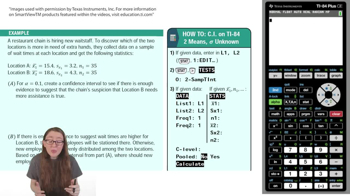
  • When using a TI-84 calculator for a two-sample t-test, which option should you select to input summary statistics?
    You should select the 'Stats' option after choosing the two-sample t-test function. This allows you to enter the sample means, standard deviations, and sizes directly.
  • How do you determine the degrees of freedom for a two-sample t-test when variances are unknown and unequal?
    Use the smaller of the two sample sizes minus one as the degrees of freedom. This is a commonly accepted method for these tests.
  • What does it mean if the confidence interval for the difference in means does not include zero?
    It means there is enough evidence to reject the null hypothesis that the means are equal. This suggests a significant difference exists between the two population means.
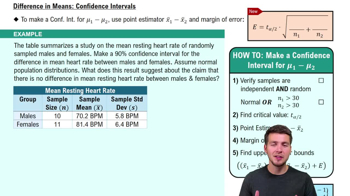
  • What is the point estimator used when constructing a confidence interval for the difference between two means?
    The point estimator is the difference between the two sample means, x̄₁ - x̄₂. This value serves as the center of the confidence interval.
  • Why is the pooled option set to 'no' when performing a two-sample t-test with unknown and unequal variances on a calculator?
    Setting pooled to 'no' ensures the test does not assume equal population variances. This is appropriate when variances are unknown and not assumed equal.
  • What is the margin of error formula for a confidence interval for the difference in means with unknown and unequal variances?
    The margin of error is t* × sqrt[(s₁²/n₁) + (s₂²/n₂)], where t* is the critical t-value. This formula accounts for both sample variances and sizes.
  • How do you interpret a confidence interval for the difference in means that includes zero?
    If zero is included in the interval, it means there is not enough evidence to conclude the population means are different. Therefore, you fail to reject the null hypothesis.