Two Proportions quiz #1 Flashcards

Two Proportions quiz #1
Control buttons has been changed to "navigation" mode.
1/10
  • What are some key considerations that are true when investigating two population proportions in hypothesis testing?
    When investigating two population proportions, the following are true: (1) The null hypothesis is that the proportions are equal (p1 = p2); (2) The test statistic is a z-score calculated using the difference in sample proportions and a pooled proportion for the standard error; (3) The samples should be independent and randomly selected, with at least five successes and five failures in each sample to ensure normality; (4) A confidence interval for the difference in proportions is constructed using the sample proportions and their standard errors, and whether zero is included in the interval helps determine if there is evidence of a difference.
  • What is the purpose of using a pooled proportion (p-bar) in the hypothesis test for two population proportions?
    The pooled proportion combines successes and sample sizes from both groups to estimate the overall proportion under the null hypothesis. It is used to calculate the standard error in the z-score formula for hypothesis testing.
  • How do you determine the critical z value when constructing a confidence interval for the difference in two proportions?
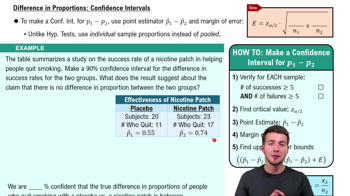
    The critical z value is based on the chosen confidence level, such as 1.645 for a 90% confidence interval. It is independent of the sample data and is found using standard normal distribution tables.
  • When calculating the margin of error for a confidence interval of two proportions, which sample statistics are used?
    You use the individual sample proportions (p1-hat and p2-hat) and their complements (q1-hat and q2-hat) for each group. The pooled proportion is not used in the margin of error calculation for confidence intervals.
  • What does it mean if zero is included in the confidence interval for the difference between two population proportions?
    If zero is included, it suggests that there may be no difference between the two population proportions. This means you fail to reject the null hypothesis of equal proportions.
  • Which calculator function is used to perform a hypothesis test for two population proportions on a TI-84?
    The function used is '2-PropZTest' found in the STAT menu under tests. It allows you to input sample data and select the alternative hypothesis to calculate the p-value and test statistic.
  • How do you interpret a p-value that is less than the significance level alpha in a two-proportion hypothesis test?
    If the p-value is less than alpha, you reject the null hypothesis. This indicates there is enough evidence to support the alternative hypothesis that the proportions are different.
  • What is the difference between the formulas for the standard error in hypothesis testing and confidence interval construction for two proportions?
    In hypothesis testing, the standard error uses the pooled proportion (p-bar), while in confidence interval construction, it uses the individual sample proportions (p1-hat and p2-hat). This distinction affects the calculation of the test statistic and margin of error.
  • What steps should you follow to use the TI-84 to construct a confidence interval for two population proportions?
    You use the '2-PropZInt' function, enter the sample data and confidence level, and then calculate to obtain the interval. The resulting interval estimates the difference between the two population proportions.
  • Why is it important to check for at least five successes and five failures in each sample before conducting a two-proportion hypothesis test?
    This condition ensures that the sampling distribution of the difference in proportions is approximately normal. It is necessary for the validity of the z-test and confidence interval calculations.