Back

Type I & Type II Errors definitions

Control buttons has been changed to "navigation" mode.
1/15
  • Hypothesis Test

    A procedure using sample data to decide between initial assumptions and alternative claims about a population.
  • Null Hypothesis

    An initial assumption about a population, often representing no effect or the status quo.
  • Alternative Hypothesis

    A claim that contradicts the initial assumption, suggesting a difference or effect in the population.
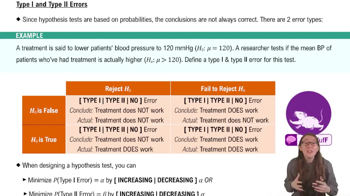
  • Type I Error

    Mistakenly concluding an effect exists when the initial assumption is actually correct.
  • Type II Error

    Failing to detect an effect when the initial assumption is actually incorrect.
  • Alpha

    The threshold probability for rejecting the initial assumption, representing the risk of a false positive.
  • Beta

    The probability of missing a real effect, representing the risk of a false negative in decision-making.
  • P Value

    The probability of observing sample results as extreme as those obtained, assuming the initial assumption is true.
  • Blood Pressure

    A measurable health outcome used to assess treatment effectiveness in the example scenario.
  • Treatment Efficacy

    The ability of a medical intervention to produce the intended health outcome, central to hypothesis testing.
  • Sample Data

    Collected observations from a subset of the population, used to inform statistical decisions.
  • Error

    A mismatch between statistical conclusions and actual reality, even when procedures are followed correctly.
  • Significance Level

    A chosen benchmark for deciding whether to reject the initial assumption, often set before analysis.
  • Probability

    A numerical measure of the likelihood of an event, central to quantifying risks in hypothesis testing.
  • Population Mean

    The average value in the entire group under study, often the focus of initial assumptions.