Statistics
My Course
Learn
Exam Prep
AI Tutor
Study Guides
Textbook Solutions
Flashcards
Explore
Try the app
My Course
Learn
Exam Prep
AI Tutor
Study Guides
Textbook Solutions
Flashcards
Explore
Try the app
Back
Type I & Type II Errors quiz
You can tap to flip the card.
What is a Type I error in hypothesis testing?
You can tap to flip the card.
👆
What is a Type I error in hypothesis testing?
A Type I error occurs when a true null hypothesis is wrongly rejected. Its probability is equal to the significance level, alpha (α).
Track progress
Control buttons has been changed to "navigation" mode.
1/15
Related flashcards
Related practice
Recommended videos
Type I & Type II Errors definitions
Type I & Type II Errors
15 Terms
9. Hypothesis Testing for One Sample
1 topic
3 problems
Chapter
David-Paige
03:21
Type I & Type II Errors Example 1
197
views
3
rank
06:02
Type I & Type II Errors
377
views
6
rank
Terms in this set (15)
Hide definitions
What is a Type I error in hypothesis testing?
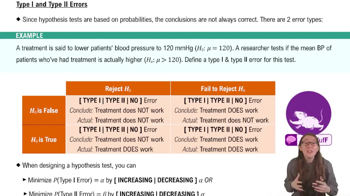
A Type I error occurs when a true null hypothesis is wrongly rejected. Its probability is equal to the significance level, alpha (α).
What is a Type II error in hypothesis testing?
A Type II error happens when a false null hypothesis is not rejected. Its probability is denoted by beta (β).
What does the null hypothesis represent in the blood pressure treatment example?
The null hypothesis states that the mean blood pressure is 120 and the treatment works as advertised.
What is the alternative hypothesis in the blood pressure treatment example?
The alternative hypothesis is that the mean blood pressure is greater than 120, meaning the treatment does not work as advertised.
What outcome occurs if you reject a false null hypothesis?
Rejecting a false null hypothesis means your conclusion matches reality, so no error is made.
What outcome occurs if you fail to reject a true null hypothesis?
Failing to reject a true null hypothesis means your conclusion matches reality, so no error is made.
What is the memory tool 'rat fluff' used for?
'Rat fluff' helps remember that Type I error is rejecting a true null hypothesis and Type II error is failing to reject a false null hypothesis.
How can you reduce the probability of a Type I error?
You can reduce the probability of a Type I error by decreasing the significance level, alpha (α).
How can you reduce the probability of a Type II error?
You can reduce the probability of a Type II error by increasing the significance level, alpha (α).
What is the relationship between minimizing Type I and Type II errors?
Minimizing one type of error increases the chance of the other, so balancing alpha is necessary based on which error is more serious.
What does alpha (α) represent in hypothesis testing?
Alpha is the smallest probability you are willing to accept for the null hypothesis to be true before rejecting it.
What does beta (β) represent in hypothesis testing?
Beta is the probability of making a Type II error, failing to reject a false null hypothesis.
Why might a Type II error be considered more serious in treatment efficacy tests?
A Type II error means concluding a treatment works when it actually does not, which can be unethical and harmful.
What does it mean if your conclusion matches what is actually happening in reality after a hypothesis test?
It means no error has been made; your statistical decision reflects the true state.
What is the consequence of rejecting a true null hypothesis?
Rejecting a true null hypothesis results in a Type I error, leading to a false conclusion about the treatment's effectiveness.