Skip to main content
Introductory Statistics
My Course
Learn
Exam Prep
AI Tutor
Study Guides
Textbook Solutions
Flashcards
Explore
Try the app
My Course
Learn
Exam Prep
AI Tutor
Study Guides
Textbook Solutions
Flashcards
Explore
Try the app
Back
Coefficient of Determination quiz
You can tap to flip the card.
What does the coefficient of determination (R²) measure in a dataset?
You can tap to flip the card.
👆
What does the coefficient of determination (R²) measure in a dataset?
R² measures how much of the variation in the dependent variable (y) is explained by the independent variable (x).
Track progress
Control buttons has been changed to "navigation" mode.
1/15
Related flashcards
Related practice
Recommended videos
Coefficient of Determination definitions
Coefficient of Determination
15 Terms
Coefficient of Determination
12. Regression
3 problems
Topic
12. Regression
6 topics
9 problems
Chapter
Justin
Guided course
06:14
Coefficient of Determination
1079
views
10
rank
1
comments
Terms in this set (15)
Hide definitions
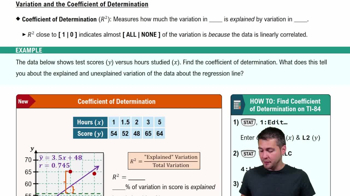
What does the coefficient of determination (R²) measure in a dataset?
R² measures how much of the variation in the dependent variable (y) is explained by the independent variable (x).
How is the coefficient of determination (R²) related to the linear correlation coefficient (r)?
R² is calculated by squaring the value of the linear correlation coefficient (r).
What is the typical range of values for R²?
R² ranges from 0 to 1.
If R² is close to 1, what does this indicate about the data?
It indicates that almost all of the variation in y is explained by the linear relationship with x.
If R² is close to 0, what does this suggest about the relationship between x and y?
It suggests that very little of the variation in y is explained by x; the data is minimally correlated.
How do you calculate R² if you are given the value of r?
You calculate R² by squaring the value of r.
What is the formula for R² in terms of variation?
R² = explained variation / total variation.
What does 'explained variation' refer to in the context of R²?
Explained variation is the sum of squared distances from the regression line to the mean, representing variation accounted for by the model.
What does 'total variation' refer to in the context of R²?
Total variation is the sum of squared distances from each data point to the mean of y.
How is R² typically expressed in the context of interpreting results?
R² is often expressed as a percentage, indicating the percent of variation in y explained by x.
What does the complement of R² (1 - R²) represent?
It represents the proportion of variation in y that is unexplained by the model, due to randomness or other factors.
Why is R² always a positive value between 0 and 1?
Because it is the square of r, and squaring any real number results in a non-negative value.
How can you find R² using a graphing calculator?
Input the data, use the linear regression function, and the calculator will display both r and R² values.
What does it mean graphically if the data points are close to the regression line?
It means R² will be close to 1, indicating a strong linear relationship.
What are some factors, other than the independent variable, that can explain variation in the dependent variable?
Other factors could include randomness, external variables, or measurement errors not accounted for by the model.
 BackBack
 06:14
06:14