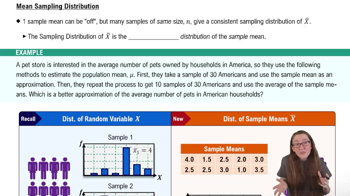
A sampling distribution is the probability distribution of a statistic obtained from a large number of samples drawn from the same population.
What does the Central Limit Theorem (CLT) state?
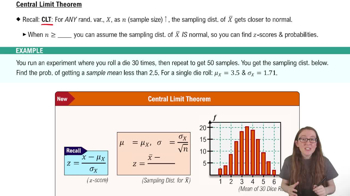
The Central Limit Theorem states that the sampling distribution of the sample mean approaches a normal distribution as the sample size increases, regardless of the population's distribution.
Why is the Central Limit Theorem important in statistics?
It allows us to use normal probability models to make inferences about population means even when the population distribution is not normal, provided the sample size is large enough.
What is a confidence interval?
A confidence interval is a range of values, derived from sample data, that is likely to contain the population parameter with a specified level of confidence.
What does a 95% confidence interval mean?
It means that if we were to take many samples and build confidence intervals from each, approximately 95% of those intervals would contain the true population parameter.
How do you calculate a confidence interval for a population mean when the population standard deviation is known?
Use the formula: sample mean ± \(z^* \times \frac{\sigma}{\sqrt{n}}\), where z* is the critical z-value for the confidence level.
What is the formula for the standard error of the mean?
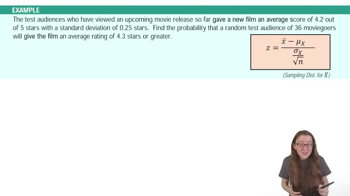
The standard error is \(\frac{\sigma}{\sqrt{n}}\), where σ is the population standard deviation and n is the sample size.
When is the t-distribution used instead of the normal distribution for confidence intervals?
The t-distribution is used when the population standard deviation is unknown and the sample size is small.
How do you calculate a confidence interval for a population proportion?
Use the formula: sample proportion ± \(z^* \times \sqrt{\frac{\hat{p}(1-\hat{p})}{n}}\), where z* is the critical z-value.
What is the sample proportion notation?
The sample proportion is denoted by \(\hat{p}\) and represents the fraction of successes in the sample.
What conditions must be met to use the normal approximation for confidence intervals of proportions?
Both np and n(1-p) should be at least 10 to justify using the normal approximation.
What is the difference between a parameter and a statistic?
A parameter describes a population characteristic, while a statistic describes a sample characteristic.
What does the margin of error represent in a confidence interval?
The margin of error is the maximum expected difference between the sample statistic and the population parameter at a given confidence level.
How does increasing the sample size affect the confidence interval?
Increasing the sample size decreases the standard error, resulting in a narrower confidence interval and more precise estimate.
What is the critical value in confidence intervals?
The critical value is the z or t score that corresponds to the desired confidence level, determining the width of the interval.
What is the relationship between confidence level and interval width?
Higher confidence levels produce wider intervals because they require more certainty that the interval contains the parameter.
What is the purpose of a quick quiz on Unit 4 topics?
To assess understanding of sampling distributions, Central Limit Theorem, and confidence intervals for means and proportions.
What is the difference between confidence intervals for means and proportions?
Confidence intervals for means estimate a population mean, while those for proportions estimate a population proportion.
What is the role of sample size in the Central Limit Theorem?
A larger sample size makes the sampling distribution of the sample mean more normal, improving the accuracy of confidence intervals.
What is the significance of sections 9.1, 9.2, and 9.3 in the study material?
They cover sampling distributions, the Central Limit Theorem, and confidence intervals for means, which are key concepts in inferential statistics.
 Back
 02:33