Skip to main content
Introductory Statistics
My Course
Learn
Exam Prep
AI Tutor
Study Guides
Textbook Solutions
Flashcards
Explore
Try the app
My Course
Learn
Exam Prep
AI Tutor
Study Guides
Textbook Solutions
Flashcards
Explore
Try the app
Back
Statistics Final Exam Key Concepts
You can tap to flip the card.
What is the Binomial Distribution used for?
You can tap to flip the card.
👆
What is the Binomial Distribution used for?
It models the number of successes in a fixed number of independent trials with the same probability of success.
Track progress
Control buttons has been changed to "navigation" mode.
1/20
Recommended videos
Guided course
03:33
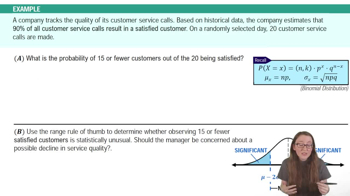
Finding Binomial Probabilities Using TI-84 Example 1
1456
views
18
rank
Guided course
04:20
Finding Binomial Probabilities Using TI-84 Example 2
1121
views
28
rank
Guided course
03:28
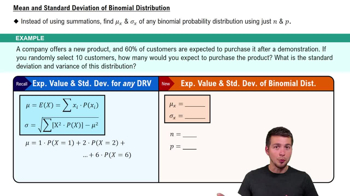
Mean & Standard Deviation of Binomial Distribution
3238
views
57
rank
Terms in this set (20)
Hide definitions
What is the Binomial Distribution used for?
It models the number of successes in a fixed number of independent trials with the same probability of success.
What is a contingency table?
A table used to display the frequency distribution of variables and analyze the relationship between them.
What does regression analysis examine?
It studies the relationship between a dependent variable and one or more independent variables.
What is the purpose of ANOVA in regression analysis?
ANOVA tests whether the regression model explains a significant amount of variation in the dependent variable.
What does the correlation coefficient (r) indicate?
It measures the strength and direction of a linear relationship between two variables.
What is a confidence interval for a mean?
A range of values that likely contains the population mean with a specified level of confidence.
What is a confidence interval for a proportion?
A range of values that likely contains the population proportion with a specified level of confidence.
What is hypothesis testing?
A method to decide whether there is enough evidence to reject a null hypothesis based on sample data.
What is a one-sample hypothesis test?
A test comparing a sample statistic to a known or hypothesized population parameter.
What is a two-sample hypothesis test?
A test comparing statistics from two independent samples to determine if their population parameters differ.
What is paired observation testing?
A hypothesis test comparing two related samples or measurements taken from the same subjects.
How do you use Z tables?
Z tables provide the area (probability) under the standard normal curve for a given Z-score.
How do you use t tables?
T tables provide critical values for the t-distribution used in hypothesis tests and confidence intervals with small samples.
What is the significance of Binomial tables?
They provide cumulative probabilities for the binomial distribution to simplify calculations.
What is the formula for the slope coefficient in simple linear regression?
The slope is calculated as \(b=\frac{\sum (x_i - \bar{x})(y_i - \bar{y})}{\sum (x_i - \bar{x})^2}\).
What does the p-value indicate in hypothesis testing?
The p-value measures the probability of observing the data if the null hypothesis is true.
What is the null hypothesis in regression analysis?
It states that the regression coefficients are equal to zero, meaning no relationship exists.
What is the alternative hypothesis in regression analysis?
It states that at least one regression coefficient is not zero, indicating a relationship.
What is the purpose of analyzing significance in regression?
To determine if the independent variables significantly predict the dependent variable.
What is the difference between population and sample in statistics?
The population is the entire group of interest; a sample is a subset used to make inferences about the population.
 BackBack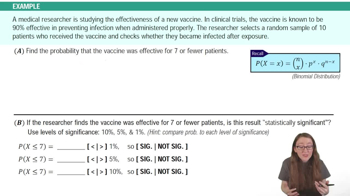
 03:33
03:33