 Back
BackAddition Rule and Mutually Exclusive Events in Probability
Study Guide - Smart Notes
 Tailored notes based on your materials, expanded with key definitions, examples, and context.
Section 3.3: The Addition Rule in Probability
Mutually Exclusive Events
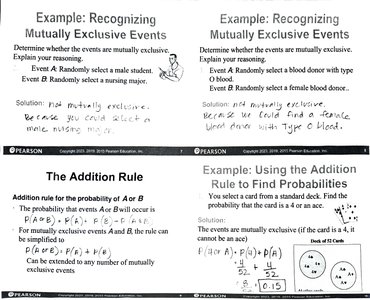
Mutually exclusive events are events that cannot occur at the same time. If one event happens, the other cannot. Recognizing whether events are mutually exclusive is essential for applying the correct probability rules.
Definition: Two events, A and B, are mutually exclusive if they have no outcomes in common.
Example 1: Rolling a 3 on a die (Event A) and rolling a 4 on a die (Event B) are mutually exclusive, since a single roll cannot result in both outcomes.
Example 2: Selecting a male student (Event A) and selecting a nursing major (Event B) are not mutually exclusive, as a student could be both male and a nursing major.
Example 3: Selecting a blood donor with type O blood (Event A) and selecting a female blood donor (Event B) are not mutually exclusive, since a donor could be a female with type O blood.
The Addition Rule
The Addition Rule is used to find the probability that at least one of two events occurs. The formula depends on whether the events are mutually exclusive.
General Addition Rule:
For Mutually Exclusive Events: Since for mutually exclusive events.
Extension: The rule can be extended to any number of mutually exclusive events by summing their individual probabilities.
Examples: Using the Addition Rule
Example 1: Drawing a 4 or an ace from a standard deck of 52 cards.
Events are mutually exclusive (a card cannot be both a 4 and an ace).
Calculation:
Example 2: Rolling a number less than 3 or an odd number on a die.
Events are not mutually exclusive (the outcome 1 is both less than 3 and odd).
Calculation:
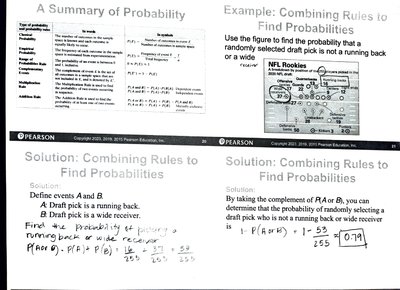
A Summary of Probability
This section summarizes key probability concepts and rules, providing a foundation for solving probability problems.
Type | Description | Formula |
|---|---|---|
Classical Probability | All outcomes are equally likely. | |
Empirical Probability | Estimated from experimentation or observation. | |
Range Rule | Probability is always between 0 and 1, inclusive. | |
Complementary Events | The complement of event E is all outcomes not in E. | |
Multiplication Rule | Probability of two events occurring in sequence. | (dependent) (independent) |
Addition Rule | Probability of at least one of two events occurring. |
Combining Rules to Find Probabilities
Sometimes, probability problems require combining the addition and complement rules. For example, to find the probability that a randomly selected NFL draft pick is not a running back or wide receiver, first find the probability of selecting a running back or wide receiver, then subtract from 1.
Define Events:
A: Draft pick is a running back
B: Draft pick is a wide receiver
Calculation:
Number of running backs: 16
Number of wide receivers: 37
Total picks: 255
Probability of not a running back or wide receiver:
