 Back
BackAdvanced Topics in ANOVA, Regression, and Nonparametric Statistics: A Study Guide
Study Guide - Smart Notes
 Tailored notes based on your materials, expanded with key definitions, examples, and context.
Analysis of Variance (ANOVA)
Overview of ANOVA
Analysis of Variance (ANOVA) is a statistical method used to compare means across three or more groups to determine if at least one group mean is significantly different from the others. It is commonly used when the independent variable is categorical and the dependent variable is continuous.
Null Hypothesis (H0): All group means are equal (...)
Alternative Hypothesis (Ha): At least one group mean is different.
F-test: The test statistic used in ANOVA to compare the variance between groups to the variance within groups.
Example: Comparing the effectiveness of three teaching methods on fire safety knowledge scores.
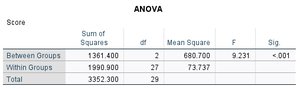
Interpreting Significant F Values
A significant F value indicates that there is a difference among group means, but does not specify where the difference lies. Post-hoc tests are required to identify which groups differ.
First, check if the F-test is significant.
If significant, conduct pairwise comparisons (e.g., t-tests) to locate differences.
Control for Type I error (false positives) when making multiple comparisons.
Type I Error and Multiple Comparisons
Conducting multiple pairwise tests increases the overall probability of making a Type I error. For example, with three comparisons at , the actual error rate increases to approximately 0.143.
As the number of groups (k) increases, the risk of Type I error rises sharply.
Solutions include using correction methods such as Bonferroni, Tukey, or Scheffé procedures.
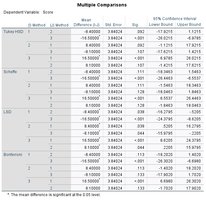
Post-Hoc Mean Comparisons
Post-hoc tests are used after a significant ANOVA to determine which specific group means differ. Common methods include Tukey HSD, Bonferroni, and Scheffé tests.
Regression Analysis
Introduction to Multiple Regression
Multiple regression analysis (MRA) is used to predict the value of a dependent variable based on several independent variables. It is a flexible and widely used technique in the social sciences.
Dependent Variable: The outcome being predicted (e.g., perceived learning).
Independent Variables: Predictors such as instructional delivery, grading & feedback, workload & difficulty, student motivation, and perceived learning environment.
Example: Predicting perceived learning from student perceptions of teaching components.
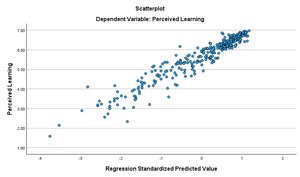
Scatterplot of Predicted vs. Observed Values
A scatterplot can be used to visualize the relationship between predicted and observed values of the dependent variable, indicating the fit of the regression model.
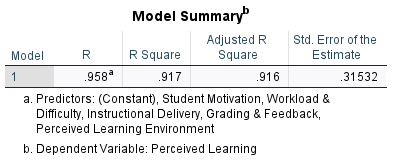
Model Summary and Interpretation
The model summary provides key statistics for evaluating the regression model:
R: Multiple correlation coefficient.
R2: Proportion of variance in the dependent variable explained by the predictors.
Adjusted R2: Adjusted for the number of predictors in the model.
Standard Error of Estimate: Average distance that the observed values fall from the regression line.
ANOVA Table for Regression
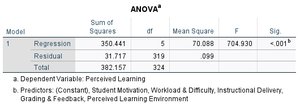
The ANOVA table for regression tests whether the overall regression model is a good fit for the data.
F-test: Tests the null hypothesis that all regression coefficients are zero.
Significance (Sig.): If p < 0.05, the model is statistically significant.
Regression Coefficients
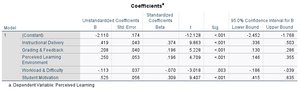
The coefficients table provides the estimated effect of each predictor on the dependent variable, along with their statistical significance and confidence intervals.
Unstandardized Coefficient (B): Change in the dependent variable for a one-unit change in the predictor.
Standardized Coefficient (Beta): Effect size in standard deviation units.
t-test and Sig.: Test whether each coefficient is significantly different from zero.
Assumptions and Limitations of Regression
Regression analysis relies on several assumptions, including linearity, independence, homoscedasticity, and normality of residuals. Violations can affect the validity of the results.
All relevant predictors should be included for unbiased estimates.
Regression is foundational for more advanced statistical techniques.

Confidence Intervals
Constructing Confidence Intervals
Confidence intervals provide a range of values within which the population parameter is likely to fall, with a specified level of confidence (e.g., 95%).
Formula for Confidence Interval:
Where is the sample mean, is the standard deviation, is the sample size, and is the critical value from the standard normal distribution (e.g., 1.96 for 95% confidence).
Example: For a sample mean of 4.738, standard deviation 0.6783, and n = 325, the 95% confidence interval is approximately [4.5937, 4.8823].
Confidence Interval for Difference Between Means
When comparing two groups, the confidence interval for the difference between means indicates the range in which the true difference likely falls.

Effect Sizes
Understanding Effect Sizes
Effect size quantifies the magnitude of a difference or relationship, providing context beyond statistical significance. Common effect sizes include:
Coefficient of Determination (R2): Proportion of variance explained in regression.
Cohen's d: Standardized difference between two means.
Example: Cohen's d = 0.58 indicates a moderate effect size.
Nonparametric Tests
Kruskal-Wallis Test (Nonparametric ANOVA)
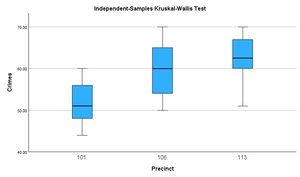
The Kruskal-Wallis test is a nonparametric alternative to one-way ANOVA, used when assumptions of normality or equal variances are not met. It compares the distributions of three or more independent groups using ranked data.
Ranks all data points and sums ranks within each group.
Null hypothesis: All group distributions are the same.
Test statistic compared to a chi-square distribution.
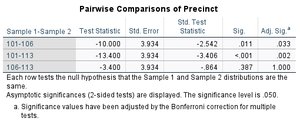
Interpreting Kruskal-Wallis Output
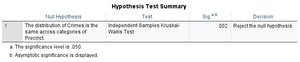
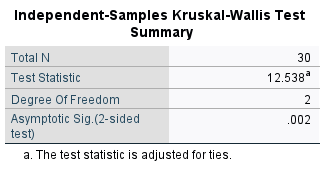
A significant result indicates that at least one group distribution differs from the others. Post-hoc pairwise comparisons can identify which groups differ.
Wilcoxon Tests
The Wilcoxon signed-rank test is used for two related samples, while the Wilcoxon rank-sum test (Mann-Whitney U) is used for two independent samples. Both tests use ranks rather than raw scores and do not assume normality.
Wilcoxon signed-rank: Tests for differences in paired data (e.g., before and after measurements).
Wilcoxon rank-sum: Tests for differences between two independent groups.
Spearman's ρ: Nonparametric measure of rank correlation.
Additional info: This guide covers advanced topics in ANOVA, regression, confidence intervals, effect sizes, and nonparametric tests, providing definitions, examples, and relevant SPSS output for practical understanding.
