 Back
BackBlocking and Matched Pairs in Experimental Design
Study Guide - Smart Notes
 Tailored notes based on your materials, expanded with key definitions, examples, and context.
Experiments and Observational Studies
Introduction to Experimental Design
Experimental design is a fundamental aspect of statistics, allowing researchers to draw valid conclusions about causal relationships. Two important concepts in experimental design are blocking and matched pairs, which help control for variability and improve the reliability of results.
Blocking
Definition and Purpose
Blocking is a technique used in experiments to group subjects that are similar in ways not being studied, thereby reducing unwanted variation. By randomizing treatments within these blocks, researchers can more accurately assess the effects of the treatments.
Block: A group of experimental units that are similar in some way that is not of primary interest to the experiment.
Randomization within blocks: Treatments are randomly assigned within each block to control for confounding variables.
Purpose: To reduce variability due to known sources, making it easier to detect the effect of the treatment.
Blocking Example: Laundry Detergent Experiment
Suppose an experiment is conducted to determine which of four brands of laundry detergent (Tide, All, Cheer, Gain) best removes grass stains from soccer uniforms. Blocking can be used to make each treatment group more similar, for example, by grouping uniforms by the amount of staining or fabric type.
Each block contains uniforms with similar characteristics.
Within each block, uniforms are randomly assigned to one of the four detergent brands.
Results are compared within blocks to control for variation due to uniform differences.

Blocking Example: Nail Polish Experiment
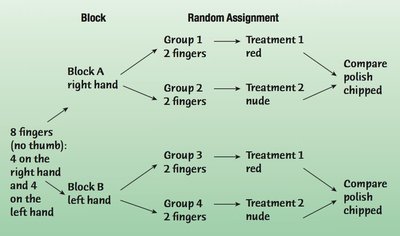
In a nail polish experiment, each hand is defined as a block. Treatments (red or nude polish) are randomly assigned to fingers within each hand, and results are compared within blocks.
Each hand serves as a block.
Randomization occurs within each hand.
Results are combined to compare the effectiveness of the polishes.
Blocking versus Stratifying
Blocking in experiments is conceptually similar to stratifying in sampling. Both methods group subjects based on similarities to reduce variation.
Blocking: Used in experiments to control for known sources of variation.
Stratifying: Used in sampling to ensure representation of subgroups.
Randomization occurs within groups in both methods.
Do not use the term "stratify" for experiments or "block" for samples.
Key Point: Blocks are used to reduce variability so the effects of the factors can be seen more clearly. The effects of the blocks themselves are not the focus of the study.
Matched Pairs
Definition and Purpose
Matched pairs is an experimental design in which subjects are paired based on similarity, or each subject receives both treatments in a random order. This design removes subject-to-subject differences, further reducing variation.
Matched pairs: Subjects are paired by similarity or each subject receives both treatments.
Randomization: The order of treatments is randomized within pairs or for each subject.
Purpose: To control for individual differences and isolate the treatment effect.
Matched Pairs Example: Reading Speed Study
In a study to determine whether people read faster on paper or a Kindle, 16 subjects read two sets of instructions, one on each medium. The order was randomized, and differences in reading speed were compared for each subject.
Each subject serves as their own block.
Variation due to individual reading speed is controlled.
Results showed reading was faster on paper.
Comparison Table: Blocking vs. Matched Pairs
Design | Purpose | How Subjects Are Grouped | Randomization |
|---|---|---|---|
Blocking | Reduce variation from known sources | Subjects grouped by similarity (blocks) | Randomize treatments within blocks |
Matched Pairs | Remove subject-to-subject differences | Subjects paired or each subject receives both treatments | Randomize order of treatments within pairs/subjects |
Key Principles of Experimental Design
Randomization: Assign treatments randomly to reduce bias.
Blocking: Group similar subjects to control for confounding variables.
Replication: Repeat the experiment to ensure reliability.
Control Group: Use a group that does not receive the treatment for comparison.
Example Question: Popcorn Experiment
In an experiment testing whether popcorn stored in the freezer pops better than room temperature popcorn, if different brands are mixed in treatment groups, the principle of blocking is ignored. The blocking variable would be the brand of popcorn.
Formulas and Equations
Difference in Means for Matched Pairs
For matched pairs, the difference in means is calculated as:
where and are the measurements for subject under treatment 1 and treatment 2, respectively.
Variance Reduction
Blocking and matched pairs reduce the variance of the treatment effect estimate:
where is the variance of the differences and is the number of pairs.
