 Back
BackChapter 1: Introduction to Statistics – Study Notes
Study Guide - Smart Notes
 Tailored notes based on your materials, expanded with key definitions, examples, and context.
Introduction to Statistics
1-1 Statistical and Critical Thinking
Statistics is the science of collecting, analyzing, interpreting, and presenting data. Statistical thinking involves not only performing calculations but also understanding the context, evaluating the source, and applying critical reasoning to draw meaningful conclusions.
Data: Collections of observations, such as measurements, genders, or survey responses.
Statistics: The science of planning studies and experiments, obtaining data, and organizing, summarizing, presenting, analyzing, and interpreting those data to draw conclusions.
Population: The complete collection of all measurements or data that are being considered. Inferences are typically made about the population.
Census: The collection of data from every member of a population.
Sample: A subcollection of members selected from a population, used to draw conclusions about the population.
Example: In a survey of 410 human resource professionals, 148 said job candidates were disqualified due to social media postings. Here, the population is all human resource professionals, and the sample is the 410 surveyed.
1-2 Types of Data
Understanding the types of data is essential for selecting appropriate statistical methods and interpreting results accurately.
Qualitative (Categorical) Data: Consists of names or labels (e.g., gender, eye color).
Quantitative (Numerical) Data: Consists of numbers representing counts or measurements (e.g., height, weight).
Discrete Data: Countable values (e.g., number of students).
Continuous Data: Measurable values that can take any value within a range (e.g., height, temperature).
Additional info: Proper classification of data types is crucial for choosing statistical tests and graphical representations.
1-3 Collecting Sample Data
Collecting data properly is fundamental to the validity of statistical conclusions. The process involves careful planning and execution to avoid bias and ensure representativeness.
Voluntary Response Sample: Also known as a self-selected sample, where respondents decide whether to participate. This method is prone to bias and should be avoided for making population inferences.
Random Sampling: Individuals are selected randomly, reducing bias and increasing the reliability of conclusions.
Example: A television poll where viewers call in is a voluntary response sample and may not represent the population accurately. A random sample of 500 respondents provides more reliable results than a voluntary response of 186,000.
The Statistical Process
Prepare, Analyze, and Conclude
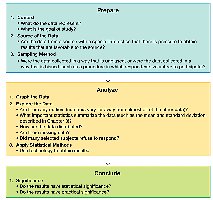
The process of conducting a statistical study can be summarized in three main steps: Prepare, Analyze, and Conclude.
Prepare: Understand the context, identify the source of data, and examine the sampling method.
Analyze: Graph and explore the data, apply statistical methods, and use common sense in interpretation.
Conclude: Distinguish between statistical significance and practical significance, and communicate findings clearly.
Statistical and Practical Significance
It is important to differentiate between statistical significance and practical significance when interpreting results.
Statistical Significance: Achieved if the likelihood of an event occurring by chance is 5% or less. For example, getting 98 girls in 100 births is statistically significant.
Practical Significance: Even if a result is statistically significant, it may not be meaningful in practice. For example, a weight loss of 2.1 kg over a year may not be practically significant for dieters.
Example: In a weight loss study, a statistically significant average loss may not be practically significant if the amount lost is too small to matter to participants.
Potential Pitfalls in Analyzing Data
Several pitfalls can undermine the validity of statistical analysis. Awareness of these issues is essential for sound statistical practice.
Misleading Conclusions: Conclusions should be clear and understandable to non-experts.
Sample Data Reported Instead of Measured: Direct measurement is preferred over self-reported data to avoid inaccuracies.
Loaded Questions: Poorly worded survey questions can bias results.
Order of Questions: The sequence of questions can influence responses.
Nonresponse: Occurs when individuals do not participate, potentially biasing results.
Low Response Rates: Decrease reliability and increase the risk of bias.
Misleading Percentages: Percentages should not exceed 100% unless justified; otherwise, they may mislead.
Additional info: Careful survey design and data collection are essential to minimize these pitfalls and ensure valid conclusions.
