 Back
BackChapter 1: The Nature of Statistics - Structured Study Notes
Study Guide - Smart Notes
 Tailored notes based on your materials, expanded with key definitions, examples, and context.
Chapter 1: The Nature of Statistics
Definition and Importance of Statistics
Statistics is the science of collecting, organizing, analyzing, and interpreting data to make decisions. It is fundamental in various fields, including science, business, and social sciences, for making informed decisions based on data.
Statistics: The study of methods for gathering, summarizing, and interpreting data.
Data: Information collected from observations, measurements, or experiments.
Population: The entire group of individuals or items of interest.
Sample: A subset of the population selected for study.
Parameter: A numerical characteristic of a population.
Statistic: A numerical characteristic calculated from a sample.
Example: If you want to know the average height of students in a university (population), you may measure the height of 100 randomly selected students (sample) and calculate the average (statistic).

Branches of Statistics
Statistics is divided into two main branches: descriptive statistics and inferential statistics.
Descriptive Statistics: Methods for summarizing and organizing data, such as tables, charts, and averages.
Inferential Statistics: Methods for making predictions or inferences about a population based on sample data.
Example: Calculating the mean and standard deviation of test scores (descriptive), then using those results to estimate the average score for all students (inferential).
Types of Data and Measurement Scales
Data can be classified according to its nature and the scale of measurement used.
Qualitative (Categorical) Data: Describes qualities or categories (e.g., gender, color).
Quantitative (Numerical) Data: Represents counts or measurements (e.g., height, weight).
Discrete Data: Countable values (e.g., number of students).
Continuous Data: Measurable values within a range (e.g., temperature).
Measurement Scales:
Nominal: Categories without order (e.g., types of fruit).
Ordinal: Categories with a meaningful order (e.g., rankings).
Interval: Ordered values with equal intervals, no true zero (e.g., temperature in Celsius).
Ratio: Ordered values with equal intervals and a true zero (e.g., height, weight).
Example: The scale used to measure temperature (interval) versus the scale used to measure weight (ratio).
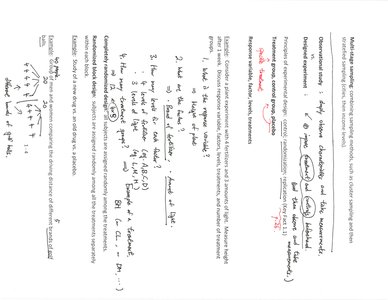
Statistical Methods and Sampling
Statistical methods involve collecting data through various sampling techniques to ensure representativeness and minimize bias.
Random Sampling: Every member of the population has an equal chance of being selected.
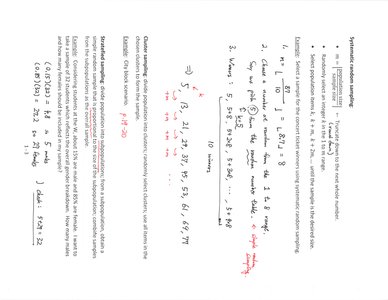
Systematic Sampling: Selecting every nth member from a list.
Stratified Sampling: Dividing the population into subgroups and sampling from each.
Cluster Sampling: Dividing the population into clusters and randomly selecting clusters for study.
Example: To study student opinions, you might randomly select students from each class (stratified sampling).
Summary Table: Key Concepts in Statistics
Concept | Definition | Example |
|---|---|---|
Population | Entire group of interest | All students in a university |
Sample | Subset of the population | 100 randomly selected students |
Parameter | Numerical summary of population | Average height of all students |
Statistic | Numerical summary of sample | Average height of sampled students |
Descriptive Statistics | Summarizing data | Mean, median, mode |
Inferential Statistics | Making predictions | Estimating population mean |
Key Formulas
Sample Mean:
Population Mean:
Sample Standard Deviation:
Additional info: These notes provide foundational concepts for understanding statistics, including definitions, types of data, sampling methods, and key formulas. The images included directly reinforce the handwritten explanations and calculations found in the original materials.
