 Back
Chapter 12: From Randomness to Probability – Study Notes
Study Guide - Smart Notes
 Tailored notes based on your materials, expanded with key definitions, examples, and context.
Random Phenomena and Probability
Understanding Random Phenomena
Random phenomena are processes or experiments whose outcomes cannot be predicted with certainty, but follow a predictable pattern in the long run. Each repetition of a random phenomenon is called a trial, and the result of a trial is an outcome. A combination of outcomes forms an event, and the set of all possible outcomes is called the sample space (S).
Trial: A single occurrence of a random experiment (e.g., flipping a coin).
Outcome: The result of a trial (e.g., heads or tails).
Event: A set of one or more outcomes (e.g., getting at least one head in two flips).
Sample Space (S): The collection of all possible outcomes.
Gambling and the Birth of Statistics
Many foundational concepts in statistics originated from analyzing games of chance. For example, if a coin is flipped and lands heads four times in a row, common questions arise about the fairness of the coin or the likelihood of the next outcome. These questions illustrate the need for a formal understanding of probability.
The Law of Large Numbers (LLN)
Definition and Implications
The Law of Large Numbers states that as the number of independent repetitions of a random experiment increases, the relative frequency of an event approaches a single value, called the probability of the event. Independence means that the outcome of one trial does not affect the outcome of another (e.g., coin flips).
Relative Frequency: The proportion of times an event occurs in a large number of trials.
Independence: Trials are independent if the outcome of one does not influence another.
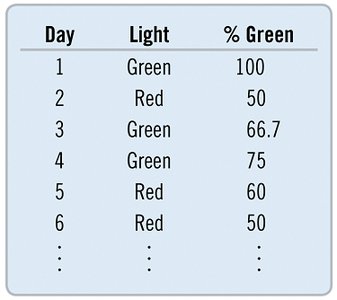
Example: The percentage of green lights observed over many days stabilizes around a certain value, illustrating the LLN.
LLN vs. Law of Averages
The "Law of Large Numbers" refers to the stabilization of relative frequencies in the long run. The so-called "Law of Averages" is a misconception; it suggests that outcomes are "due" to balance out in the short run, which is not supported by probability theory.
Coin Flip Example and Relative Frequency
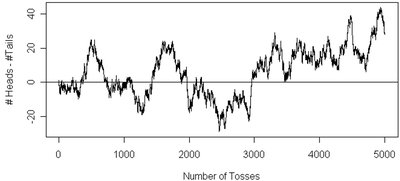
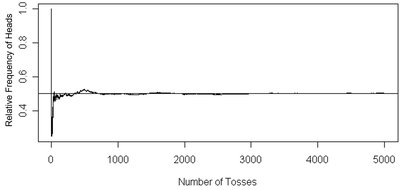
When flipping a fair coin many times, the difference between the number of heads and tails may not approach zero, but the relative frequency of heads approaches 0.5 as the number of tosses increases.
Modeling Probability
Mathematically Determined Probabilities
In some cases, probabilities can be determined mathematically without repeated trials. This is common in games of chance where all outcomes are known and equally likely.
Equally Likely Outcomes: If all outcomes have the same chance of occurring, probability calculations are straightforward.
Personal Probability
Personal or subjective probabilities express uncertainty based on personal judgment rather than formal calculations. These do not have the consistency required for statistical analysis.
Probability Formula for Equally Likely Outcomes
If all outcomes are equally likely, the probability of an event A is:
Example: U.S. Currency and Probability
Suppose you have one of each denomination of U.S. paper currency: $1, $2, $5, $10, $20, $50, $100. What is the probability of selecting a bill with a president's portrait?
Example: Coin Flips
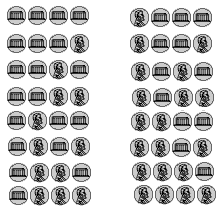
Flipping a fair coin four times yields 16 possible equally likely outcomes. If event A is getting at least 3 heads, the probability is:
Formal Probability Rules
Probability Requirements
Probabilities are numbers between 0 and 1:
If , event A cannot happen; if , event A is certain.
Probability Assignment Rule
The probability of the entire sample space is 1:
Example: For a fair six-sided die, and .
Complement Rule
The probability that an event does not occur is 1 minus the probability that it does occur:
Similarly,
Example: If the probability of selecting a president is , then the probability of not selecting a president is .
Addition Rule for Disjoint Events
Events are disjoint (mutually exclusive) if they cannot occur at the same time. For two disjoint events A and B:
Example: Rolling a die: Event A = roll a 5 or greater; Event B = roll a 2 or less. These are disjoint events.
Addition Rule Example
Suppose event A is getting 3 or more heads in four coin flips, and event B is getting an even number of tails (not including zero tails). Are these events disjoint? Calculate , , and .
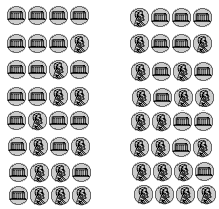
Another Addition Rule Example
Suppose event B is getting an even number of tails (not including zero tails), and event C is getting 2 or more heads. Are these events disjoint? Calculate , , and .
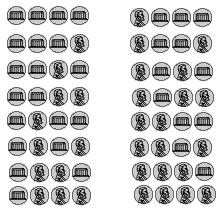
Independence and the Multiplication Rule
Two events are independent if the occurrence of one does not affect the probability of the other. For independent events A and B:
Example: The probability of flipping two heads in a row is .
Multiplication Rule Example
If the probability that an airline does not lose your luggage on a flight is 0.993, the probability that your luggage is not lost on three independent flights is:
At Least One Event Occurs
The probability that at least one event occurs is 1 minus the probability that none occur:
Application Example: Telephone Survey
Given: Probability of contacting someone by phone is 0.76. Each call is independent.
a) Probability of contacting the next household:
b) Probability of contacting both of the next two households:
c) Probability that the first successful contact is the third household:
d) Probability of at least one successful contact among the next five households:
Assumptions and Reasonableness
Many statistical methods require the assumption of independence. However, it is important to consider whether this assumption is reasonable in the context of the problem.
Example: The probability of stopping at a traffic light on different days may be independent, but weather events on the same day may not be.
