 Back
BackChapter 3: Probability – Fundamental Concepts and Applications
Study Guide - Smart Notes
 Tailored notes based on your materials, expanded with key definitions, examples, and context.
Probability: Basic Concepts and Counting
Probability Experiments and Sample Space
Probability is a foundational concept in statistics, used to quantify uncertainty and predict outcomes. A probability experiment is an action or trial that produces specific results, called outcomes. The sample space is the set of all possible outcomes of a probability experiment. An event is a subset of the sample space, consisting of one or more outcomes.
Outcome: The result of a single trial in a probability experiment.
Sample Space: All possible outcomes (e.g., for a coin toss: {Heads, Tails}).
Event: One or more outcomes (e.g., rolling an even number on a die).
Example: Determining the sample space for blood types (O, A, B, AB) and Rh factor (positive or negative) yields eight possible outcomes.
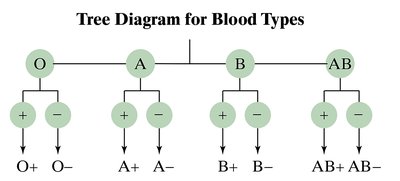
Simple Events
A simple event consists of a single outcome. If an event contains more than one outcome, it is not simple.
Example: Selecting a specific defective machine part is a simple event (only one outcome).
Example: Rolling at least a 4 on a six-sided die is not a simple event (outcomes: 4, 5, 6).
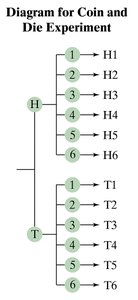
The Fundamental Counting Principle
The Fundamental Counting Principle states that if one event can occur in m ways and another in n ways, the number of ways both can occur in sequence is m × n. This principle extends to any number of sequential events.
Example: Choosing a car from three manufacturers, two sizes, and four colors: ways.
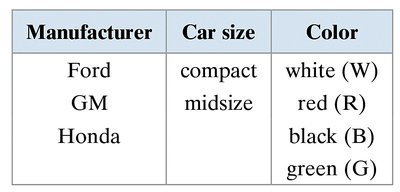
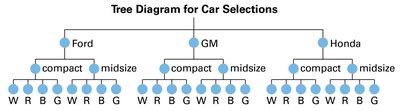
Counting Access Codes
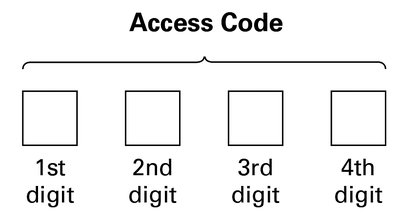
Access codes often require counting the number of possible combinations under different constraints.
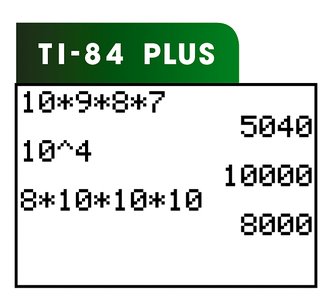
Digits not repeated: possible codes.
Digits can be repeated: possible codes.
First digit cannot be 0 or 1: possible codes.
Types of Probability
Classical (Theoretical) Probability
Classical probability applies when all outcomes in the sample space are equally likely. The probability of an event E is:

Example: Rolling a 3 on a six-sided die:
Example: Rolling a number less than 5:
Empirical (Statistical) Probability
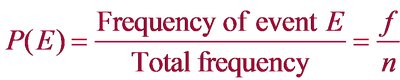
Empirical probability is based on observed data from experiments. It is calculated as the relative frequency of an event:
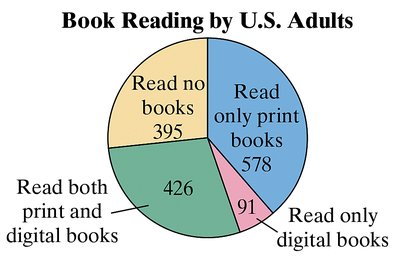
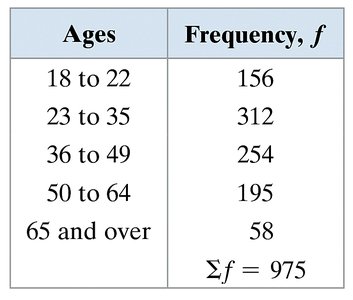
Example: In a survey of 1490 adults, 578 read only print books.
Example: Probability that the next surveyed user is 23 to 35 years old:
Law of Large Numbers
The Law of Large Numbers states that as an experiment is repeated many times, the empirical probability approaches the theoretical probability.

Subjective Probability
Subjective probability is based on intuition, educated guesses, or estimates, rather than formal calculations or observed data.
Example: A doctor estimates a 90% chance of recovery.
Example: Predicting the probability of getting an A on a test based on personal judgment.
Range of Probabilities and Complementary Events
Range of Probabilities Rule
The probability of any event E must satisfy . Probabilities outside this range are not valid.

Complementary Events
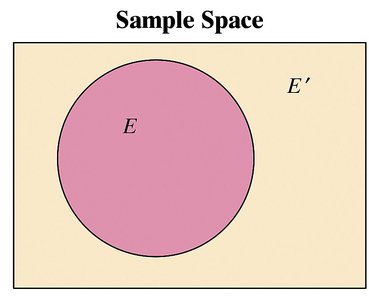
The complement of event E (denoted E') consists of all outcomes in the sample space not in E. The probabilities of an event and its complement add up to 1:
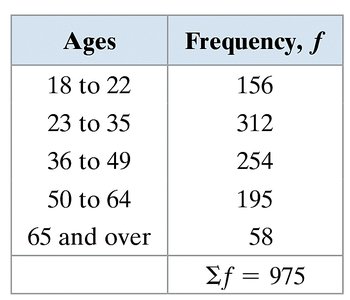
Example: Probability that a user is not 23 to 35 years old:
Tree Diagrams and Probability Calculation
Tree Diagrams
Tree diagrams are visual tools used to display all possible outcomes of a probability experiment, especially when multiple events occur in sequence.
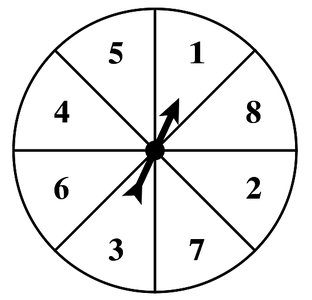
Example: Tossing a coin and spinning a spinner with eight numbers. The tree diagram shows all possible combinations.
Event A: Tossing a tail and spinning an odd number:
Event B: Tossing a head or spinning a number greater than 3:
Application of Counting Principle
When generating random identification numbers, the probability of getting a specific number is extremely small due to the large number of possible combinations.
Example: College ID number with eight digits (each 0-9, repeated): possible numbers. Probability of randomly generating your ID:
Summary Table: Types of Probability
Type | Definition | Example |
|---|---|---|
Classical | Equally likely outcomes | Rolling a die |
Empirical | Based on observed data | Survey results |
Subjective | Intuition or estimate | Doctor's prognosis |
Key Formulas
Classical Probability:
Empirical Probability:
Complement:
