 Back
BackChapter 4: Introduction to Probability – Study Notes for Statistics Students
Study Guide - Smart Notes
 Tailored notes based on your materials, expanded with key definitions, examples, and context.
Probability: Fundamental Concepts
Definition of Probability
Probability is a core concept in statistics, representing the likelihood that an uncertain event will occur. The probability of any event A is always a value between 0 and 1, inclusive, where 0 means the event is impossible and 1 means it is certain.
Probability (P): The chance that an event will occur.
Range: for any event A.
Interpretation: A probability of 0.5 indicates equal likelihood of occurrence and non-occurrence.
Assessing Probability
There are three main approaches to assessing the probability of an uncertain event:
Classical Probability: Assumes all outcomes in the sample space are equally likely. The probability of event A is calculated as:
Empirical Probability: Based on observed data or experiments.
Subjective Probability: Based on personal judgment or experience.
Rules for Combining Probabilities
Addition Rule for Probabilities
Probabilities can be added when events are alternatives (i.e., mutually exclusive or non-mutually exclusive). The addition rule differs based on whether events overlap.
Mutually Exclusive Events: Events that cannot occur together. The probability of either event A or B occurring is:
Non-Mutually Exclusive Events: Events that can occur together. The probability of either event A or B occurring is:

Multiplication Rule for Probabilities
Probabilities are multiplied when considering the joint occurrence of two events. The multiplication rule depends on whether events are independent or dependent.
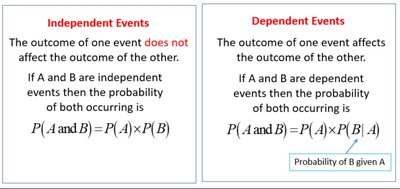
Independent Events: The outcome of one event does not affect the other. The probability of both events A and B occurring is:
Dependent Events: The outcome of one event affects the other. The probability of both events A and B occurring is:
Conditional Probability
Definition and Formula
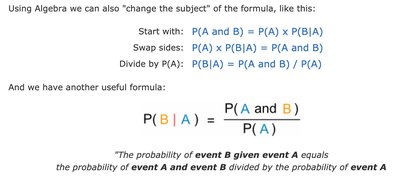
Conditional probability measures the likelihood of an event occurring given that another event has already occurred. It is denoted as , the probability of event B given event A.
Formula:
Application Example: Medical Testing
Consider a scenario in healthcare management: In 2021, an estimated 281,500 women and 2,650 men in the United States were diagnosed with breast cancer. A mammogram is a common method for detection. Suppose a 40-year-old woman wants to know the probability she has breast cancer after a mammogram test.
Prior probability of having breast cancer: 1.4% ()
Sensitivity (true positive rate): 75% ()
False positive rate: 10% ()
This example illustrates the use of conditional probability in interpreting medical test results.
Worked Examples
Excel Patients Data
Using patient data, probabilities can be calculated for various events:
Gender: Probability of a patient being female or male.
Age Groups: Probability of a patient being in specific age groups or combinations.
Combined Events: Probability of a patient being either female or in a certain age group.
Conditional Probability in Patient Data
Gender and Length of Stay: Probability of a patient being female and staying 1-5 days, or male and staying 6-10 days.
Conditional Events: Probability of being female given a stay of 1-5 days, or being in group 6-10 given male.
Summary Table: Probability Rules
Rule | Formula | When to Use |
|---|---|---|
Addition (Mutually Exclusive) | Events cannot occur together | |
Addition (Non-Mutually Exclusive) | Events can occur together | |
Multiplication (Independent) | Events do not affect each other | |
Multiplication (Dependent) | Events affect each other | |
Conditional Probability | Probability of B given A |
Key Takeaways
Probability quantifies uncertainty and is foundational for statistical inference.
Rules for combining probabilities depend on event relationships (mutually exclusive, independent, dependent).
Conditional probability is essential for interpreting real-world scenarios, especially in healthcare and business analytics.
