 Back
BackChapter 4: Probability – Foundations and Applications in Statistics
Study Guide - Smart Notes
 Tailored notes based on your materials, expanded with key definitions, examples, and context.
Probability: Introduction and Foundations
Definition and Importance of Probability
Probability is a branch of mathematics that quantifies the likelihood of events occurring. It is fundamental in statistics for making inferences about populations and for decision-making under uncertainty.
Probability measures how often an event occurs or is expected to occur, expressed as a number between 0 and 1.
Probability theory is essential for interpreting data and making predictions.
The Rare Event Rule states: If, under a given assumption, the probability of an observed event is extremely small, then the assumption is probably not correct. Such events are called statistically significant.
Basic Probability Concepts
Key Terms
Event: An outcome or a set of outcomes of a random procedure.
Simple event: An event that cannot be decomposed into simpler components.
Sample space: The set of all possible outcomes of a procedure.
Examples of Sample Spaces:
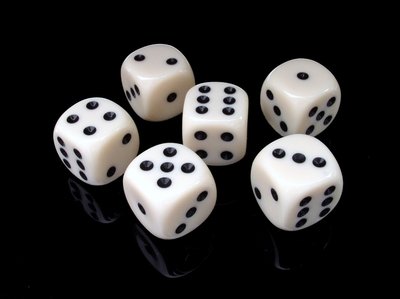
One roll of a six-sided die: {1, 2, 3, 4, 5, 6}
One coin flip: {Heads, Tails}
Two coin flips: {HH, HT, TH, TT}
Three coin flips: {HHH, HHT, HTH, HTT, THH, THT, TTH, TTT}

Tree Diagrams
Tree diagrams are visual tools used to systematically list all possible outcomes of a sequence of events, helping to construct the sample space for complex experiments.
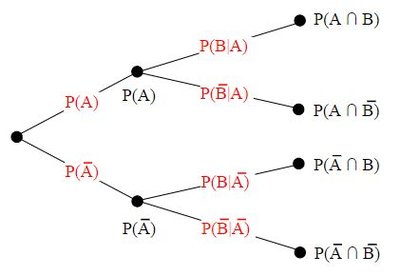
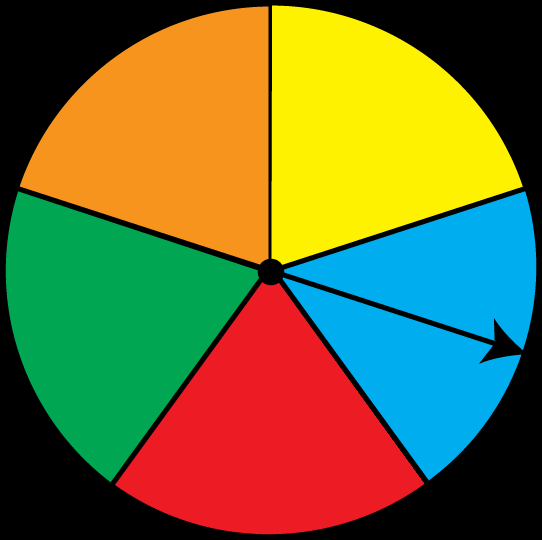
Example: For a game involving a coin flip, a spinner with red, green, and blue areas, and another coin flip, a tree diagram helps enumerate all possible outcomes.
Counting Principles in Probability
Fundamental Counting Principle
The Fundamental Counting Principle states that if a procedure can be broken into stages, the total number of outcomes is the product of the number of choices at each stage.
Example: If you have 4 shirts, 3 pairs of pants, and 3 pairs of shoes, the total number of outfits is 4 × 3 × 3 = 36.
For passwords, passcodes, or arrangements, multiply the number of choices for each position.
Factorial Notation
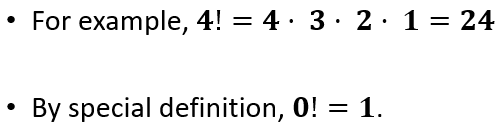
The factorial of a positive integer n, denoted n!, is the product of all positive integers from n down to 1. By definition, 0! = 1.
For example,
(by definition)
Probability Rules and Properties
Probability Values
Probabilities are always between 0 and 1, inclusive.
A probability of 0 means the event is impossible; a probability of 1 means the event is certain.

Classical vs. Relative Frequency Probability
Classical probability: Used when all outcomes are equally likely and calculated without conducting experiments.
Relative frequency probability: Estimated from actual data collected from repeated trials.
Law of Large Numbers: As the number of trials increases, the relative frequency probability approaches the true probability.
Calculating Probability
The probability of an event A is given by:
Examples:
Probability of rolling a 2 on a 6-sided die:
Probability of drawing an ace from a standard deck of 52 cards:

The Complement Rule
The complement of an event A, denoted , consists of all outcomes where A does not occur. The probability of the complement is:
Example: If the probability of rain is 0.8, the probability it does not rain is 0.2.
Types of Events
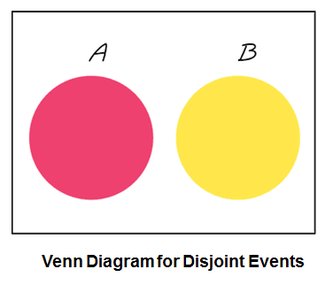
Disjoint (Mutually Exclusive) Events
Disjoint events cannot occur at the same time. If A and B are disjoint, .
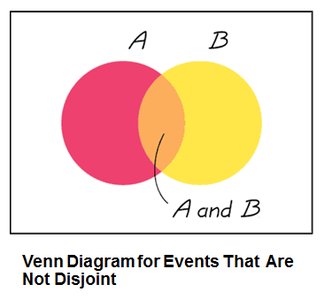
Non-Disjoint Events
Events that can occur together are not disjoint. Their probabilities may overlap.
Compound Events and the Addition Rule
Compound events combine two or more simple events. The probability of A or B occurring is given by the Addition Rule:
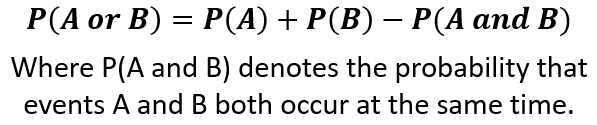
If A and B are disjoint, .
Independence and Conditional Probability
Independent and Dependent Events
Independent events: The occurrence of one does not affect the probability of the other.
Dependent events: The occurrence of one affects the probability of the other.

Conditional Probability
Conditional probability is the probability of event A occurring given that event B has already occurred. It is denoted as and calculated as:
This concept is crucial when events are dependent or when selections are made without replacement.
Multiplication Rule
The probability of both A and B occurring (in sequence) is:
If A and B are independent, , so .
Contingency Tables
Using Contingency Tables to Find Probabilities
Contingency tables organize data into categories to facilitate probability calculations, especially for joint and conditional probabilities.
O | A | B | AB | Total | |
|---|---|---|---|---|---|
Rh+ | 35 | 30 | 6 | 6 | 77 |
Rh- | 7 | 9 | 1 | 4 | 21 |
Total | 42 | 39 | 7 | 10 | 98 |
Examples:
Probability of blood group A:
Probability of not Rh-:
Probability of blood group O or B:
Probability of blood group B or Rh-:
Probability of blood group AB and Rh+:
Probability of blood group A and Rh-:
Probability of Rh+ given A:
Probability of A given Rh+:
Additional info: These foundational probability concepts are essential for understanding more advanced topics in statistics, such as probability distributions, hypothesis testing, and inferential statistics.
