 Back
BackChapter 5: Probability – Rules, Methods, and Applications
Study Guide - Smart Notes
 Tailored notes based on your materials, expanded with key definitions, examples, and context.
Probability: Fundamental Concepts and Rules
Introduction to Probability
Probability is a measure of the likelihood that a random phenomenon or chance behavior will occur. It is foundational to statistics, allowing us to quantify uncertainty and make informed decisions based on data.
Random Process: An experiment or process whose outcome cannot be predicted with certainty in the short term, but exhibits predictable patterns in the long run.
Simulation: A technique to mimic random events, either physically (e.g., flipping a coin) or virtually (e.g., computer simulation), to study probabilities.
Law of Large Numbers: As the number of repetitions of a probability experiment increases, the observed proportion of a particular outcome approaches the theoretical probability of that outcome.


Key Definitions
Experiment: Any process that can be repeated and has uncertain results.
Sample Space (S): The set of all possible outcomes of an experiment.
Event: Any collection of outcomes from a probability experiment. A simple event contains only one outcome.
Example: For the experiment of having two children:
Outcomes: (boy, boy), (boy, girl), (girl, boy), (girl, girl)
Sample Space: S = {(boy, boy), (boy, girl), (girl, boy), (girl, girl)}
Event E = "exactly one boy": E = {(boy, girl), (girl, boy)}
Rules of Probability
Basic Probability Rules
Rule 1: For any event E,
Rule 2: The sum of the probabilities of all outcomes in the sample space is 1:
A probability model lists all possible outcomes and their probabilities, and must satisfy the above rules.
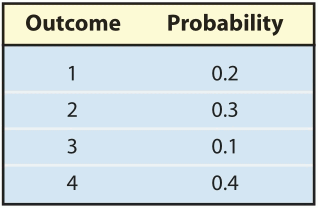
Impossible event: Probability is 0. Certain event: Probability is 1. Unusual event: An event with a low probability of occurring.
Methods for Computing Probability
Empirical (Experimental) Method
The empirical method estimates probability based on observed data from experiments or historical records.
Formula:
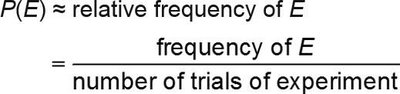
Example: In the game Pass the Pigs™, a class of 52 students rolled pigs 3,939 times. The probability of each outcome is estimated by dividing the frequency of each outcome by the total number of rolls.
Outcome | Probability |
|---|---|
Side with no dot | 0.341 |
Side with dot | 0.329 |
Razorback | 0.195 |
Trotter | 0.093 |
Snouter | 0.035 |
Leaning Jowler | 0.008 |
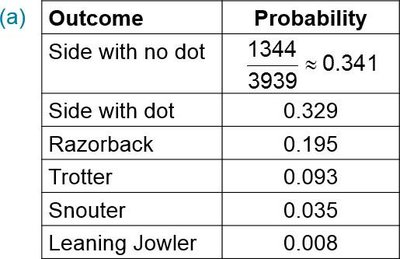
Interpretation: In 1,000 throws, about 329 are expected to land on "side with dot". "Leaning Jowler" is an unusual event (expected about 8 times in 1,000 throws).
Classical (Theoretical) Method
The classical method applies when all outcomes are equally likely. The probability of an event E is:
Formula: where is the number of outcomes in event E, and is the total number of outcomes in the sample space.

Example: A bag contains 9 brown, 6 yellow, 7 red, 4 orange, 2 blue, and 2 green candies (total 30). Probability of yellow: ; probability of blue: .
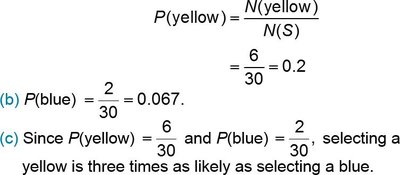
Yellow is three times as likely as blue.
Comparing Empirical and Classical Methods
Empirical probabilities are based on observed data, while classical probabilities are based on equally likely outcomes.
Example: In a survey of 500 families with three children, 180 had two boys and one girl. Empirical probability: .
Classical probability (assuming equal likelihood): List all possible outcomes (e.g., BBB, BBG, BGB, BGG, GBB, GBG, GGB, GGG). There are 8 outcomes; 3 have two boys and one girl. .

In 1,000 families, about 375 are expected to have two boys and one girl if outcomes are equally likely.
Subjective Probability
Definition and Application
Subjective probability is based on personal judgment, intuition, or expert opinion rather than formal calculations or experiments. It is often used when empirical or classical methods are not feasible.
Example: An economist predicts a 20% chance of recession next year based on their analysis and judgment.
Probabilities in betting markets (e.g., horse racing odds) are also subjective, reflecting collective beliefs rather than experimental or theoretical calculations.
Summary Table: Probability Methods Comparison
Method | Basis | Example |
|---|---|---|
Empirical | Observed data/experiments | Game outcomes, survey results |
Classical | Equally likely outcomes | Coin toss, dice roll, cards |
Subjective | Personal judgment | Expert predictions, betting odds |
Key Formulas
Empirical Probability:
Classical Probability:
Additional info: The Law of Large Numbers is often misunderstood as the "Law of Averages," which incorrectly suggests that outcomes will "even out" in the short run. In reality, the law only applies as the number of trials becomes very large.
