 Back
BackChapter 5 Review: Modeling Variation with Probability
Study Guide - Smart Notes
 Tailored notes based on your materials, expanded with key definitions, examples, and context.
Probability Concepts and Properties
Basic Probability Properties
Probability is a fundamental concept in statistics used to model random events and quantify uncertainty. The following properties are essential for calculating probabilities:
Addition Rule:
Conditional Probability:
Multiplication Rule for Independent Events: If A and B are independent,
Definitions of Key Terms
Randomness: No predictable pattern; each outcome is equally likely.
Theoretical Probability: Long-run relative frequency based on theory; remains constant and can be mathematically determined.
Empirical Probability: Short-run relative frequency based on experiment; varies with each experiment and cannot be mathematically proven.
Law of Large Numbers: As the number of trials increases, empirical probability approaches theoretical probability.
Probability Range and Event Types
Probability Range: Probability values fall between 0 and 1 (not -1 to 1; additional info: probabilities cannot be negative).
AND: Both events must occur.
OR: At least one event occurs (either, or both).
Mutually Exclusive Events: Events that cannot both occur.
Conditional Probability: Probability of event A given event B has occurred.
Independent Events: Occurrence of one event does not affect the probability of the other.
Examples and Applications
Example 1: Theoretical Probability with Dice
Calculating the probability of rolling an odd number on a six-sided die:
Sample Space: {1, 2, 3, 4, 5, 6}
Odd Outcomes: {1, 3, 5}
Probability:
Example 2: Law of Large Numbers Misinterpretation
Observing five heads in a row does not guarantee five tails will follow. The Law of Large Numbers states that as trials increase, empirical probability approaches theoretical probability, but individual outcomes remain random.
Analyzing Categorical Data with Two-Way Tables
Two-Way Table: Transportation Choices by Gender
Two-way tables are used to organize categorical data and calculate probabilities for combined and conditional events.
Probability of a male riding a bike:
Probability of riding a bike given the person is male:
Proportion of females riding the bus:
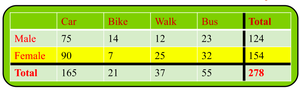
Table: Transportation Choices by Gender
Car | Bike | Walk | Bus | Total | |
|---|---|---|---|---|---|
Male | 75 | 14 | 12 | 23 | 124 |
Female | 90 | 7 | 25 | 32 | 154 |
Total | 165 | 21 | 37 | 55 | 278 |
Probability with Dice: Sample Space and Independence
Sample Space for Two Dice
When two dice are rolled, the sample space can be represented as a grid showing all possible sums.
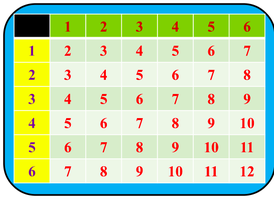
Probability the sum is 7:
Probability the first die is 4:
Conditional probability sum is 7 given first die is 4:
Probability both sum is 7 and first die is 4:
Independence: Events S=7 and D1=4 are independent because and
Probability in Real-World Contexts
Example: Social Media Privacy
Given 45% of Americans keep their social media accounts private, calculate probabilities for four randomly selected individuals:
All 4 keep accounts private:
None keep accounts private:
At least one keeps accounts private:
Summary Table: Probability Rules and Event Types
Rule/Concept | Formula | Explanation |
|---|---|---|
Addition Rule | Probability of either event A or B occurring | |
Conditional Probability | Probability of A given B has occurred | |
Multiplication Rule (Independence) | Probability of both A and B occurring if independent | |
Mutually Exclusive | -- | Events cannot both occur |
Law of Large Numbers | -- | Empirical probability approaches theoretical probability as trials increase |
Additional info: Probability values are always between 0 and 1. The notes clarify the distinction between theoretical and empirical probability, and provide practical examples for exam preparation.
