 Back
BackChi-Square Goodness of Fit Test for Grade Distributions
Study Guide - Smart Notes
 Tailored notes based on your materials, expanded with key definitions, examples, and context.
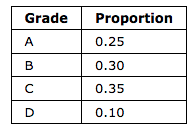
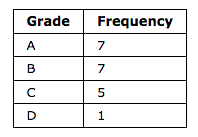
Q7. A teacher predicts what the distribution of grades on the final exam will be and they are recorded in the table below. The actual distribution for a class of 20 is in the table below. She wants to know how well her expectations met with what was observed.
Background
Topic: Chi-Square Goodness of Fit Test
This question is testing your ability to compare observed frequencies with expected frequencies under a hypothesized distribution using the chi-square goodness of fit test. This is a common method for determining if categorical data fits a specified distribution.
Key Terms and Formulas
Chi-Square Test Statistic: The formula is: $\chi^2 = \sum \frac{(O_i - E_i)^2}{E_i}$ where $O_i$ is the observed frequency for category $i$, and $E_i$ is the expected frequency for category $i$.
Degrees of Freedom (df): $df = k - 1$, where $k$ is the number of categories.
Null Hypothesis ($H_0$): The observed frequencies fit the expected distribution.
Alternative Hypothesis ($H_a$): The observed frequencies do not fit the expected distribution.
Step-by-Step Guidance
State the null and alternative hypotheses: $H_0$: The grade distribution in the population matches the teacher's predicted proportions. $H_a$: The grade distribution in the population does not match the teacher's predicted proportions.
Calculate the expected frequencies for each grade using the predicted proportions and the total number of students (20): $E_i = \text{proportion}_i \times 20$ for each grade.
List the observed frequencies from the actual data for each grade (from the observed table).
For each grade, compute the value $\frac{(O_i - E_i)^2}{E_i}$, where $O_i$ is the observed frequency and $E_i$ is the expected frequency.
Sum these values across all grades to get the chi-square test statistic: $\chi^2 = \sum \frac{(O_i - E_i)^2}{E_i}$
Determine the degrees of freedom: $df = k - 1$, where $k$ is the number of grade categories.
Try solving on your own before revealing the answer!
Final Answer:
(a) The appropriate test is the chi-square goodness of fit test.
(b) $H_0$: The observed grade distribution fits the expected proportions. $H_a$: The observed grade distribution does not fit the expected proportions.
(c) The chi-square test statistic is approximately 4.57.
(d) The p-value is approximately 0.2062.
(e) At the 5% significance level, we fail to reject the null hypothesis.
(f) Conclusion: There is not enough evidence to suggest that the observed grade distribution is different from the expected distribution.
