 Back
BackCompound Events and Probability Rules in Statistics
Study Guide - Smart Notes
 Tailored notes based on your materials, expanded with key definitions, examples, and context.
Compound Events and Probability Rules
Compound Events
A compound event is any event that combines two or more simple events. Compound events are fundamental in probability theory, as they allow us to analyze situations where multiple outcomes or actions are considered together.
Simple event: An event with a single outcome.
Compound event: An event formed by combining two or more simple events.
Example: Rolling two dice and considering the sum of their faces is a compound event.
The Addition Rule
The Addition Rule is used to find the probability that at least one of several events occurs. It is especially useful when events may overlap or be mutually exclusive.
General Addition Rule: For any two events A and B, the probability that A or B occurs is given by:
Mutually exclusive (disjoint) events: If A and B cannot occur together, then , so:
Example: If the probability of drawing a red card or a king from a deck is required, use the addition rule to avoid double-counting the red kings.
Disjoint (Mutually Exclusive) Events
Disjoint events are events that cannot occur at the same time. If two events are disjoint, their intersection is empty, and the probability of both occurring is zero.
Definition: Events A and B are disjoint if .
Addition Rule for Disjoint Events:
Example: Drawing a heart or a club from a deck in one draw are disjoint events.
Multiplication Rule
The Multiplication Rule is used to find the probability that two or more events occur together. The rule differs depending on whether the events are independent or dependent.
General Multiplication Rule:
Independent Events: If A and B are independent, , so:
Dependent Events: If A and B are not independent, use conditional probability.
Example: The probability of flipping two heads in a row with a fair coin is .
Independent and Dependent Events
Events are independent if the occurrence of one does not affect the probability of the other. Otherwise, they are dependent.
Independent:
Dependent:
Sampling without replacement: If the sample size is no more than 5% of the population, treat selections as independent for practical purposes.
Example: Drawing two cards from a deck with replacement is independent; without replacement is dependent.
Redundancy in Probability
Redundancy refers to the use of multiple components to reduce the probability of system failure. In probability, redundancy increases the likelihood that at least one component will function.
Example: If a hard drive has a failure rate of 2.89% per year, the probability it works for a year is .
Two hard drives: Probability at least one works:
"At Least One" Probability
The probability of getting "at least one" success in multiple trials is often calculated using the complement rule.
Complement Rule:
Example: If the defect rate is 15% and 12 products are purchased, the probability at least one is defective:
Conditional Probability
Conditional probability is the probability of an event occurring given that another event has already occurred. It is denoted as , the probability of A given B.
Formula:
Example: Probability that a randomly selected subject had a positive test result, given that the subject uses drugs.
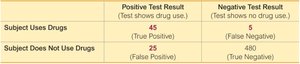
Drug Test Results Table
The following table summarizes the outcomes of drug tests for 555 subjects:
Positive Test Result (Test shows drug use) | Negative Test Result (Test shows no drug use) | |
|---|---|---|
Subject Uses Drugs | 45 (True Positive) | 5 (False Negative) |
Subject Does Not Use Drugs | 25 (False Positive) | 480 (True Negative) |
True Positive: Test correctly identifies drug use (45 cases).
False Negative: Test fails to identify drug use (5 cases).
False Positive: Test incorrectly identifies drug use (25 cases).
True Negative: Test correctly identifies no drug use (480 cases).
Applications: This table is used to calculate conditional probabilities, such as:
Additional info: The table is inferred to be a confusion matrix for drug test results, commonly used in statistics to analyze test accuracy and conditional probabilities.
