 Back
BackConfounding, Lurking Variables, and Experimental Design in Statistics
Study Guide - Smart Notes
 Tailored notes based on your materials, expanded with key definitions, examples, and context.
Experiments and Observational Studies
Introduction to Experiments and Observational Studies
Understanding the distinction between experiments and observational studies is fundamental in statistics. Experiments involve the deliberate manipulation of variables to observe their effect, while observational studies involve observing subjects without intervention.
Experiment: The researcher assigns treatments to subjects and observes the outcomes.
Observational Study: The researcher observes outcomes without assigning treatments.
Confounding and Lurking Variables
Confounding Variables
Confounding occurs when two factors are associated in such a way that their individual effects on a response variable cannot be distinguished. This makes it difficult to determine which factor is causing the observed effect.
Definition: Two factors are confounded if the levels of one are associated with the levels of the other.
Example: In a study comparing animated and subdued teaching styles, the weather (fall vs. spring) was confounded with the professor's style, making it unclear whether the teaching style or the weather caused the difference in student evaluations.
Challenge: Avoiding confounding is difficult and sometimes introduces new confounders.
Lurking Variables
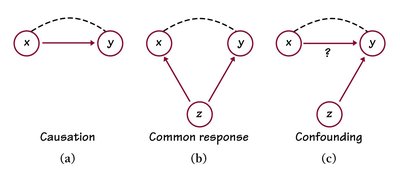
A lurking variable is an unobserved variable that influences both the explanatory and response variables, creating a spurious association between them.
Definition: A lurking variable is associated with both the explanatory variable (x) and the response variable (y), making it appear that x causes y.
Example: The association between the number of TVs and life expectancy is likely due to a lurking variable such as economic conditions, which affects both TV ownership and health care quality.
Comparison: Lurking vs. Confounding Variables
Lurking Variable: Associated with both x and y, making it appear that x causes y.
Confounding Variable: Associated in a noncausal way with a factor and affects the response, making it hard to isolate the effect of the factor.
Both types of variables are outside influences that complicate the interpretation of relationships in data.
Establishing Causation
Criteria for Causation
True causation can only be established through well-designed experiments. Observational studies can suggest associations but cannot confirm causation due to potential confounding and lurking variables.
The cause must be plausible.
The cause must precede the effect.
The association should be strong and consistent across studies.
Higher doses should be associated with stronger responses.
When experiments are not ethical or feasible (e.g., studying the effects of smoking on lung cancer), researchers must rely on observational evidence and statistical reasoning.
Designing Good Experiments
Principles of Experimental Design
To draw valid conclusions from experiments, statisticians follow four key principles:
Control: Control sources of variation other than the factors being tested by making conditions as similar as possible for all groups.
Randomization: Randomly assign subjects to treatments to balance confounding variables.
Replication: Apply each treatment to multiple subjects to ensure results are not due to chance.
Blocking: Group similar subjects together to control for variables that cannot be controlled directly.
Blinding and Control Groups
Single-blind Study: Either the subjects or the evaluators are unaware of which treatment is being administered.
Double-blind Study: Both the subjects and the evaluators are unaware of the treatment assignments.
Control Group: Receives a placebo or null treatment to serve as a baseline for comparison.
Observational Studies: Retrospective vs. Prospective
Retrospective Study: Looks at present outcomes and investigates past factors that may be related.
Prospective Study: Selects subjects and follows them into the future as events unfold.
Experiments vs. Surveys
Surveys: Aim to estimate population parameters and require representative random samples.
Experiments: Aim to estimate the effects of treatments by randomizing subjects to different groups.
Be alert for possible confounding variables that may affect the results in both designs.
Practical Considerations and Common Pitfalls
Do not give up if an experiment is not possible; observational studies can still provide valuable insights.
Use randomization and blocking to minimize confounding.
Record additional information that may help explain unexpected results (e.g., environmental factors).
Conduct pilot studies before full-scale experiments to refine procedures and factor levels.
Summary Table: Lurking vs. Confounding Variables
Type | Definition | Effect | Example |
|---|---|---|---|
Lurking Variable | Associated with both explanatory and response variables | Creates a spurious association | Economic status affecting both TV ownership and life expectancy |
Confounding Variable | Associated with a factor and affects the response | Makes it hard to isolate the effect of the factor | Weather confounded with teaching style in a study |
Key Takeaways
Recognize the difference between observational studies and experiments.
Understand the roles of confounding and lurking variables in statistical analysis.
Apply the principles of experimental design to minimize bias and confounding.
Be cautious in interpreting associations as causation, especially in observational studies.
