 Back
BackCounting Principles and Permutations in Probability
Study Guide - Smart Notes
 Tailored notes based on your materials, expanded with key definitions, examples, and context.
Section 3.4: Additional Topics in Probability and Counting
Section 3.4 Objectives
This section introduces advanced counting techniques essential for probability and statistics. The main objectives are:
To determine the number of ways a group of objects can be arranged in order.
To find the number of ways to choose several objects from a group without regard to order.
To use counting principles to calculate probabilities.
Permutations
Definition and Formula
A permutation is an ordered arrangement of objects. The order in which the objects are arranged is important. The number of different permutations of n distinct objects is given by the factorial of n:
Factorial: The product of all positive integers up to n, denoted as n!
The formula for the number of permutations of n objects is:
Example: Finding the Number of Permutations of n Objects
Problem: The objective of a 9 x 9 Sudoku number puzzle is to fill the grid so that each row, each column, and each 3 x 3 grid contains the digits 1 to 9. How many different ways can the first row of a blank 9 x 9 Sudoku grid be filled?
Solution: The number of permutations is .
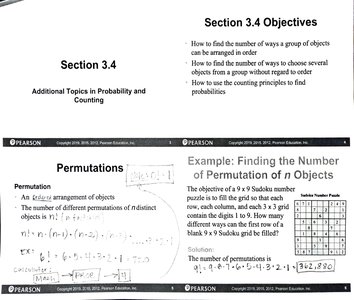
Example Application: This calculation is used to determine the number of possible arrangements for the first row in Sudoku, illustrating the concept of permutations in a real-world puzzle.
