 Back
BackCounting Principles and Probability: Permutations, Combinations, and Applications
Study Guide - Smart Notes
 Tailored notes based on your materials, expanded with key definitions, examples, and context.
Chapter 3: Probability
Section 3.4: Additional Topics in Probability and Counting
This section explores advanced counting principles used in probability, including factorials, permutations, combinations, and their applications. These concepts are fundamental for calculating probabilities in situations where the arrangement or selection of objects is important.
Factorials
The factorial of a positive integer n, denoted as n!, is the product of all positive integers less than or equal to n. Factorials are used extensively in counting problems, especially in permutations and combinations.
Definition:
Example:
Application: Used to count the number of ways to arrange n distinct objects.
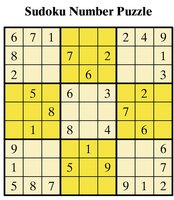
Example: In a 9x9 Sudoku puzzle, the number of ways to fill the first row with digits 1 to 9 is .

StatCrunch Application: Factorials can be computed in StatCrunch using the Fact(n) function.
Permutations
A permutation is an ordered arrangement of items. Permutations are used when the order of selection matters and no item is repeated.
Definition: The number of permutations of n distinct objects taken r at a time is
Key Properties:
All objects are distinct.
No object is repeated.
Order is important.
Example: The arrangements ABC, ACB, BAC, BCA, CAB, and CBA are all different permutations of the letters A, B, and C.
Example: Forming four-digit codes from 10 digits (0-9) with no repetition:

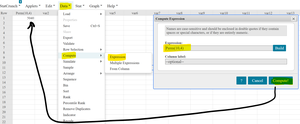
StatCrunch Application: Permutations can be calculated in StatCrunch using Perm(n, r).
Example: In a car race with 33 cars, the number of ways to select the top 3 finishers is

Permutations with Repeated Items (Distinguishable Permutations)
When some items are identical, certain arrangements should not be double-counted. The formula for distinguishable permutations is:
Formula: , where n is the total number of objects, and are the counts of each type.
Example: Arranging 6 one-story, 4 two-story, and 2 split-level houses:
Application: Used in password formation and other scenarios with repeated items.
Combinations
A combination is a selection of items from a group where order does not matter and repetition is not allowed. Combinations are used when only the group of selected items is important, not their arrangement.
Definition: The number of combinations of n objects taken r at a time is
Key Properties:
Order does not matter.
No object is repeated.
Example: Selecting 4 companies from 16 bids:


Summary of Counting Principles
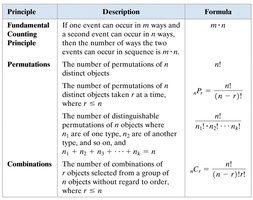
The table below summarizes the main counting principles used in probability:
Principle | Description | Formula |
|---|---|---|
Fundamental Counting Principle | If one event can occur in m ways and a second event can occur in n ways, then the number of ways the two events can occur in sequence is m × n. | |
Permutations | The number of permutations of n distinct objects; the number of permutations of n distinct objects taken r at a time; the number of distinguishable permutations of n objects where n1 are of one type, n2 are of another type, etc. | , , |
Combinations | The number of combinations of r objects selected from a group of n objects without regard to order. |
Applications of Counting Principles in Probability
Counting principles are used to calculate probabilities in various scenarios, such as selecting committee members, dealing cards, and jury selection.
Example: Student Advisory Board - Probability of selecting 3 specific members for chair, secretary, and webmaster positions. Order is important, so permutations are used.

Example: Competition - Probability of you and your two friends being selected from a class of 30 students. Combinations are used since order does not matter.
Example: Playing Cards - Probability of being dealt 5 diamonds from a standard deck. Combinations are used for both total ways and restricted ways.
Example: Jury Selection - Probability of selecting exactly 7 men and 5 women from a pool of 75 people. Combinations are used for each group.
StatCrunch Calculations
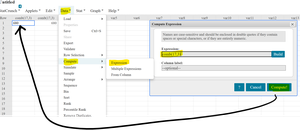
StatCrunch is a statistical software tool that can be used to compute factorials, permutations, and combinations efficiently. The commands Fact(n), Perm(n, r), and Comb(n, r) are used for these calculations.

Conclusion
Understanding factorials, permutations, and combinations is essential for solving probability problems involving arrangements and selections. These counting principles provide the foundation for calculating probabilities in a wide range of statistical applications.
