 Back
BackChapter 9: Estimating the Value of a Parameter: Confidence Intervals for Proportions, Means, and Variances
Study Guide - Smart Notes
 Tailored notes based on your materials, expanded with key definitions, examples, and context.
Estimating the Value of a Parameter
Estimating a Population Proportion
Estimating a population proportion involves using sample data to infer the value of a population parameter. The main tools are point estimates and confidence intervals.
Point Estimate: The value of a statistic that estimates the value of a parameter. For a population proportion, the point estimate is \( \hat{p} = \frac{x}{n} \), where x is the number of individuals with the characteristic and n is the sample size.
Confidence Interval: An interval of numbers based on a point estimate, designed to capture the true parameter with a specified level of confidence.
Example: In a survey of 2019 adults, 1252 frequently worry about their financial situation. The sample proportion is \( \hat{p} = \frac{1252}{2019} \approx 0.620 \).
Constructing and Interpreting Confidence Intervals for a Population Proportion
A confidence interval for a population proportion is constructed using the sampling distribution of \( \hat{p} \). For large enough samples, this distribution is approximately normal.
Mean of \( \hat{p} \): \( \mu_{\hat{p}} = p \)
Standard Error: \( \sigma_{\hat{p}} = \sqrt{\frac{p(1-p)}{n}} \)
95% Confidence Interval: \( \hat{p} \pm 1.96 \sigma_{\hat{p}} \)
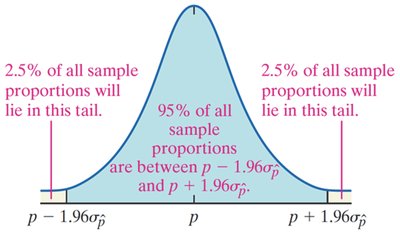
The margin of error determines the width of the interval. For a 95% confidence interval, 95% of all sample proportions will result in intervals containing the population proportion, while 5% will not.
General (1 – α)·100% Confidence Interval: \( \hat{p} \pm z_{\alpha/2} \sigma_{\hat{p}} \)
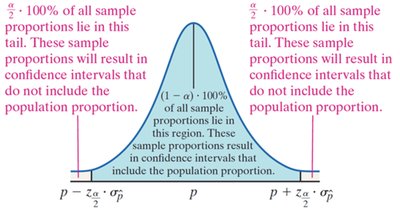
The value \( z_{\alpha/2} \) is the critical value from the standard normal distribution for the desired confidence level.
Level of Confidence | Area in Each Tail | Critical Value (\( z_{\alpha/2} \)) |
|---|---|---|
90% | 0.05 | 1.645 |
95% | 0.025 | 1.96 |
99% | 0.005 | 2.575 |
Interpretation: A (1 – α)·100% confidence interval means that (1 – α)·100% of all such intervals from repeated samples will contain the true parameter.
Determining Sample Size for Estimating a Proportion
To estimate a population proportion within a specified margin of error E, solve for n:
\( n = \left( \frac{z_{\alpha/2}}{E} \right)^2 \hat{p}(1-\hat{p}) \)
If no prior estimate, use \( \hat{p} = 0.5 \) for maximum variability.
Estimating a Population Mean
When estimating a population mean, the sample mean \( \bar{x} \) is used as the point estimate. Confidence intervals are constructed using the t-distribution when the population standard deviation is unknown.
Student’s t-Distribution: Used when \( \sigma \) is unknown and the sample is from a normal population or n is large.
t-Statistic: \( t = \frac{\bar{x} - \mu}{s/\sqrt{n}} \), where s is the sample standard deviation.
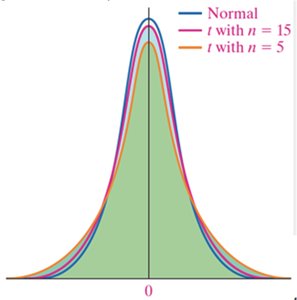
The t-distribution is wider with heavier tails for smaller n, approaching the normal distribution as n increases.
Constructing and Interpreting Confidence Intervals for a Population Mean
(1 – α)·100% Confidence Interval: \( \bar{x} \pm t_{\alpha/2,\,df} \frac{s}{\sqrt{n}} \), where df = n – 1.
Check normality for small samples (n < 30) using normal probability plots or boxplots.
Determining Sample Size for Estimating a Mean
\( n = \left( \frac{z_{\alpha/2} s}{E} \right)^2 \), rounded up to the next integer.
Choosing the Appropriate Confidence Interval
To determine which confidence interval to use, consider the parameter of interest and the data conditions.
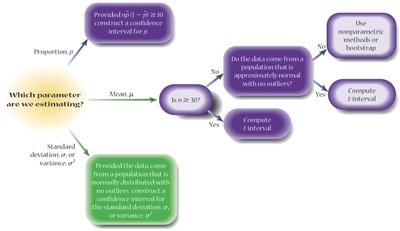
For proportions, use the normal approximation if conditions are met.
For means, use the t-distribution if the population is normal or n is large.
For variances or standard deviations, use the chi-square distribution if the population is normal.
Estimating a Population Standard Deviation or Variance
To estimate the population variance (\( \sigma^2 \)) or standard deviation (\( \sigma \)), use the chi-square distribution. The sample variance (\( s^2 \)) is the point estimate.
The chi-square distribution is not symmetric and depends on degrees of freedom (df = n – 1).
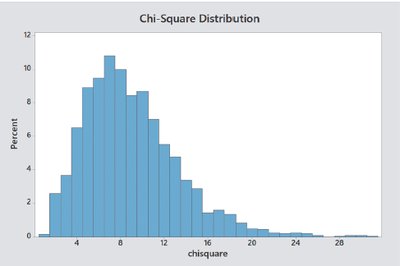
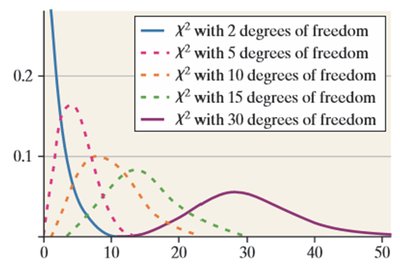
As degrees of freedom increase, the distribution becomes more symmetric.
Degrees of Freedom | Shape |
|---|---|
Low (e.g., 2, 5) | Highly skewed right |
High (e.g., 30) | Nearly symmetric |
Confidence Interval for \( \sigma^2 \):
Lower bound: \( \frac{(n-1)s^2}{\chi^2_{\alpha/2}} \) Upper bound: \( \frac{(n-1)s^2}{\chi^2_{1-\alpha/2}} \)
To find a confidence interval for \( \sigma \), take the square root of the bounds above.
Estimating with Bootstrapping
Bootstrapping is a nonparametric, computer-intensive method for estimating parameters and constructing confidence intervals when parametric assumptions are not met.
Resample the observed data with replacement many times (e.g., 1000 or 10,000 resamples).
Calculate the statistic of interest for each resample.
Use the distribution of these statistics to estimate confidence intervals (e.g., using percentiles).
Requirements: The bootstrap distribution should be centered near the original sample statistic and be symmetric.
Summary Table: Confidence Interval Methods
Parameter | Point Estimate | Interval Method | Distribution |
|---|---|---|---|
Proportion (p) | \( \hat{p} \) | \( \hat{p} \pm z_{\alpha/2} \sqrt{\frac{\hat{p}(1-\hat{p})}{n}} \) | Normal |
Mean (\( \mu \)) | \( \bar{x} \) | \( \bar{x} \pm t_{\alpha/2,\,df} \frac{s}{\sqrt{n}} \) | t-distribution |
Variance (\( \sigma^2 \)) | \( s^2 \) | See above | Chi-square |
