 Back
BackExperiments and Observational Studies: Control Groups, Placebos, and Blinding
Study Guide - Smart Notes
 Tailored notes based on your materials, expanded with key definitions, examples, and context.
Experiments and Observational Studies
Control Groups in Experiments
Control groups are fundamental in experimental design, providing a baseline for comparison against the treatment group. This allows researchers to isolate the effect of the treatment and determine its true impact.
Control Group: The group that receives no treatment or a standard treatment, serving as a baseline.
Experimental Units: Subjects assigned to either the control or treatment group.
Control Treatment: The specific intervention (often 'no treatment') used for comparison.
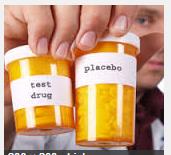
Placebo: A fake treatment used to blind participants and mimic the experience of receiving the real treatment.
Example: In a knee surgery study for arthritis, subjects were randomly assigned to real surgery, no surgery, or a fake surgery (placebo). Both real and fake surgery groups reported similar improvements, highlighting the importance of control and placebo groups.

Different Uses of the Word 'Control'
The term 'control' can refer to controlling extraneous sources of variation or to a specific group in an experiment. In the context of experimental design, it refers to a level of the factor included for comparison, where 'nothing happens.'
Controlling Variation: Managing external factors that could influence the outcome.
Control Group: Used to compare treatment results to a baseline scenario.
Placebos and the Placebo Effect
A placebo is a fake treatment designed to look like the real treatment, used to blind participants from knowing whether they are receiving the actual intervention. The placebo effect occurs when participants experience changes simply because they believe they are being treated.
Blinding: Prevents participants from knowing their group assignment, reducing bias.
Realistic Placebos: Modern placebos are designed to mimic side effects of the real treatment to maintain blinding.
Example: Drug manufacturers create placebos that cause similar side effects as the drug being tested to prevent participants from guessing their assignment.
Blinding in Experiments
Blinding is a technique used to mask the treatment assignment from participants and/or evaluators, minimizing bias in the experiment.
Single-Blind: One class of individuals (either participants or evaluators) is blinded.
Double-Blind: Both classes (participants and evaluators) are blinded.
Example: In a soda taste test, unlabeled cups are used to blind participants from brand influence.
Who Can Affect the Experiment?
Two main classes of individuals can influence an experiment:
Those who can influence results: Subjects, treatment administrators, technicians.
Those who evaluate results: Individuals who assess outcomes.
Blinding these groups helps ensure unbiased results. Double-blinding is ideal for minimizing both participant and evaluator bias.
Example: Blinding with Pet Food
When the response variable involves judgment, blinding the evaluator is crucial. In a pet food safety experiment, the veterinarian should not know which dogs received which food. Double-blinding can be achieved by also blinding the workers who feed the animals, and making the foods look similar.
The Best Experiments
The most reliable experiments are designed to be randomized, comparative, double-blind, and placebo-controlled. This structure ensures that the results are valid and unbiased.
Randomized: Subjects are randomly assigned to groups.
Comparative: Results from different groups are compared.
Double-Blind: Both participants and evaluators are blinded.
Placebo-Controlled: Placebos are used to maintain blinding and provide a baseline.
Randomized Comparative Experiment Design
Experimental units are randomly assigned to groups, each receiving a different treatment. Results are compared to assess the effect of the explanatory variable on the response variable.
Group | Treatment | Results |
|---|---|---|
Group 1 | Treatment A | Results A |
Group 2 | Treatment B | Results B |
Key Terms and Definitions
Experimental Unit: The subject or object being studied.
Explanatory Variable: The variable manipulated by the researcher.
Response Variable: The outcome measured in the experiment.
Random Assignment: Allocating subjects to groups by chance.
Relevant Equations
While experimental design does not rely heavily on equations, randomization and comparison can be described mathematically:
