 Back
BackGuided Practice: Conditional Probability, Independence, and Bayes' Theorem in Actuarial and Health Contexts
Study Guide - Smart Notes
 Tailored notes based on your materials, expanded with key definitions, examples, and context.
Q11. Probability of Neither Collision Nor Disability Coverage
Background
Topic: Conditional Probability, Independence, and Complements
This question tests your understanding of how to use information about independent events, their probabilities, and complements to find the probability that neither of two events occurs.
Key Terms and Formulas
Let = collision coverage, = disability coverage.
Independence:
Complement Rule:
Addition Rule:
Step-by-Step Guidance
Let . Since collision is twice as likely as disability, .
Since and are independent, .
From the problem, . Set and solve for (but do not compute the final value yet).
Find using the value of you found above.
Calculate using the addition rule.
Try solving on your own before revealing the answer!

Final Answer: 0.67
Using the complement rule, .
This means there is a 67% chance an owner purchases neither coverage.
Q13. Probability of No Risk Factors Given Not A
Background
Topic: Conditional Probability and Law of Total Probability
This question involves using given probabilities for combinations of risk factors and applying conditional probability to find the probability that a woman has none of the three risk factors, given she does not have risk factor A.
Key Terms and Formulas
Let , , be the three risk factors.
Conditional Probability:
Law of Total Probability for and none
Step-by-Step Guidance
List all possible combinations of risk factors that do not include (i.e., only , only , and , or none).
Sum the probabilities for all cases where is not present to find .
Identify the probability that a woman has none of the three risk factors (i.e., not , not , not ).
Apply the conditional probability formula: nonenone.
Try solving on your own before revealing the answer!

Final Answer: 0.311
After calculating the relevant probabilities and applying the conditional probability formula, the answer is 0.311.
Q14. Probability of More Than One Claim
Background
Topic: Recurrence Relations and Probability Distributions
This question tests your ability to use a recurrence relation to model probabilities and to sum probabilities for discrete events.
Key Terms and Formulas
Recurrence relation: for
Probability of more than one claim:
Step-by-Step Guidance
Express in terms of using the recurrence relation.
Express in terms of , and so on, to find a general formula for .
Use the fact that the sum of all probabilities must be 1: .
Solve for using the geometric series formula.
Find and then set up .
Try solving on your own before revealing the answer!

Final Answer: 0.16
After solving for and , the probability that a policyholder files more than one claim is 0.16.
Q19. Probability Driver Was Age 16-20 Given Accident
Background
Topic: Bayes' Theorem and Conditional Probability
This question asks you to use Bayes' Theorem to find the probability that a driver was in a certain age group, given that an accident occurred.
Key Terms and Formulas
Bayes' Theorem:
Law of Total Probability:
Step-by-Step Guidance
Let = driver is age 16-20, = accident occurs.
Find and from the table.
Calculate using the law of total probability, summing over all age groups.
Apply Bayes' Theorem to find .
Try solving on your own before revealing the answer!
Final Answer: 0.13
After applying Bayes' Theorem, the probability is 0.13.
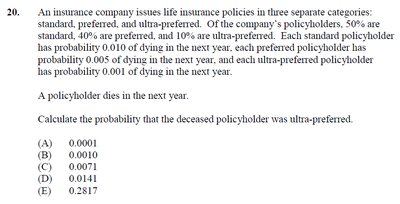
Q20. Probability Deceased Policyholder Was Ultra-Preferred
Background
Topic: Bayes' Theorem and Conditional Probability
This question requires you to use Bayes' Theorem to find the probability that a deceased policyholder was ultra-preferred, given the probabilities and proportions for each policy type.
Key Terms and Formulas
Bayes' Theorem:
Law of Total Probability:
Step-by-Step Guidance
Let = ultra-preferred, = died in the next year.
Find and from the problem statement.
Calculate using the law of total probability, summing over all policy types.
Apply Bayes' Theorem to find .
Try solving on your own before revealing the answer!

Final Answer: 0.0141
After applying Bayes' Theorem, the probability is 0.0141.
Q21. Probability Patient Was Serious Given Survival
Background
Topic: Conditional Probability and Law of Total Probability
This question asks you to use conditional probability to find the probability that a patient was categorized as serious, given that they survived.
Key Terms and Formulas
Let = serious, = survived.
Conditional Probability:
Law of Total Probability for
Step-by-Step Guidance
Find the probability that a patient was serious and survived: survived.
Calculate by summing the probabilities of survival for all categories (critical, serious, stable).
Apply the conditional probability formula: .
Try solving on your own before revealing the answer!
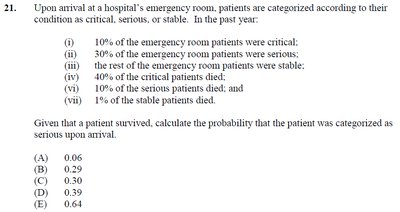
Final Answer: 0.29
After calculating the relevant probabilities, the answer is 0.29.
Q22. Probability Participant Was Heavy Smoker Given Death
Background
Topic: Bayes' Theorem and Conditional Probability
This question involves using Bayes' Theorem to find the probability that a participant was a heavy smoker, given that they died during the study period.
Key Terms and Formulas
Bayes' Theorem:
Law of Total Probability:
Step-by-Step Guidance
Let = heavy smoker, = died during the study.
Assign probabilities for each group (heavy, light, nonsmoker) and their death rates based on the information given.
Calculate using the law of total probability.
Apply Bayes' Theorem to find .
Try solving on your own before revealing the answer!

Final Answer: 0.42
After applying Bayes' Theorem, the probability is 0.42.
Q27. Probability Automobile Was Model Year 2014 Given Accident
Background
Topic: Bayes' Theorem and Conditional Probability
This question asks you to use Bayes' Theorem to find the probability that a car involved in an accident was a 2014 model, given the proportions and accident probabilities for each model year.
Key Terms and Formulas
Bayes' Theorem:
Law of Total Probability:
Step-by-Step Guidance
Let = accident, = model year .
Find and from the table.
Calculate using the law of total probability, summing over all model years.
Apply Bayes' Theorem to find .
Try solving on your own before revealing the answer!

Final Answer: 0.22
After applying Bayes' Theorem, the probability is 0.22.
