 Back
BackChapter 10: Hypothesis Testing: Concepts, Errors, and Methods
Study Guide - Smart Notes
 Tailored notes based on your materials, expanded with key definitions, examples, and context.
Chapter 10: Hypothesis Tests Regarding a Parameter
The Language of Hypothesis Testing
Hypothesis testing is a fundamental statistical procedure used to make inferences about population parameters based on sample data. It involves formulating assumptions and using probability to determine whether observed data provide sufficient evidence to reject those assumptions.
Null Hypothesis (H0): The statement being tested, typically representing no change, no effect, or no difference. It is assumed true until evidence suggests otherwise.
Alternative Hypothesis (H1): The statement for which we seek supporting evidence, indicating a change, effect, or difference.
Types of Tests:
Two-tailed: H0: parameter = value; H1: parameter ≠ value
Left-tailed: H0: parameter = value; H1: parameter < value
Right-tailed: H0: parameter = value; H1: parameter > value
Example: If a coin lands heads five times in a row, we may question whether the coin is fair (H0: coin is fair) or biased (H1: coin is not fair).
Type I and Type II Errors
When conducting hypothesis tests, two types of errors can occur:
Type I Error (α): Rejecting H0 when it is actually true. The probability of this error is denoted by α, the level of significance.
Type II Error (β): Failing to reject H0 when H1 is true. The probability of this error is denoted by β.
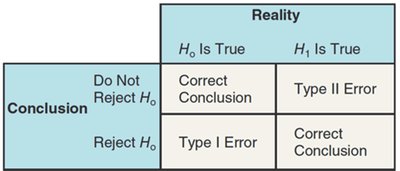
Key Point: The level of significance (α) is chosen before data collection and represents the probability of making a Type I error.
Stating Conclusions in Hypothesis Testing
We never "accept" the null hypothesis; instead, we either reject it or do not reject it based on the evidence. This is analogous to a court verdict of "not guilty" rather than "innocent."
If the null hypothesis is rejected, we conclude there is sufficient evidence for the alternative hypothesis.
If the null hypothesis is not rejected, we conclude there is insufficient evidence for the alternative hypothesis.
Hypothesis Tests for a Population Proportion
Logic of Hypothesis Testing for Proportions
Testing hypotheses about a population proportion involves comparing the sample proportion to a hypothesized value using probability models. The null hypothesis is typically H0: p = p0, with alternatives as two-tailed, left-tailed, or right-tailed tests.
Sample Proportion: where x is the number of successes and n is the sample size.
Sampling Distribution: For large samples, is approximately normal with mean and standard deviation .
Conditions:
Simple random sample
np and n(1-p) ≥ 10
Sample values are independent (n ≤ 0.05N)
Methods for Hypothesis Testing
Classical (Critical Value) Approach
P-value Approach
Confidence Interval Approach
Classical Approach Example
Calculate the z-score for the sample proportion and compare it to critical values. If the z-score is too extreme, reject H0.
P-value Approach
The P-value is the probability of observing a sample statistic as extreme as the one obtained, assuming H0 is true. If the P-value is less than α, reject H0.
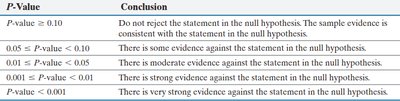
Confidence Interval Approach
If the hypothesized value is within the confidence interval, do not reject H0. Otherwise, reject H0.
Step-by-Step: Testing Hypotheses Regarding a Population Proportion
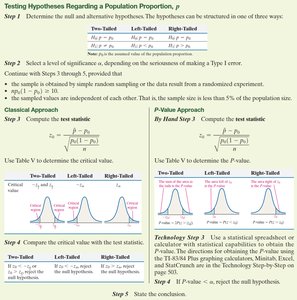
Hypothesis Tests for a Population Mean
Testing Hypotheses about a Mean
To test hypotheses about a population mean, the Student's t-distribution is used (for unknown population standard deviation). The logic is similar to that for proportions.
Conditions:
Simple random sample or randomized experiment
No outliers and normal population, or large sample (n ≥ 30)
Independent sampled values
Test Statistic:
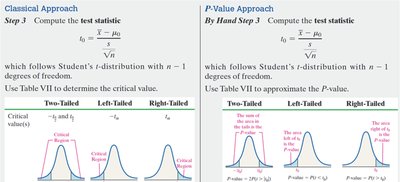
Statistical Significance vs. Practical Significance
Statistical significance means the observed effect is unlikely under H0, but practical significance considers whether the effect size is large enough to be meaningful in context. Large samples can yield statistically significant results that are not practically important.
Choosing the Appropriate Hypothesis Test
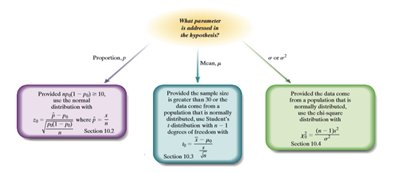
The choice of hypothesis test depends on the parameter of interest and the data's characteristics:
Proportion (p): Use normal distribution if np(1-p) ≥ 10.
Mean (μ): Use t-distribution if sample size is large or population is normal.
Standard deviation (σ): Use chi-square distribution if population is normal.
Hypothesis Tests for a Population Standard Deviation
Chi-Square Distribution
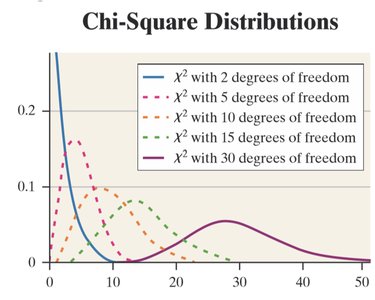
The chi-square distribution is used to test hypotheses about population variance or standard deviation. It is not symmetric and its shape depends on the degrees of freedom (n-1).
Testing Hypotheses about a Population Standard Deviation
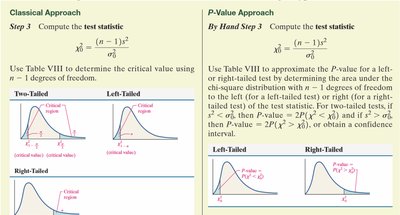
Test Statistic:
Hypotheses:
Two-tailed: H0: σ = σ0; H1: σ ≠ σ0
Left-tailed: H0: σ = σ0; H1: σ < σ0
Right-tailed: H0: σ = σ0; H1: σ > σ0
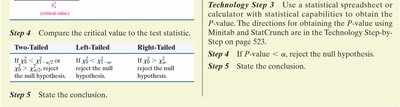
Steps:
State the hypotheses.
Select the significance level (α).
Compute the test statistic.
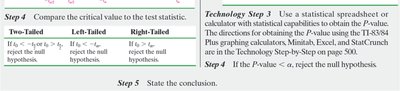
Compare to critical value or compute P-value.
State the conclusion.
Summary Table: Types of Hypothesis Tests
Parameter | Test Statistic | Distribution | Conditions |
|---|---|---|---|
Proportion (p) | Normal | np(1-p) ≥ 10 | |
Mean (μ) | t-distribution | n ≥ 30 or normal population | |
Standard Deviation (σ) | Chi-square | Normal population |
