 Back
IE 3302 Engineering Statistics: Syllabus and Course Structure Study Notes
Study Guide - Smart Notes
 Tailored notes based on your materials, expanded with key definitions, examples, and context.
Course Overview
This course, IE 3302 – Engineering Statistics, provides an introduction to probability and statistics with a focus on engineering applications. Students will learn to analyze data, apply statistical reasoning, and solve real-world engineering problems using statistical methods. The course emphasizes both conceptual understanding and practical application.
Course Structure and Topics
Course Content Outline
The course is organized into major topics that align with the foundational chapters of an introductory statistics curriculum. Each topic builds upon the previous, guiding students from basic concepts to advanced statistical inference and applications.
Introduction to Statistics and Data Collection: Understanding the role of statistics in engineering, types of data, and methods for collecting data.
Describing Data: Using tables, graphs, and numerical summaries to describe and interpret data sets.
Probability: Fundamental probability concepts, rules, and theorems essential for statistical inference.
Random Variables and Distributions: Discrete and continuous random variables, probability distributions, and their properties.
Expectation and Variance: Calculating expected values and variances for random variables.
Common Discrete Distributions: Binomial, geometric, negative binomial, Poisson, and uniform distributions.
Common Continuous Distributions: Uniform, normal, exponential, chi-square, t, and F distributions.
Sampling Distributions: Understanding the distribution of sample statistics and their role in inference.
Confidence Intervals: Constructing and interpreting confidence intervals for means and proportions.
Hypothesis Testing: Conducting hypothesis tests for means, proportions, and variances, including goodness-of-fit and independence tests.
Course Objectives
Explain and apply basic probability concepts and theorems.
Analyze and compute probabilities for discrete and continuous random variables.
Calculate expectations and variances of random variables.
Apply discrete and continuous probability distributions to engineering problems.
Construct and interpret confidence intervals.
Conduct hypothesis tests for various parameters and distributions.
Course Schedule Overview
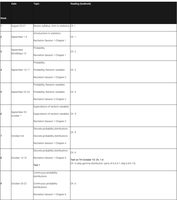
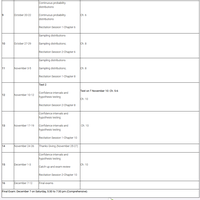
The following table summarizes the tentative schedule of topics and readings for the semester. This schedule is subject to change based on course progress and university requirements.
Week | Topic | Reading/Notes |
|---|---|---|
1 | Course Syllabus, Intro to statistics | Ch. 1 |
2 | Descriptive statistics, Data visualization | Ch. 2 |
3 | Probability, Random variables | Ch. 3 |
4 | Discrete probability distributions | Ch. 4, 5 |
5 | Continuous probability distributions | Ch. 6 |
6 | Sampling distributions | Ch. 8 |
7 | Confidence intervals and hypothesis testing | Ch. 10 |
8 | Goodness-of-fit and independence tests | Ch. 11 |
9 | Regression and correlation | Ch. 12 |
10 | ANOVA | Ch. 14 |
Grading and Evaluation
Midterm Exams: 2 exams, each worth 20% of the final grade.
Final Exam: Comprehensive, worth 30% of the final grade.
Assignments, Attendance, and Recitation: Combined 30% of the final grade.
Letter grades are assigned based on the following scale:
Percentage | Letter Grade |
|---|---|
≥ 97 | A+ |
93 - 96.99 | A |
90 - 92.99 | A- |
87 - 89.99 | B+ |
83 - 86.99 | B |
80 - 82.99 | B- |
77 - 79.99 | C+ |
73 - 76.99 | C |
70 - 72.99 | C- |
67 - 69.99 | D+ |
63 - 66.99 | D |
60 - 62.99 | D- |
< 60 | F |
Course Policies and Expectations
Attendance: Mandatory for both lectures and recitations; missing three sessions results in loss of attendance points.
Assignments: Must be submitted on time via Moodle; late submissions incur penalties.
Exams: In-person, multiple-choice format; strict rules regarding electronic devices and academic integrity.
Academic Integrity: Cheating, plagiarism, and unauthorized collaboration are strictly prohibited and subject to university disciplinary action.
Accommodations: Students with disabilities should register with Disability Services and provide documentation to the instructor.
Textbook and Resources
Textbook: Probability & Statistics for Engineers & Scientists, latest edition, Prentice Hall, by R.E. Walpole, R. H. Myers, S. L. Myers, and K. Ye.
Lecture Videos: Posted on Moodle after each class session.
Recitation Sessions: Led by the Teaching Assistant; attendance and participation required.
Summary of Key Statistical Topics
Probability: Basic rules, conditional probability, independence, and Bayes’ theorem.
Random Variables: Discrete and continuous types, probability mass and density functions.
Expectation and Variance: Calculation and interpretation for engineering applications.
Common Distributions: Binomial, Poisson, Normal, Exponential, and others.
Statistical Inference: Confidence intervals, hypothesis testing, and goodness-of-fit tests.
Regression and ANOVA: Methods for analyzing relationships between variables and comparing group means.
Example: Calculating the probability of a certain number of defective items in a batch using the binomial distribution, or constructing a 95% confidence interval for the mean strength of a material sample.
Additional info: The course schedule and content are directly aligned with the standard introductory statistics curriculum for engineers, covering all major topics from data collection to advanced inference methods.
