 Back
BackInference on the Least-Squares Regression Model and Multiple Regression
Study Guide - Smart Notes
 Tailored notes based on your materials, expanded with key definitions, examples, and context.
Chapter 14: Inference on the Least-Squares Regression Model and Multiple Regression
Section 14.1: Testing the Significance of the Least-Squares Regression Model
This section introduces the process of making statistical inferences about the least-squares regression model, focusing on the requirements, computation, and hypothesis testing for the slope coefficient.
Learning Objectives
State the requirements of the least-squares regression model.
Compute the standard error of the estimate.
Verify that the residuals are normally distributed.
Conduct inference on the slope of the least-squares regression model.
Construct a confidence interval about the slope of the least-squares regression model.
Example: Least-Squares Regression
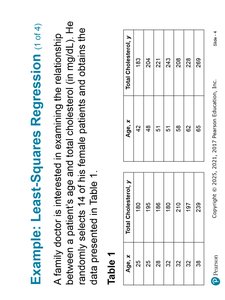
This example examines the relationship between age and total cholesterol in female patients. The data are presented in a table and analyzed using least-squares regression techniques.
Age, x | Total Cholesterol, y |
|---|---|
25 | 180 |
28 | 186 |
31 | 195 |
35 | 200 |
38 | 210 |
42 | 220 |
45 | 225 |
48 | 230 |
51 | 235 |
55 | 239 |
58 | 250 |
61 | 260 |
65 | 270 |
68 | 280 |
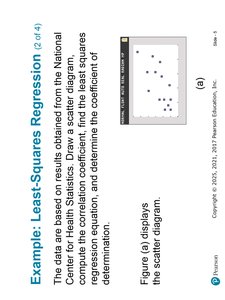
The scatter diagram and regression output are used to find the least-squares regression equation and the coefficient of determination.
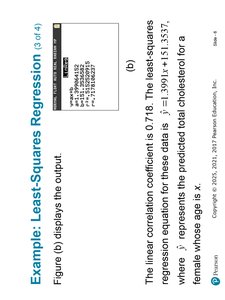
Regression Equation:
Correlation Coefficient:
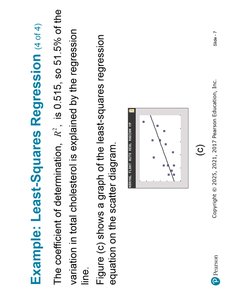
Coefficient of Determination: (51.5% of the variation in cholesterol is explained by age)
Requirements for Inference on the Least-Squares Regression Model
Linearity: For any value of the explanatory variable , the mean response is a linear function of $x$: \mu_y = \beta_1 x + \beta_0 $ $ where and are population parameters.
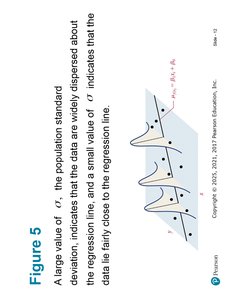
Normality: The response variable is normally distributed with mean and standard deviation .
Interpretation: The mean response changes linearly with , while the standard deviation remains constant. A large indicates data are widely dispersed about the regression line; a small $\sigma$ means data are close to the line.
Definitions
Least-Squares Regression Model: y_i = \beta_1 x_i + \beta_0 + \varepsilon_i $ $ where is the response, is the explanatory variable, and are parameters, and is the random error.
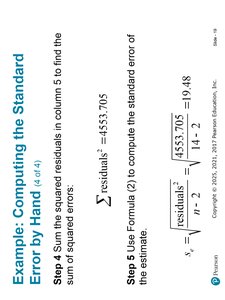
Standard Error of the Estimate (): s_e = \sqrt{\frac{\sum (y_i - \hat{y}_i)^2}{n-2}} $ $ where are the predicted values and is the sample size.
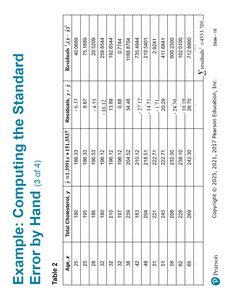
Example: Computing the Standard Error by Hand
To compute the standard error, use the observed and predicted values to find the residuals, square them, sum them, and apply the formula above.
Example: Obtaining the Standard Error Using Technology
Statistical software can be used to compute the standard error, which should match the hand calculation.
Verifying That the Residuals Are Normally Distributed
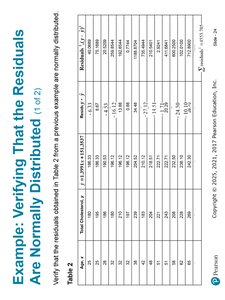
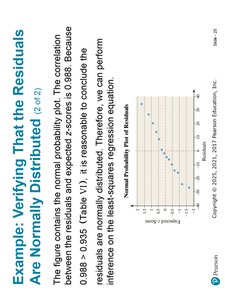
To perform inference, residuals must be approximately normally distributed. This can be checked using a normal probability plot and by comparing the correlation between residuals and expected z-scores to a critical value.
Conducting Inference on the Slope of the Least-Squares Regression Model
Hypothesis tests are used to determine if there is a significant linear relationship between two quantitative variables.
Null Hypothesis (): (no linear relationship)
Alternative Hypothesis (): , , or (depending on the test)
Test Type | Null Hypothesis | Alternative Hypothesis |
|---|---|---|
Two-tailed | ||
Right-tailed | ||
Left-tailed |
Test Statistic: t = \frac{b_1}{s_{b_1}} $ $ where is the sample slope and is its standard error. The test statistic follows a t-distribution with degrees of freedom.
Classical Approach
Compute the test statistic.
Determine the critical value from the t-distribution.
Compare the test statistic to the critical value and state the conclusion.
P-Value Approach
Compute the test statistic.
Use statistical software or tables to find the p-value.
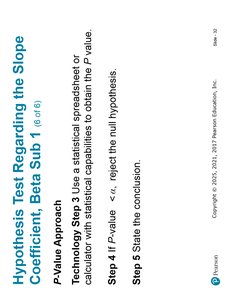
If p-value < , reject the null hypothesis.
State the conclusion.
Caution
Before testing , always draw a residual plot to verify that a linear model is appropriate.
Example: Testing for a Linear Relation
To test for a linear relationship between age and cholesterol at , follow these steps:
State hypotheses: vs.
Set significance level:
Compute the test statistic using the sample data and standard error.
Compare to the critical value or use the p-value approach.
Draw a conclusion about the existence of a linear relationship.
Summary: This section provides a comprehensive approach to testing the significance of the least-squares regression model, including requirements, computation of standard error, verification of normality, and hypothesis testing for the slope coefficient.
