Back
BackIntroduction to Statistics and Data Collection
Study Guide - Smart Notes
 Tailored notes based on your materials, expanded with key definitions, examples, and context.
Introduction to Statistics
Definition and Purpose
Statistics is the science of collecting, organizing, analyzing, and interpreting data in order to make decisions. It is used to understand and describe phenomena, make predictions, and inform decision-making in various fields.
Statistics: The study of how to collect, organize, analyze, and interpret numerical information from data.
Data: Information collected from observations, measurements, or experiments.
Population: The entire group that is being studied.
Sample: A subset of the population selected for study.
Types of Statistics
Statistics can be divided into two main branches:
Descriptive Statistics: Methods for organizing and summarizing data. Examples include tables, graphs, and numerical summaries such as mean and standard deviation.
Inferential Statistics: Methods for making predictions or inferences about a population based on a sample of data.
Collecting Data
Data collection is a fundamental step in statistics. The quality and reliability of statistical conclusions depend on how data is collected.
Observational Study: Observes individuals and measures variables without influencing them.
Experiment: Applies a treatment to individuals and observes the effect.
Survey: Collects data by asking questions to a sample of people.
Sampling Methods
Sampling is the process of selecting a subset of individuals from a population to estimate characteristics of the whole population.
Random Sampling: Every member of the population has an equal chance of being selected.
Systematic Sampling: Selects every nth member of the population.
Stratified Sampling: Divides the population into subgroups (strata) and samples from each stratum.
Cluster Sampling: Divides the population into clusters and randomly selects entire clusters.
Key Terms and Concepts
Parameter: A numerical summary of a population.
Statistic: A numerical summary of a sample.
Bias: Systematic error in data collection or sampling that leads to inaccurate results.
Variable: A characteristic or property that can take on different values.
Example: Sampling in Practice
Suppose a researcher wants to estimate the average height of college students. Instead of measuring every student (the population), the researcher selects a random sample of 100 students and calculates the average height (a statistic). This statistic is used to infer the average height of all college students (the parameter).
Formulas
Sample Mean:
Population Mean:
Additional info:
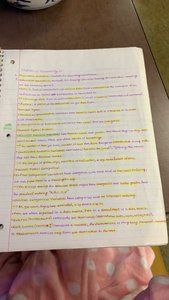
Some content was inferred based on standard introductory statistics topics and the visible structure of the handwritten notes.