 Back
BackIntroduction to Statistics: Key Concepts and Methods
Study Guide - Smart Notes
 Tailored notes based on your materials, expanded with key definitions, examples, and context.
Introduction to Statistics
What is Statistics?
Statistics is the science of collecting, organizing, analyzing, and interpreting data to make informed decisions. It is foundational for understanding data-driven conclusions in many fields, including business, health, and social sciences.
Data: Information gathered from counting, measuring, or collecting responses.
Population: The entire set of data or individuals of interest (e.g., all employees at a company).
Sample: A subset of the population, selected for analysis.
Parameter: A numerical value that describes a characteristic of a population.
Statistic: A numerical value that describes a characteristic of a sample.
Example: If you measure the salary of every employee at a marketing firm, you have population data and the average salary is a parameter. If you measure the salaries of 12 out of 100 employees, you have sample data and the average salary is a statistic.
Practice Questions
Collecting test scores from every other student in a class: Sample
46.5% of all registered voters are registered democrats: Parameter
Amount spent by each customer in a grocery store: Population
Survey of 40 gym members finds average workout duration: Statistic
Types of Data
Qualitative vs. Quantitative Data
Data can be categorized as either qualitative or quantitative, each with distinct properties and uses.
Qualitative Data: Describes qualities or categories (e.g., favorite color, eye color, brands of smartphones).
Quantitative Data: Describes quantities or amounts (e.g., number of students, heights, weights).
Discrete Data: Quantitative data that can only take specific values (e.g., number of goals scored).
Continuous Data: Quantitative data that can take any value within a range (e.g., time, temperature).
Examples:
Surveying nationalities: Qualitative
Measuring distances walked: Quantitative; Continuous
Number of goals scored: Quantitative; Discrete


Levels of Measurement
Understanding Levels of Measurement
Levels of measurement describe the nature of information within the values assigned to variables. They determine what kinds of statistical analysis are appropriate.
Level | Description | Qualitative/Quantitative | Example |
|---|---|---|---|
Nominal | Categories, names, or labels; no order or calculations | Either | Hair color, music genre |
Ordinal | Ordered categories; differences not meaningful | Either | Letter grades, satisfaction ratings |
Interval | Ordered, meaningful differences; no true zero | Quantitative | Temperature in °C or °F |
Ratio | Ordered, meaningful differences; true zero exists | Quantitative | Heights, weights, distances |
Example: Birth years (interval), satisfaction ratings (ordinal), working hours (ratio), favorite music genre (nominal).

Practice Identifying Levels of Measurement
Participants rate symptoms as mild, moderate, or severe: Ordinal
Dates of establishment for businesses: Interval
Favorite menu item: Nominal
Birth weights of newborns: Ratio
Collecting Data
Observational Studies vs. Experiments
There are two main ways to collect data in statistics:
Experiment: Researchers apply a treatment and measure its effects. Causation can be inferred.
Observational Study: Researchers observe and measure characteristics without influencing them. Causation cannot be inferred.
Examples:
Testing a medication with a placebo group: Experiment (can infer causation)
Surveying students about sleep habits: Observational Study (cannot infer causation)
Comparing results from fair and loaded dice: Experiment
Sampling Methods
Simple Random Sampling (SRS)
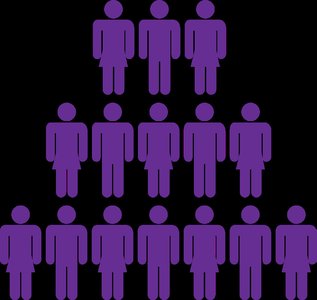
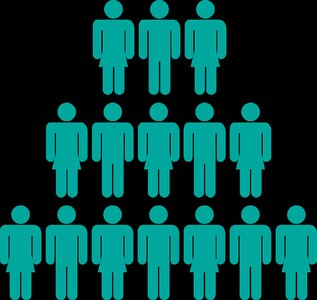
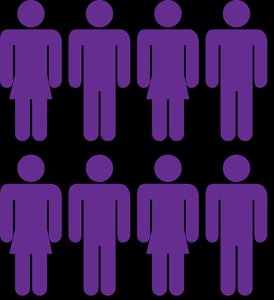
Sampling is the process of selecting a subset (sample) from a larger group (population). A representative sample accurately reflects the characteristics of the population.
Simple Random Sampling (SRS): Every subject and every possible group of subjects is equally likely to be selected.
Example: Randomly selecting 3 marbles from a bag with 2 red and 4 blue marbles.
Other Sampling Methods
Systematic Sampling: Select every nth subject from the population (e.g., every 12th cookie).
Cluster Sampling: Divide the population into groups (clusters), randomly select clusters, and include all members from selected clusters.
Stratified Sampling: Divide the population into groups (strata) based on shared characteristics, then randomly sample from each stratum.
Example: A university surveys 50 random undergrads and 50 random grad students (stratified sampling).
Practice Identifying Sampling Methods
Testing every 12th cookie: Systematic Sampling
Randomly selecting 15 employees: Simple Random Sampling
Surveying all students in randomly selected classes: Cluster Sampling
Surveying random undergrads and grad students: Stratified Sampling
