 Back
Introductory Statistics Chapter 4: Probability Study Notes
Study Guide - Smart Notes
 Tailored notes based on your materials, expanded with key definitions, examples, and context.
Probability
Introduction to Probability
Probability is a fundamental concept in statistics that quantifies how likely an event is to occur. It provides a mathematical framework for making decisions and predictions based on data.
Probability: How often something occurs or is expected to occur.
Probability gives us information about data in a widely accessible format.
Probability theory can be used to make decisions about populations, such as by applying the Rare Event Rule.
Rare Event Rule for Inferential Statistics
The Rare Event Rule is used to determine whether an observed event is statistically significant. If the probability of an event is extremely small under a given assumption, the assumption is likely incorrect.
An event is called statistically significant if it is too unlikely to occur by chance.
This rule is foundational for hypothesis testing and will be revisited later in the course.
Basic Probability Terms
Definitions
Understanding basic probability terms is essential for analyzing random processes and outcomes.
Event: An outcome of a procedure.
Simple event: An event that cannot be broken down into simpler components.
Outcome: The result of a single trial in a procedure.
Sample Space: The set of all possible outcomes of a procedure.
Sample Space and Tree Diagrams
Tree Diagrams
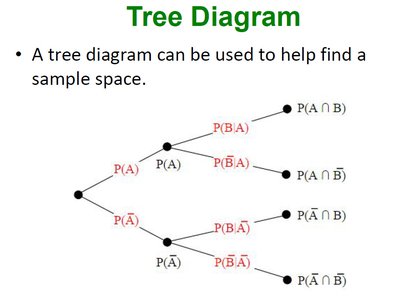
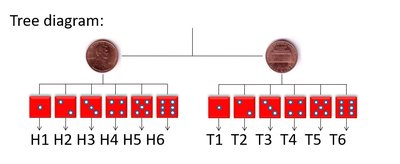
Tree diagrams are visual tools used to enumerate all possible outcomes (sample space) of a procedure, especially when multiple steps or random choices are involved.
Each branch represents a possible outcome at each stage.
Tree diagrams help in calculating probabilities for complex events.
Examples of Sample Spaces
Sample spaces can be constructed for simple random experiments such as rolling dice or flipping coins.
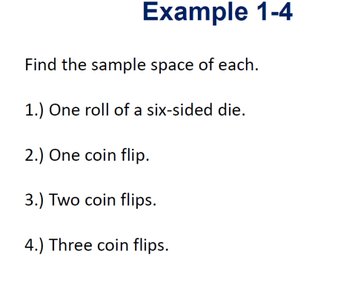
One roll of a six-sided die: Sample space = {1, 2, 3, 4, 5, 6}
One coin flip: Sample space = {Heads, Tails}
Two coin flips: Sample space = {HH, HT, TH, TT}
Three coin flips: Sample space = {HHH, HHT, HTH, HTT, THH, THT, TTH, TTT}
Complex Sample Spaces
Sample spaces can become more complex when combining different random processes, such as flipping coins and spinning a spinner.
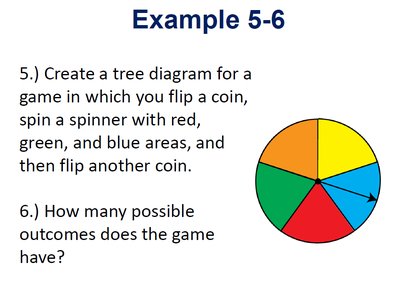
Example: Flip a coin, spin a spinner with red, green, and blue areas, then flip another coin.
To find the total number of possible outcomes, use a tree diagram or the Fundamental Counting Principle.
Fundamental Counting Principle
Definition and Application
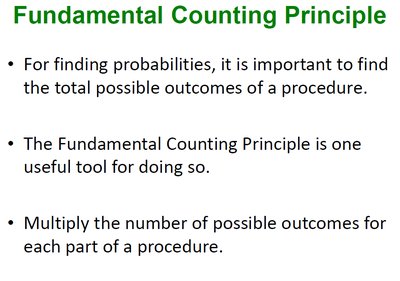
The Fundamental Counting Principle is a method for determining the total number of possible outcomes in a multi-step procedure.
Multiply the number of possible outcomes for each part of a procedure.
Useful for calculating probabilities in complex scenarios.
Examples Using Counting Principle
Apply the Fundamental Counting Principle to real-world scenarios, such as selecting a car or creating outfits.
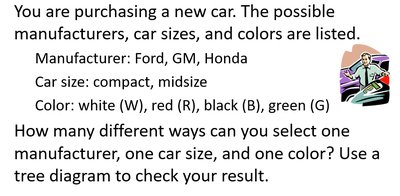
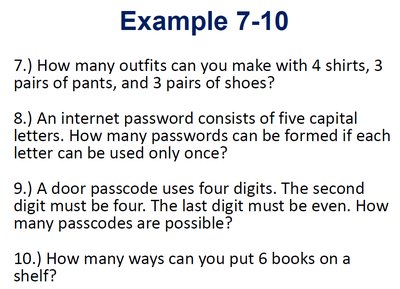
Example: Selecting a car from 3 manufacturers, 2 sizes, and 4 colors yields 3 × 2 × 4 = 24 possible combinations.
Example: Making outfits with 4 shirts, 3 pairs of pants, and 3 pairs of shoes yields 4 × 3 × 3 = 36 possible outfits.
Factorials
Definition and Calculation
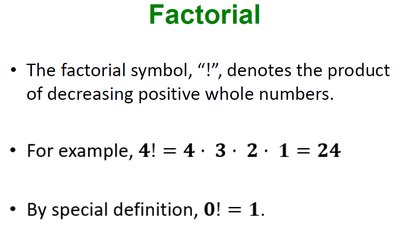
Factorials are used in counting and probability to determine the number of ways to arrange or select objects.
The factorial symbol "!" denotes the product of decreasing positive whole numbers.
For example,
By definition,
Factorial Examples
Calculate factorial values for various numbers to understand their use in probability and counting.
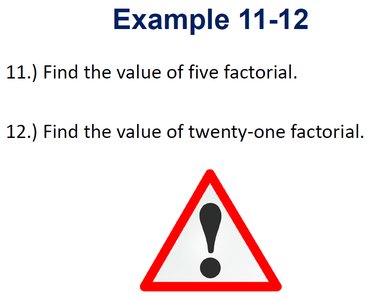
Find the value of five factorial:
Find the value of twenty-one factorial: (a very large number, typically calculated with a calculator or software)
Probability Rules
Basic Rules
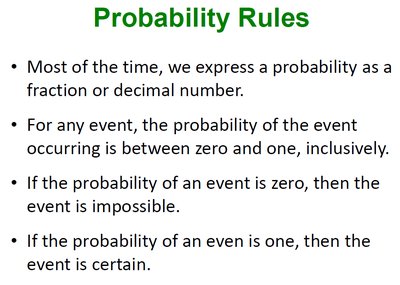
Probability values are always between 0 and 1, inclusive. These rules help interpret and calculate probabilities correctly.
Probability is usually expressed as a fraction or decimal.
For any event,
If , the event is impossible.
If , the event is certain.
Probability Values Example
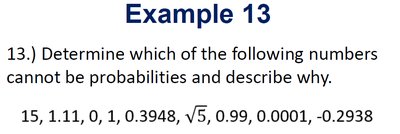
Determine which numbers can be probabilities and explain why.
Valid probabilities: 0, 1, 0.3948, 0.99, 0.0001
Invalid probabilities: 15, 1.11, , -0.2938 (because they are not between 0 and 1)
Types of Probability
Classical vs. Relative Frequency Probability
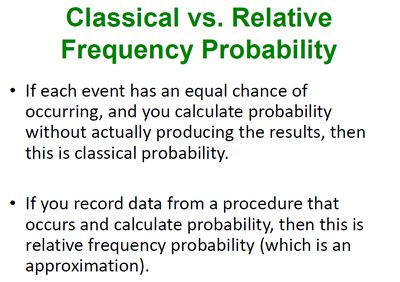
There are two main approaches to calculating probability: classical and relative frequency.
Classical Probability: Used when each event has an equal chance of occurring and is calculated without actually performing the experiment.
Relative Frequency Probability: Calculated by recording data from actual experiments; it is an approximation based on observed frequencies.
Calculating Probability
Probability Formula
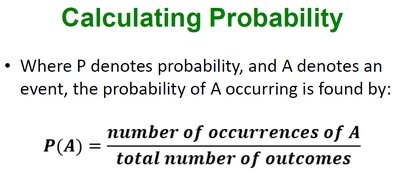
The probability of an event A is calculated as the ratio of the number of occurrences of A to the total number of possible outcomes.
Formula:
This formula is fundamental for both classical and empirical probability calculations.
Summary Table: Probability Concepts
Concept | Definition | Example |
|---|---|---|
Event | Outcome of a procedure | Rolling a 4 on a die |
Sample Space | All possible outcomes | {1,2,3,4,5,6} for a die |
Probability | Likelihood of an event | |
Factorial | Product of decreasing positive integers | |
Counting Principle | Multiply outcomes for each step | 3 shirts × 2 pants = 6 outfits |
