Back
BackIntroductory Statistics: Course Structure, Success Strategies, and Study Skills
Study Guide - Smart Notes
 Tailored notes based on your materials, expanded with key definitions, examples, and context.
Course Overview and Structure
Introduction to Statistics and Course Purpose
This course, MATH 1530: Introductory Statistics, is designed to provide students with foundational knowledge in both descriptive and inferential statistics. The curriculum covers statistical design, graphical and numerical data analysis, probability, probability distributions, estimation, hypothesis testing, and correlation and regression. The course emphasizes critical thinking, mathematical reasoning, and the application of statistical concepts to real-world problems.
Descriptive Statistics: Summarizing and describing data using measures of center, variation, and graphical displays.
Inferential Statistics: Drawing conclusions about populations based on sample data, including estimation and hypothesis testing.
Probability: Understanding chance, random variables, and probability distributions.
Statistical Reasoning: Applying statistical thinking to interpret research, evaluate claims, and make informed decisions.
Additional info: The course uses "Statistical Reasoning for Everyday Life" by Bennett, Briggs, and Triola as the primary text, with integrated technology and online resources for assignments and assessments.
Course Components and Resources
Key Platforms and Tools
The course is delivered asynchronously online, utilizing several digital platforms and resources to facilitate learning and assessment:
Momentum: The main course management system for announcements, course documents, and links to resources.
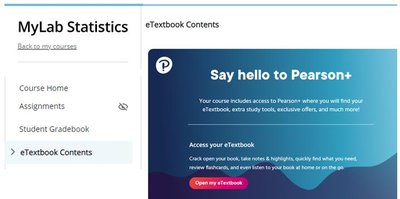
MyLab Statistics (MLS): The platform for homework, quizzes, practice tests, and exams. It also provides access to the eText and instructional videos.
Guided Notebook: Printable notes and guided exercises to accompany each chapter, supporting active learning and exam preparation.
Calculator: A TI-83 or TI-84 Plus calculator is required for statistical computations.
Course Policies and Success Strategies
Grading and Evaluation
Student performance is evaluated through a combination of online homework, quizzes, practice tests, unit exams, and a final exam. The grading breakdown is as follows:
Online Homework: 20%
Online Quizzes & Practice Tests: 15%
3 Unit Exams + Final Exam: 65%
Letter grades are assigned according to the following scale:
A: 90–100%
B: 80–89.9%
C: 70–79.9%
D: 60–69.9%
F: 0–59.9%
Assignment and Exam Policies
All assignments and quizzes have strict due dates; late submissions incur a 10% penalty.
Two lowest homework scores and one lowest quiz score are dropped at the end of the semester.
One missed unit exam may be replaced by the final exam score.
All exams must be taken in a proctored testing center; no extensions are granted except for documented disabilities.
Academic Integrity
Plagiarism, cheating, fabrication, and facilitation are strictly prohibited. Academic misconduct may result in a failing grade for the assignment or course and administrative action.
Student Responsibilities and Study Skills
Keys to Success in Online Statistics
Success in this course requires strong time management, self-motivation, and the ability to follow written instructions. Students are expected to:
Print and organize all course materials in a three-ring binder.
Dedicate 6–10 hours per week to lectures, assignments, and studying.
Use all provided resources (syllabus, calendar, guided notes, eText, and instructor support) before seeking additional help.
Communicate professionally with the instructor, providing specific details and evidence of attempted work when asking for help.

Recommended Workflow for Each Chapter
Watch section videos and complete guided notes.
Complete media assignments (score at least 90%).
Complete homework assignments (score at least 80%).
Take chapter quizzes (two attempts allowed; highest score counts).
Take practice tests before each unit exam (unlimited attempts; highest score counts).
Take proctored unit exams and the final exam as scheduled.
Using Technology and Submitting Work
Access all assignments and resources through MyLab Statistics and Momentum.
Use CamScanner or a similar app to scan and submit handwritten assignments as PDFs.

Course Learning Outcomes
Core Competencies and Skills Developed
Apply statistical reasoning to solve conceptual and applied problems.
Classify data types and identify appropriate sampling methods.
Organize and graphically display data.
Calculate and interpret measures of center, variation, and relative standing.
Solve probability problems and analyze discrete and continuous random variables.
Construct and interpret confidence intervals for population parameters.
Conduct hypothesis tests and draw valid conclusions.
Analyze linear correlation and regression for prediction and inference.
Support and Additional Resources
Technical and Academic Support
Contact the Center for Teaching Arts and Technology (CTAT) or the Help Desk for technical issues.
Utilize the Learning Center for tutoring and additional academic support.
Students with disabilities should contact the disability services office for accommodations.
Final Notes and Instructor Advice
The instructor is committed to student success and encourages proactive communication. Students are urged to stay organized, keep up with deadlines, and use all available resources. Success in statistics is achieved through consistent effort, careful study, and responsible use of support tools.