Back
BackIntroductory Statistics: Course Structure, Success Strategies, and Study Skills
Study Guide - Smart Notes
 Tailored notes based on your materials, expanded with key definitions, examples, and context.
Course Overview and Introduction to Statistics
What is Statistics and Why Study It?
Statistics is the science of collecting, analyzing, interpreting, and presenting data. In today's world, statistical reasoning is essential for interpreting research, making informed decisions, and communicating effectively in many fields. This course aims to provide foundational knowledge in both descriptive and inferential statistics, preparing students for further study and practical application.
Descriptive Statistics: Methods for summarizing and organizing data (e.g., measures of center, variation, and graphical displays).
Inferential Statistics: Techniques for making predictions or inferences about a population based on a sample (e.g., confidence intervals, hypothesis testing).
Probability: Understanding and quantifying uncertainty and chance events.
Statistical Reasoning: Applying logical thinking to interpret data and research findings.
Key Learning Goals:
Interpret and critique statistical information in everyday life and news reports.
Understand the importance of good sampling and experimental design.
Apply statistical methods to solve real-world problems.
Additional info: Statistical thinking is now considered as fundamental as reading and writing for educated citizenship (H.G. Wells).
Course Structure and Requirements
Course Components and Resources
This course is delivered asynchronously online, requiring students to manage their time and learning independently. The main components include:
Momentum (Learning Management System): Access course news, technical support, calculator requests, and guided notes.
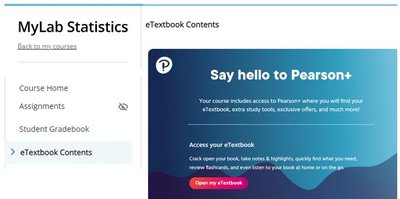
MyLab Statistics: Complete assignments, quizzes, exams, and access the eTextbook.
Guided Notebook: Print and complete guided notes for each chapter to reinforce learning and prepare for assessments.
Instructor Support: The instructor provides resources, answers questions, and offers encouragement, but students are expected to use all available tools before seeking help.
Course Materials
Textbook: Statistical Reasoning for Everyday Life, 6th Edition, Bennett, Briggs, Triola (Pearson/MyLab access included with tuition).
Calculator: TI-83 or TI-84 Plus (required; available for checkout from the library).
Notebook: 2–2.5 inch three-ring binder for organizing printed notes and assignments.
Grading and Evaluation
Assessment Breakdown
Online Homework: 20% (lowest two scores dropped; late penalty applies).
Quizzes & Practice Tests: 15% (lowest quiz score dropped; two attempts per quiz).
Exams (3 Unit Exams + Final): 65% (final exam can replace one missed unit exam).
Grading Scale: A: 90–100%, B: 80–89.9%, C: 70–79.9%, D: 60–69.9%, F: 0–59.9%
Success Strategies for Online Statistics
Keys to Success
Commit to working on the course 4–5 days per week, 2–3 hours per day.
Stay organized: print all course materials, keep a calendar, and use a dedicated binder.
Use all provided resources before seeking instructor help (syllabus, calendar, guided notes, eText, etc.).
Take thorough notes during media assignments and lectures; these are essential for homework and quizzes.
Review mistakes on quizzes and practice tests before retaking or moving on.
Plan ahead for deadlines; no extensions except for documented disabilities.
Using Technology and Submitting Work
Access MyLab Statistics through the course homepage for all assignments and tests.
Use CamScanner or a similar app to scan and submit handwritten assignments as PDFs.
Check your gradebook regularly to monitor progress and identify areas for improvement.

Academic Integrity and Support
Academic Honesty
Plagiarism, cheating, fabrication, and facilitation are strictly prohibited and may result in course failure.
Students must use their official college email for all communications.
Student Support Services
Technical support is available through the Center for Teaching Arts and Technology (CTAT) and the Help Desk.
Learning Centers offer tutoring in statistics and other subjects.
Disability accommodations are available through the college’s disability services office.
Course Learning Outcomes
By the end of this course, students will be able to:
Solve real-world probability problems.
Classify data types (qualitative, quantitative discrete, quantitative continuous).
Identify and apply appropriate sampling methods.
Organize and graphically display data.
Calculate and interpret measures of center and variation using technology.
Solve problems involving discrete and continuous random variables, including the normal distribution.
Construct and interpret confidence intervals for population means and proportions.
Determine necessary sample sizes for estimation.
Conduct and interpret hypothesis tests for population parameters.
Analyze linear correlation and regression, and use regression equations for prediction.
Course Calendar and Deadlines
Staying on Track
All assignments, quizzes, and exams have strict deadlines (see course calendar).
Practice tests are unlimited and serve as preparation for exams.
Final exam is mandatory and can replace one low or missed unit exam score.
Final Notes
Success in statistics requires consistent effort, organization, and use of all available resources. The instructor is committed to supporting students who demonstrate initiative and responsibility. If you encounter difficulties, reach out early and use the support systems in place.