 Back
Introductory Statistics Section 1.1: Key Concepts and Guided Practice
Study Guide - Smart Notes
 Tailored notes based on your materials, expanded with key definitions, examples, and context.
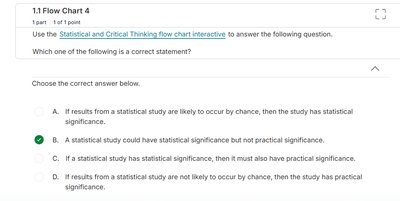
Q1. Which one of the following is a correct statement about statistical and practical significance?
Background
Topic: Statistical vs. Practical Significance
This question tests your understanding of the difference between statistical significance (results unlikely to occur by chance) and practical significance (results that are large or meaningful enough to matter in real life).
Key Terms:
Statistical significance: A result is statistically significant if it is unlikely to have occurred by random chance, often determined by a p-value less than 0.05.
Practical significance: A result is practically significant if it is large or important enough to have real-world relevance or impact.
Step-by-Step Guidance
Review the definitions of statistical and practical significance. Consider that statistical significance does not always imply practical importance.
Read each answer choice and identify whether it confuses or correctly distinguishes between the two concepts.
Recall that a study can have statistical significance without practical significance, especially if the effect size is very small.
Eliminate any answer that incorrectly claims one always implies the other.
Try solving on your own before revealing the answer!
Final Answer: B. A statistical study could have statistical significance but not practical significance.
This is correct because a result can be statistically significant (unlikely due to chance) but still be too small to matter in practice.
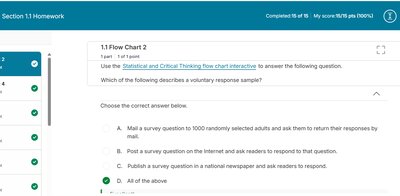
Q2. Which of the following describes a voluntary response sample?
Background
Topic: Sampling Methods
This question tests your ability to identify voluntary response samples, where participants choose themselves to be part of the sample.
Key Terms:
Voluntary response sample: A sample in which people decide for themselves whether to participate, often leading to bias.
Step-by-Step Guidance
Recall that voluntary response samples occur when individuals opt in to participate, rather than being randomly selected.
Examine each answer choice and determine if the sample is self-selected or if participants are randomly chosen.
Identify which options involve people choosing to respond, such as internet or newspaper polls.
Consider whether any answer choices describe random sampling, which is not voluntary response.
Try solving on your own before revealing the answer!
Final Answer: D. All of the above
All listed options describe situations where individuals choose to respond, making them voluntary response samples.
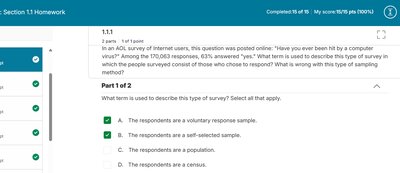
Q3. What term is used to describe a survey in which the people surveyed consist of those who chose to respond? What is wrong with this type of sampling method?
Background
Topic: Voluntary Response and Self-Selected Samples
This question asks you to identify the type of sample where respondents choose themselves and to recognize the potential issues with this method.
Key Terms:
Voluntary response sample: Respondents choose to participate, often leading to bias.
Self-selected sample: Another term for voluntary response sample.
Step-by-Step Guidance
Identify the key feature: respondents are not randomly selected but choose to participate.
Recall the terms "voluntary response sample" and "self-selected sample" as correct descriptors.
Consider why this sampling method can be problematic, such as the potential for bias.
Think about how the results may not represent the entire population due to self-selection.
Try solving on your own before revealing the answer!
Final Answer: The respondents are a voluntary response sample and a self-selected sample.
This type of sampling is problematic because it can lead to bias, as those with strong opinions are more likely to respond.
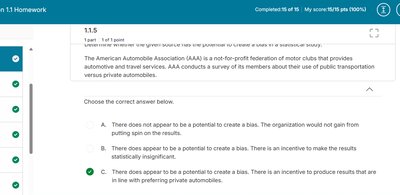
Q4. Does there appear to be a potential to create a bias in a survey conducted by an organization with an incentive?
Background
Topic: Source and Incentive Bias
This question tests your ability to recognize when the organization conducting a survey may have a bias due to incentives or interests.
Key Terms:
Bias: A systematic error introduced into sampling or testing by selecting or encouraging one outcome or answer over others.
Incentive bias: When the organization conducting the study has a reason to prefer a particular outcome.
Step-by-Step Guidance
Identify the organization conducting the survey and its possible interests or incentives.
Consider whether the organization could benefit from a particular result.
Evaluate if there is a reason to suspect the results could be biased in favor of the organization's interests.
Eliminate answer choices that ignore the potential for bias.
Try solving on your own before revealing the answer!
Final Answer: C. There does appear to be a potential to create a bias. There is an incentive to produce results that are in line with preferring private automobiles.
When an organization has a vested interest in the outcome, there is a risk of bias in the survey results.
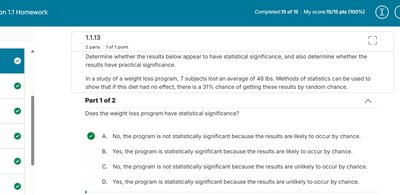
Q5. Does the weight loss program have statistical significance?
Background
Topic: Statistical Significance
This question asks you to determine if the results of a study are statistically significant, based on the probability of the results occurring by chance.
Key Terms and Formula:
Statistical significance: Results are statistically significant if the probability of them occurring by chance is less than a standard threshold (commonly 5%).
Probability: The likelihood of an event occurring, often expressed as a percentage or decimal.
Step-by-Step Guidance
Identify the probability that the results could occur by chance (given as 31%).
Recall the standard cutoff for statistical significance (usually less than 5%).
Compare the given probability to the standard cutoff.
Decide whether the results meet the criteria for statistical significance based on this comparison.
Try solving on your own before revealing the answer!
Final Answer: A. No, the program is not statistically significant because the results are likely to occur by chance.
Since the probability (31%) is much higher than the 5% threshold, the results are not statistically significant.
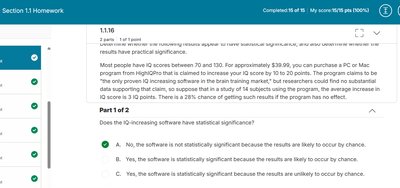
Q6. Does the IQ-increasing software have statistical significance?
Background
Topic: Statistical Significance
This question asks you to determine if the results of a study are statistically significant, based on the probability of the results occurring by chance.
Key Terms and Formula:
Statistical significance: Results are statistically significant if the probability of them occurring by chance is less than a standard threshold (commonly 5%).
Probability: The likelihood of an event occurring, often expressed as a percentage or decimal.
Step-by-Step Guidance
Identify the probability that the results could occur by chance (given as 28%).
Recall the standard cutoff for statistical significance (usually less than 5%).
Compare the given probability to the standard cutoff.
Decide whether the results meet the criteria for statistical significance based on this comparison.
Try solving on your own before revealing the answer!
Final Answer: A. No, the software is not statistically significant because the results are likely to occur by chance.
Since the probability (28%) is much higher than the 5% threshold, the results are not statistically significant.
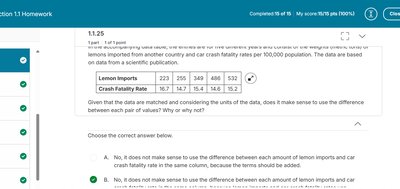
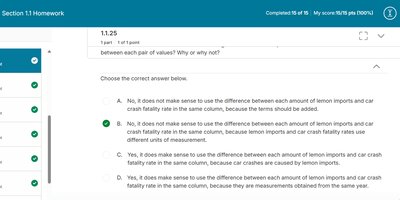
Q7. Does it make sense to use the difference between each amount of lemon imports and car crash fatality rate in the same column?
Background
Topic: Data Comparison and Units
This question tests your understanding of when it is appropriate to compare or subtract values in a data table, especially when the units differ.
Key Terms:
Units of measurement: The standard quantities used to specify measurements (e.g., number of lemons, crash fatality rate per 100,000).
Meaningful comparison: Only values with the same units can be directly compared or subtracted.
Step-by-Step Guidance
Identify the units for each column in the data table (e.g., lemon imports vs. crash fatality rate).
Recall that subtraction or direct comparison is only meaningful when the units are the same.
Consider whether it makes sense to subtract a count of lemons from a rate of car crashes.
Eliminate answer choices that ignore the difference in units.
Try solving on your own before revealing the answer!
Final Answer: B. No, it does not make sense to use the difference because lemon imports and car crash fatality rates use different units of measurement.
Comparing or subtracting values with different units does not provide meaningful information.
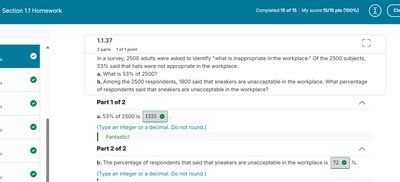
Q8. What is 53% of 2500?
Background
Topic: Percentages and Counts
This question tests your ability to calculate a percentage of a given number, a common operation in statistics.
Key Formula:
Step-by-Step Guidance
Convert the percentage to a decimal by dividing by 100.
Multiply the decimal by the total number (2500).
Set up the calculation but do not compute the final value yet.
Try solving on your own before revealing the answer!
Final Answer: 1325
of 2500 is .
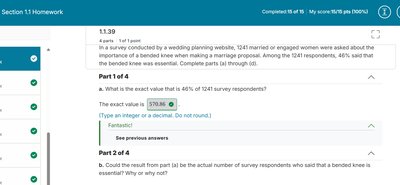
Q9. What is the exact value that is 46% of 1241 survey respondents?
Background
Topic: Percentages and Counts
This question tests your ability to calculate a percentage of a given number, which is essential for interpreting survey results.
Key Formula:
Step-by-Step Guidance
Convert 46% to a decimal by dividing by 100.
Multiply the decimal by the total number of respondents (1241).
Set up the calculation but do not compute the final value yet.
Try solving on your own before revealing the answer!
Final Answer: 570.86
of 1241 is .
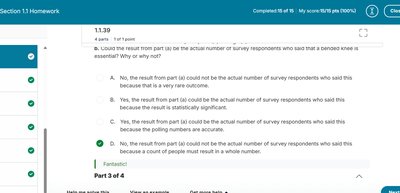
Q10. Could the result from part (a) be the actual number of survey respondents who said that a bended knee is essential? Why or why not?
Background
Topic: Whole Number Counts in Surveys
This question tests your understanding that the actual count of people must be a whole number, even if a percentage calculation gives a decimal.
Key Terms:
Whole number: The count of people must be an integer, since you cannot have a fraction of a person.
Step-by-Step Guidance
Recall that survey counts must be whole numbers.
Consider whether the calculated value from part (a) is a whole number or a decimal.
Think about how to interpret a decimal result in the context of counting people.
Try solving on your own before revealing the answer!
Final Answer: No, the result from part (a) could not be the actual number of survey respondents who said this because a count of people must result in a whole number.
People counts must be integers, so the decimal result must be rounded appropriately.
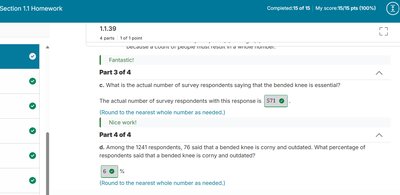
Q11. What is the actual number of survey respondents saying that the bended knee is essential?
Background
Topic: Rounding Survey Counts
This question asks you to round the calculated decimal value to the nearest whole number to represent the actual number of people.
Key Formula:
Round the decimal result from the previous calculation to the nearest whole number.
Step-by-Step Guidance
Take the decimal value calculated previously (e.g., 570.86).
Apply standard rounding rules to determine the nearest whole number.
Write down the rounded value as the actual count of respondents.
Try solving on your own before revealing the answer!
Final Answer: 571
570.86 rounded to the nearest whole number is 571.
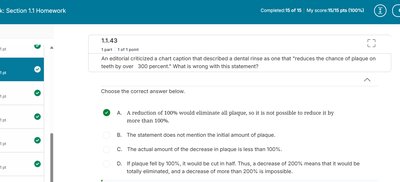
Q12. What is wrong with the statement: "reduces the chance of plaque on teeth by over 300 percent"?
Background
Topic: Percent Decrease
This question tests your understanding of percentage decreases and the logical limits of percent reduction.
Key Terms:
Percent decrease: A 100% decrease reduces a quantity to zero; a decrease greater than 100% is not possible.
Step-by-Step Guidance
Recall that a 100% decrease means the quantity is reduced to zero.
Consider whether it is possible to reduce something by more than 100%.
Evaluate the logic of the statement in the context of percent decrease.
Try solving on your own before revealing the answer!
Final Answer: A. A reduction of 100% would eliminate all plaque, so it is not possible to reduce it by more than 100%.
A decrease greater than 100% is not logically possible.
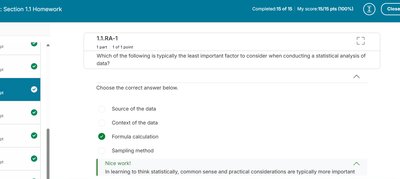
Q13. Which of the following is typically the least important factor to consider when conducting a statistical analysis of data?
Background
Topic: Factors in Statistical Analysis
This question tests your understanding of what factors are most important when analyzing data statistically.
Key Terms:
Source of data: Where the data comes from.
Context of data: The circumstances under which the data was collected.
Formula calculation: The mathematical computation used.
Sampling method: How the data was collected from the population.
Step-by-Step Guidance
Consider which factors can introduce bias or affect the validity of conclusions.
Recall that formula calculation is often less important than the source, context, or sampling method.
Eliminate options that are critical to the integrity of the data analysis.
Try solving on your own before revealing the answer!
Final Answer: Formula calculation
Common sense and practical considerations are typically more important than the specific formula used.
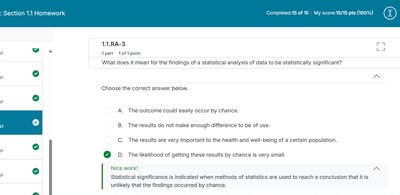
Q14. What does it mean for the findings of a statistical analysis of data to be statistically significant?
Background
Topic: Statistical Significance
This question tests your understanding of what it means for results to be statistically significant.
Key Terms:
Statistical significance: The likelihood that the results are not due to random chance.
Step-by-Step Guidance
Recall that statistical significance is about the probability of results occurring by chance.
Identify the answer choice that refers to a low likelihood of results being due to chance.
Eliminate options that focus on importance or usefulness rather than probability.
Try solving on your own before revealing the answer!
Final Answer: The likelihood of getting these results by chance is very small.
Statistical significance means the results are unlikely to have occurred by random chance.
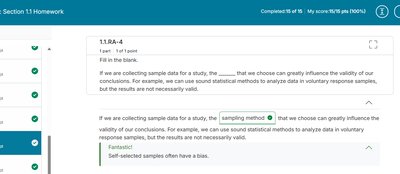
Q15. Fill in the blank: If we are collecting sample data for a study, the ________ that we choose can greatly influence the validity of our conclusions.
Background
Topic: Sampling Method
This question tests your understanding of the importance of the sampling method in statistical studies.
Key Terms:
Sampling method: The process used to select individuals from the population to be included in the sample.
Step-by-Step Guidance
Recall that the way a sample is chosen can introduce bias or affect validity.
Think about which term best fits the blank to complete the sentence logically.
Eliminate options that do not relate to how the sample is selected.
Try solving on your own before revealing the answer!
Final Answer: sampling method
The sampling method is crucial for the validity of statistical conclusions.
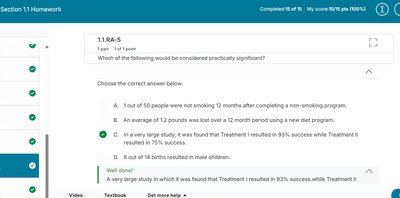
Q16. Which of the following would be considered practically significant?
Background
Topic: Practical Significance
This question tests your ability to identify results that are not only statistically significant but also meaningful in real-world terms.
Key Terms:
Practical significance: Results that are large or important enough to matter in practice.
Step-by-Step Guidance
Review each answer choice and consider whether the result would have a meaningful impact in real life.
Recall that practical significance requires more than just statistical significance; the effect must be large or important.
Eliminate options with small or trivial effects.
Try solving on your own before revealing the answer!
Final Answer: C. In a very large study, it was found that Treatment I resulted in 93% success while Treatment II resulted in 75% success.
This difference is both statistically and practically significant due to its size and impact.
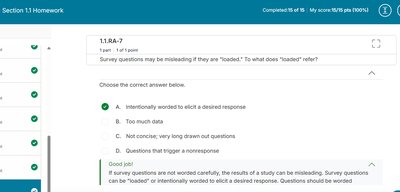
Q17. Survey questions may be misleading if they are "loaded." To what does "loaded" refer?
Background
Topic: Loaded Questions in Surveys
This question tests your understanding of how the wording of survey questions can influence responses.
Key Terms:
Loaded question: A question intentionally worded to elicit a desired response.
Step-by-Step Guidance
Recall that loaded questions are designed to influence the respondent's answer.
Identify the answer choice that describes intentional wording to get a specific response.
Eliminate options that do not relate to question wording or intent.
Try solving on your own before revealing the answer!
Final Answer: A. Intentionally worded to elicit a desired response
Loaded questions can bias survey results by influencing how people respond.
