Back
BackInverse Normal Calculations in the Normal Distribution
Study Guide - Smart Notes
 Tailored notes based on your materials, expanded with key definitions, examples, and context.
Normal Probability Distributions
Inverse Normal Calculations
The inverse normal calculation is a method used to determine the value of a variable (x or z) that corresponds to a specified area (probability) under the normal curve. This is essential for solving problems where the probability is known, but the corresponding value is unknown.
Definition: The inverse normal calculation finds the value of x or z given a probability (area) under the normal curve.
Formula: The relationship between x and z is given by: where is the mean, is the standard deviation, and is the z-score corresponding to the desired area.
Sign of z-score:
If the value is below the mean, the z-score is negative.
If the value is above the mean, the z-score is positive.
Steps for Inverse Normal Calculation:
Draw a rough normal curve and label the mean.
Determine the location of the desired value relative to the mean to find the sign of z.
Use the z-table to find the z-score corresponding to the given area.
Apply the formula to solve for the unknown value.
Examples of Inverse Normal Calculations
Several examples illustrate the application of inverse normal calculations:
Example 1: Given population mean and standard deviation , find such that .
Area to the right of is 0.95, so $a$ is to the left of the mean and z is negative.
From the z-table, (since ).
Apply the formula: .
Example 2: If the mean is 500 and standard deviation is 100, find such that 60% of the area is to the left.
Area to the left of is 0.6, so z is positive.
From the z-table, (since ).
Apply the formula: .
Example 3: For Alzheimer’s disease data (mean age 80, standard deviation 16):
Find such that :
From z-table, (since ).
.
Find such that :
From z-table, (since ).
.
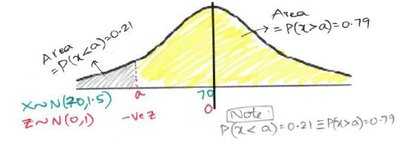
Example 4: Lifespan of palm trees (mean 70, standard deviation 1.5):
Find such that :
Area to the left is 0.21, so z is negative.
From z-table, (since ).
(rounded to 68.8).
Using the Standard Normal Table (z-table)
The z-table is used to find the area under the standard normal curve corresponding to a given z-score. It is essential for inverse normal calculations.
Purpose: To determine the probability (area) associated with a specific z-score.
Application: Used in step 3 of the inverse normal calculation to find the z-score for a given area.
Z | .00 | .01 | .02 | .03 | .04 | .05 | .06 | .07 | .08 | .09 |
|---|---|---|---|---|---|---|---|---|---|---|
0.0 | .50000 | .50399 | .50798 | .51197 | .51595 | .51994 | .52392 | .52790 | .53188 | .53586 |
0.1 | .53983 | .54380 | .54776 | .55172 | .55567 | .55962 | .56356 | .56749 | .57142 | .57535 |
0.2 | .57926 | .58317 | .58706 | .59095 | .59483 | .59871 | .60257 | .60642 | .61026 | .61409 |
0.3 | .61791 | .62172 | .62552 | .62930 | .63307 | .63683 | .64058 | .64431 | .64803 | .65173 |
0.4 | .65542 | .65910 | .66276 | .66640 | .67003 | .67364 | .67724 | .68082 | .68439 | .68793 |
0.5 | .69146 | .69497 | .69847 | .70194 | .70540 | .70884 | .71226 | .71566 | .71904 | .72240 |
0.6 | .72575 | .72907 | .73237 | .73565 | .73891 | .74215 | .74537 | .74857 | .75175 | .75490 |
0.7 | .75804 | .76115 | .76424 | .76730 | .77035 | .77337 | .77637 | .77935 | .78230 | .78524 |
0.8 | .78814 | .79103 | .79389 | .79673 | .79955 | .80234 | .80511 | .80785 | .81057 | .81327 |
0.9 | .81594 | .81859 | .82121 | .82381 | .82639 | .82894 | .83147 | .83398 | .83646 | .83891 |
1.0 | .84134 | .84375 | .84614 | .84849 | .85083 | .85314 | .85543 | .85769 | .85993 | .86214 |
1.1 | .86433 | .86650 | .86864 | .87076 | .87286 | .87493 | .87698 | .87900 | .88100 | .88298 |
1.2 | .88493 | .88686 | .88877 | .89065 | .89251 | .89435 | .89617 | .89796 | .89973 | .90147 |
1.3 | .90320 | .90490 | .90658 | .90824 | .90988 | .91149 | .91309 | .91466 | .91621 | .91774 |
1.4 | .91924 | .92073 | .92220 | .92364 | .92507 | .92647 | .92785 | .92922 | .93056 | .93189 |
1.5 | .93319 | .93448 | .93574 | .93699 | .93822 | .93943 | .94062 | .94179 | .94294 | .94408 |
1.6 | .94520 | .94630 | .94738 | .94845 | .94950 | .95053 | .95154 | .95254 | .95352 | .95449 |
1.7 | .95543 | .95637 | .95729 | .95819 | .95907 | .95994 | .96080 | .96164 | .96246 | .96327 |
1.8 | .96407 | .96485 | .96562 | .96638 | .96712 | .96784 | .96856 | .96926 | .96995 | .97062 |
1.9 | .97128 | .97193 | .97257 | .97320 | .97381 | .97441 | .97500 | .97558 | .97615 | .97670 |
2.0 | .97725 | .97778 | .97831 | .97882 | .97932 | .97982 | .98030 | .98077 | .98124 | .98169 |
Visual Representation of Inverse Normal Calculation
The following image illustrates the area under the normal curve for Example 4, showing the relationship between the mean, the value 'a', and the probability: