 Back
BackLecture 5: Probability – Foundations and Event Operations
Study Guide - Smart Notes
 Tailored notes based on your materials, expanded with key definitions, examples, and context.
Probability: Concepts and Foundations
Overview of Probability
Probability is a fundamental concept in statistics, representing the measure or estimation of the likelihood that a particular event will occur. Probabilities are assigned values between 0 (impossible event) and 1 (certain event), and are used to quantify uncertainty in experiments and real-world situations.
Probability: A numerical value expressing the chance of occurrence of an event.
Range: 0 ≤ Probability ≤ 1.
Application: Used in fields such as gaming, marketing, genetics, and more.
Quote: “The theory of probabilities is basically only common sense reduced to a calculus” – Pierre Laplace (1814)
Key Terminology
Understanding probability requires familiarity with several key terms:
Experiment: Any action or process that generates observations (e.g., rolling a die).
Outcome: The result of a single trial of an experiment (e.g., rolling a 4).
Sample Space (S): The set of all possible outcomes of the experiment (e.g., S = {1, 2, 3, 4, 5, 6} for a fair die).
Event: A collection of one or more outcomes (e.g., Event A = {2, 4, 6}, rolling an even number).
Probability of Event E: Denoted as P(E), the likelihood that event E occurs.
Approaches to Assigning Probabilities
There are three main approaches to assigning probabilities to events:
Classical Approach: Assumes all outcomes are equally likely. Probability of each outcome is , where k is the number of possible outcomes.
Subjective Approach: Probabilities are assigned based on expert opinion or personal judgment.
Relative Frequency (Frequentist) Approach: Probability is estimated by performing n identical experiments and observing the frequency of the outcome.
Formula:
Examples
Video Game Playability: 80 gamers test a game; 65 say it is playable. Probability that the game is playable:
Commuter Traffic Lights: Sample space for 3 intersections (stop or continue): S = {sss, ssc, scs, scc, css, csc, ccs, ccc}
Birthday Month: Sample space is the set of 12 months.
Calculating Probability
Classical Probability Formula
When all outcomes are equally likely, the probability of an event E is:
Example: Probability that a family with two children has at least one girl.
Example: Probability of winning the lottery (matching 6 numbers from 47):
Event Operations
Complement of an Event
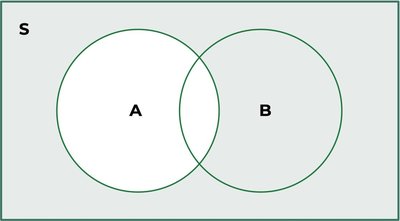
The complement of event A, denoted by A' or Ac, is the set of all outcomes not in A. The probability of the complement is:
Interpretation: Probability that A does not occur.
Union of Events
The union of events A and B, denoted by A ∪ B, is the set of all outcomes that are in A or B (or both).
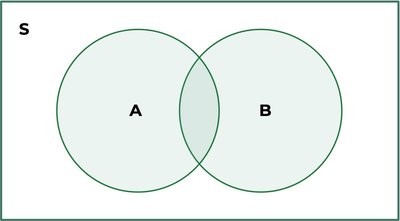
Formula:
Mutually Exclusive Events: If A and B are mutually exclusive (no overlap),
Intersection of Events
The intersection of events A and B, denoted by A ∩ B, is the set of all outcomes that are in both A and B.
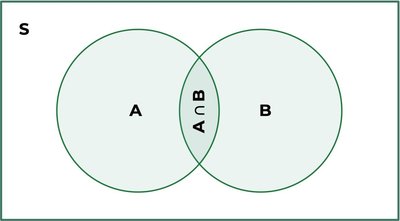
Mutually Exclusive Events: A ∩ B = ∅ (no outcomes in common).
Examples of Event Operations
Blood Type Example: In Ireland, 55% have blood type O, 3% have AB. Probability of O or AB: (since O and AB are mutually exclusive).
Marketing Campaign Example: 40% received email coupon, 30% saw social media ad, 15% saw both. Probability of at least one promotion:
Summary of Probability Rules
Probability is a measure of likelihood of occurrence of an event.
Sample space (S): Set of all possible outcomes.
Complement:
Union:
Mutually Exclusive:
Additional info: The next lecture will cover how to compute , which is essential for understanding dependent and independent events.
