 Back
BackNormal Distribution and Sampling Distribution of Means
Study Guide - Smart Notes
 Tailored notes based on your materials, expanded with key definitions, examples, and context.
Normal Distribution and Sampling Distribution of Means
Probability Density Function
A probability density function (PDF) is a function used to compute probabilities for continuous random variables. It must satisfy two properties:
The graph of the function must lie on or above the horizontal axis.
The total area under the graph must be 1.
This ensures that the PDF represents a valid probability distribution for continuous data.
Normal Distribution
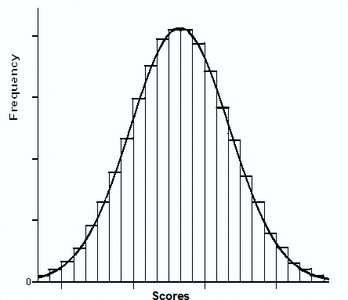
The normal distribution is a continuous probability distribution characterized by its bell-shaped, symmetric curve. It is also known as the Gaussian distribution, named after Carl Gauss, and is widely used to model natural phenomena.
The normal distribution is defined for all real numbers: .
It is described by two parameters: the mean () and the standard deviation ().
The notation for a normal distribution is or .
Example: or .
Features of the Normal Curve
The normal curve has several important features:
It is bell-shaped and symmetric about the mean ().
The mean, median, and mode are all equal and located at the center of the distribution.
The curve approaches, but never touches, the horizontal axis.
As the standard deviation () increases, the curve becomes wider and flatter; as $\sigma$ decreases, the curve becomes narrower and more peaked.
Normal Distribution Function
The probability density function for the normal distribution is given by:
is the population mean.
is the population standard deviation.
This function describes the likelihood of a random variable taking a particular value in a normal distribution.
Normal Probability and Area Under the Curve
The area under the normal curve within a given interval represents the probability that a measurement will fall within that interval. The total area under the curve is 1, meaning:
50% of the data lies to the left of the mean ().
50% of the data lies to the right of the mean ().
Ways to Identify Normality in Data
There are several methods to determine if a dataset is approximately normal:
Histogram: A normal distribution's histogram should be roughly bell-shaped.
Outliers: A normal distribution should have no more than one outlier.
Quantile-Quantile (QQ) Plot: If the data points lie close to a straight line, the data is approximately normal.
Empirical Rule (68-95-99.7 Rule)
The empirical rule describes how data is distributed in a normal distribution:
About 68% of the data falls within one standard deviation of the mean ().
About 95% of the data falls within two standard deviations of the mean ().
About 99.7% of the data falls within three standard deviations of the mean ().
This rule is useful for quickly estimating probabilities and identifying outliers in normally distributed data.
