 Back
BackNormal Probability Distributions: Study Guide
Study Guide - Smart Notes
 Tailored notes based on your materials, expanded with key definitions, examples, and context.
Normal Probability Distributions
Introduction to Normal Distributions and the Standard Normal Distribution
The normal distribution is a fundamental concept in statistics, describing how data values are distributed in many natural and social phenomena. Understanding its properties and applications is essential for statistical analysis.
Continuous Random Variable: A variable that can take any value within an interval, such as time spent studying between 0 and 24 hours.
Continuous Probability Distribution: The probability distribution for a continuous random variable, often represented by a probability density function (pdf).
Normal Distribution: A continuous probability distribution for a random variable, x, with a characteristic bell-shaped curve.
Normal Curve: The graphical representation of a normal distribution.
Properties of a Normal Distribution
The normal distribution has several key properties that make it useful for statistical inference and modeling.
Mean, Median, and Mode: All are equal in a normal distribution.
Shape: The curve is bell-shaped and symmetric about the mean.
Total Area: The area under the curve equals 1, representing the total probability.
Asymptotic: The curve approaches but never touches the x-axis as it extends away from the mean.
Inflection Points: Points where the curve changes from curving upward to downward, marking the transition in the distribution's spread.
Probability Density Function (PDF)
A probability density function describes the likelihood of a continuous random variable taking on a particular value. For a normal distribution, the PDF must satisfy:
The total area under the curve is 1.
The function is never negative.
Means and Standard Deviations
The mean and standard deviation are parameters that define the location and spread of a normal distribution.
Mean (\( \mu \)): Determines the center and line of symmetry of the distribution.
Standard Deviation (\( \sigma \)): Measures the spread or dispersion of the data.
Example: Comparing Means and Standard Deviations
Greater Mean: The curve with its line of symmetry at a higher value (e.g., x = 15 vs. x = 12) has the greater mean.
Greater Standard Deviation: The curve that is more spread out has the greater standard deviation.
Interpreting Graphs of Normal Distributions
Normal distributions are often used to model test scores and other real-world data. The mean and standard deviation can be estimated from the graph.
Example: Scaled test scores for a mathematics test are normally distributed with a mean of about 450 and a standard deviation of about 27.
Empirical Rule: Approximately 68% of values fall within one standard deviation, 95% within two, and 99.7% within three standard deviations from the mean.
The Standard Normal Distribution
The standard normal distribution is a special case of the normal distribution with a mean of 0 and a standard deviation of 1. It is used to standardize values and calculate probabilities.
Standard Normal Distribution: Mean = 0, Standard Deviation = 1.
z-score: Any value x can be transformed into a z-score using the formula:
The total area under the standard normal curve is 1.
Properties of the Standard Normal Distribution
The cumulative area under the standard normal curve represents the probability that a value is less than a given z-score.
Cumulative area is close to 0 for z-scores near -3.49.
Cumulative area increases as z-scores increase.
Cumulative area for z = 0 is 0.5000.
Cumulative area is close to 1 for z-scores near 3.49.
Using the Standard Normal Table
The Standard Normal Table provides cumulative areas (probabilities) for z-scores. It is used to find probabilities associated with normal distributions.
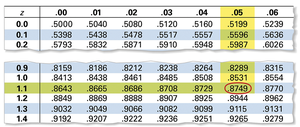
Finding Cumulative Area: Locate the z-score in the table and read the corresponding area.
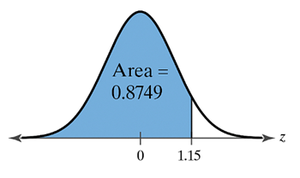
Example: For z = 1.15, the cumulative area is 0.8749.
Finding Areas Under the Standard Normal Curve
Areas under the standard normal curve correspond to probabilities. There are three main cases:
Area to the Left of z: Find the area in the Standard Normal Table for z.
Area to the Right of z: Subtract the area to the left of z from 1.
Area Between Two z-scores: Find the areas for both z-scores and subtract the smaller from the larger.
Examples
Area to the Left: For a given z, the area is found directly in the table (e.g., area = 0.1611).
Area to the Right: For z = 1.06, area = 1 - 0.8554 = 0.1446.
Area Between Two z-scores: Subtract the area for the lower z-score from the area for the higher z-score (e.g., area = 0.8276).
Summary Table: Properties of Normal and Standard Normal Distributions
Property | Normal Distribution | Standard Normal Distribution |
|---|---|---|
Mean | Any value (\( \mu \)) | 0 |
Standard Deviation | Any positive value (\( \sigma \)) | 1 |
Shape | Bell-shaped, symmetric | Bell-shaped, symmetric |
Total Area | 1 | 1 |
z-score Formula | N/A (already standardized) |
Additional info: The Empirical Rule is a useful guideline for interpreting normal distributions: 68% of data falls within one standard deviation, 95% within two, and 99.7% within three standard deviations from the mean.
