 Back
Permutations, Combinations, and Discrete Probability Distributions
Study Guide - Smart Notes
 Tailored notes based on your materials, expanded with key definitions, examples, and context.
Permutations and Combinations
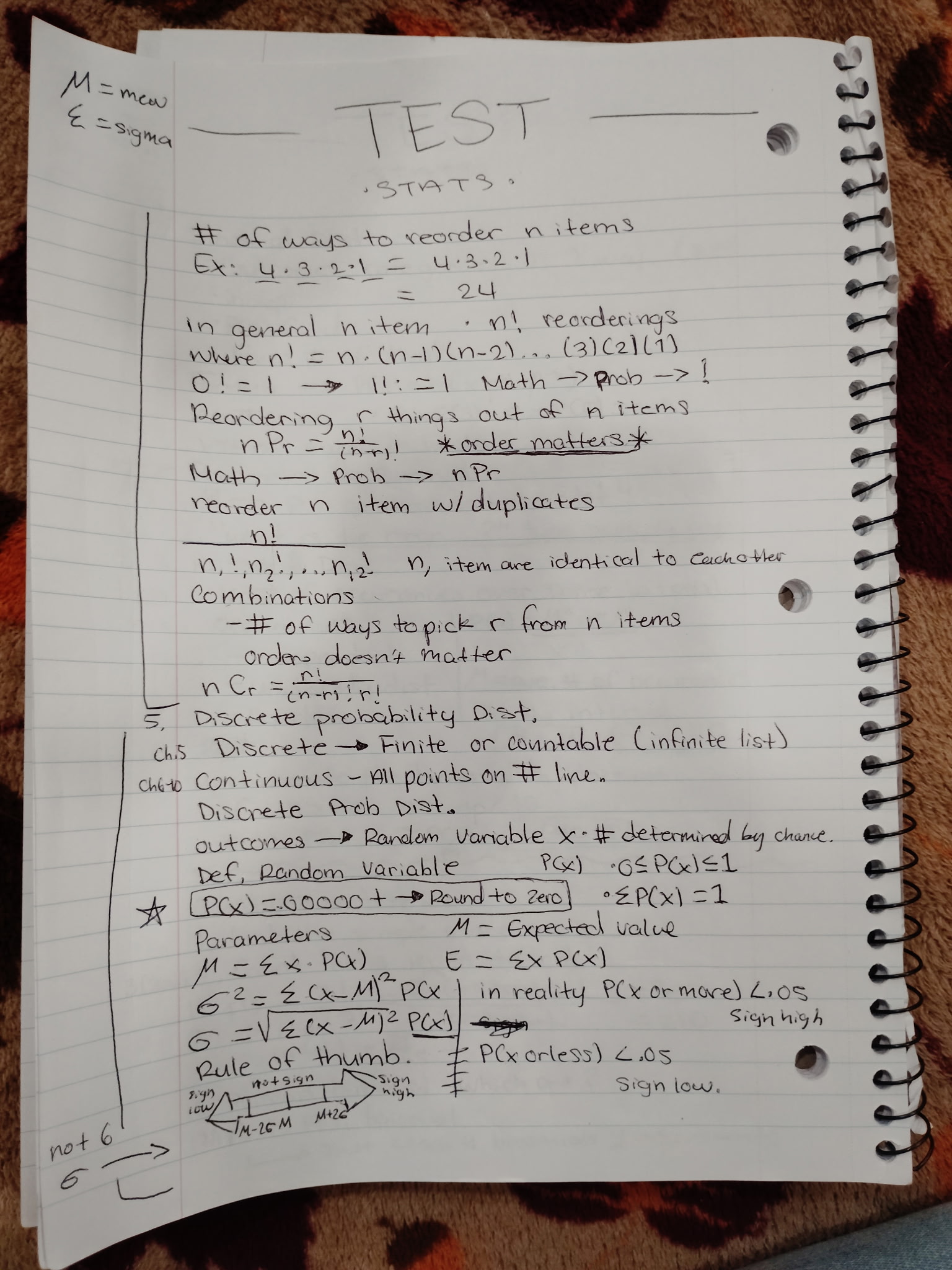
Permutations: Counting Ordered Arrangements
Permutations are used to count the number of ways to arrange a set of items where the order matters. This is a fundamental concept in probability and combinatorics.
Definition: The number of ways to reorder n items is n! (n factorial).
Formula:
Example: The number of ways to arrange 4 items:
Partial Permutations: The number of ways to reorder r things out of n items (order matters):
Permutations with Duplicates: If some items are identical, divide by the factorial of the number of identical items:
Combinations: Counting Unordered Selections
Combinations are used to count the number of ways to select items from a group where the order does not matter.
Definition: The number of ways to pick r items from n items (order does not matter):
Key Point: Use combinations when the arrangement of selected items is not important.
Discrete Probability Distributions
Discrete vs. Continuous Probability Distributions
Probability distributions describe how probabilities are assigned to values of a random variable.
Discrete Probability Distribution: The variable can take on a finite or countable (possibly infinite) list of values.
Continuous Probability Distribution: The variable can take on any value along a number line (all points in an interval).
Random Variables
A random variable is a variable whose value is determined by the outcome of a random experiment.
Notation: Random variable is usually denoted by X.
Probability Function: gives the probability that the random variable takes the value x.
Properties:
for all x
(the probabilities sum to 1)
Parameters of Discrete Probability Distributions
Key parameters describe the center and spread of a probability distribution.
Expected Value (Mean):
Variance:
Standard Deviation:
Probability Rules and Interpretation
Rule of Thumb: If , the event is considered unlikely ("sign low").
If , the event is also considered unlikely ("sign high").
Summary Table: Permutations vs. Combinations
Concept | Order Matters? | Formula | Example |
|---|---|---|---|
Permutation | Yes | Arranging 3 books out of 5 on a shelf | |
Combination | No | Selecting 3 students from a group of 5 |
Summary Table: Discrete vs. Continuous Probability Distributions
Type | Description | Examples |
|---|---|---|
Discrete | Finite or countable outcomes | Number of heads in 10 coin tosses |
Continuous | All points on a number line | Heights of students in a class |
Additional info: The notes reference 'sign low' and 'sign high' as informal terms for interpreting probabilities less than 0.05 as statistically significant or unlikely events. The formulas for mean, variance, and standard deviation are standard for discrete probability distributions.
