 Back
BackPermutations, Combinations, and the Counting Principle: Study Notes for Probability
Study Guide - Smart Notes
 Tailored notes based on your materials, expanded with key definitions, examples, and context.
Unit 5: Probability
The Counting Principle
The Counting Principle (also known as the Fundamental Principle of Counting) is a foundational concept in probability and combinatorics. It states that if there are a possible outcomes for one event and b possible outcomes for another event, the total number of outcomes for both events is the product a × b. This principle can be extended to more than two events.
Definition: If an experiment consists of a sequence of events, and each event has a fixed number of possible outcomes, multiply the number of outcomes for each event to get the total number of possible outcomes.
Example: A couple plans on having 4 children. Each child can be either a boy or a girl, so there are 2 possible outcomes per child. The total number of possible girl/boy outcomes is .
Example: You take an "Always", "Sometimes", and "Never" quiz in Calculus with 8 questions. Each question has 3 possible answers, so the total number of ways to answer the quiz is .
Example: At McDonald's, there are 31 sandwich options, 3 sizes of fries, and 3 sizes of drinks. The total number of meal combinations is .
Permutations
Permutations are arrangements of objects where order matters. The number of ways to arrange n distinct objects, taken r at a time, is given by the permutation formula. This is especially important when no repeats are allowed.
Definition: A permutation is an ordered arrangement of objects.
Factorial: The notation n! (read "n factorial") means the product of all positive integers up to n. For example, .
Special Cases: and by definition.
Permutation Formula: The number of permutations of n objects taken r at a time is:
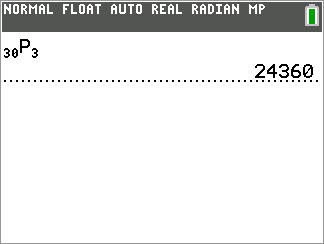
Example: In a PE class of 30 students, the number of ways to award 1st, 2nd, and 3rd place (order matters) is:
Example: Creating a 4-digit pin using 10 digits, with no repeats:
Example: Creating a 4-digit pin using 10 digits, with repeats allowed:
Example: A librarian chooses 5 books from 20 to place in a specific order:
Example: Creating an 8-digit password using lowercase letters and digits, with no repeats: (since there are 26 letters + 10 digits = 36 characters)
Combinations
Combinations are selections of objects where order does not matter. The number of ways to choose r objects from n distinct objects is given by the combination formula.
Definition: A combination is a selection of objects where the order is irrelevant.
Combination Formula: The number of combinations of n objects taken r at a time is:
Example: Selecting a jury of 12 from 30 people:
Example: Volleyball tryouts: 18 girls, 12 spots:
Example: Flight standby: 12 people, 3 seats:
Example: Ice cream shop: 4 types of cones (choose 1), 20 types of ice cream (choose 3), 5 types of toppings (choose 2): Total combinations =
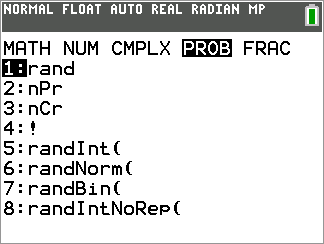
Calculator Commands for Permutations and Combinations
Modern calculators provide built-in functions for calculating permutations and combinations. These are typically found under the "PROB" (Probability) menu.
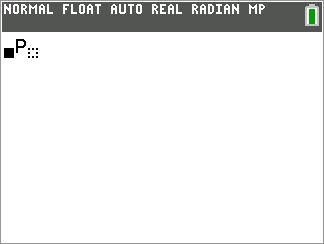
nPr: Calculates the number of permutations.
nCr: Calculates the number of combinations.
! (Factorial): Calculates the factorial of a number.
Usage: Enter values for n and r to compute the desired result.
Summary Table: Permutations vs. Combinations
Type | Order Matters? | Formula | Example |
|---|---|---|---|
Permutation | Yes | Arranging 3 students out of 30 for 1st, 2nd, 3rd place | |
Combination | No | Selecting 3 students out of 30 for a team |
Additional info: The notes above expand on brief points and fill in missing context for definitions, examples, and calculator usage. The images included are directly relevant, showing calculator menus and results for permutation calculations.
