 Back
BackPrecalculus Foundations: Sets, Numbers, and Functions
Study Guide - Smart Notes
 Tailored notes based on your materials, expanded with key definitions, examples, and context.
Introduction to Sets and Numbers
Classification of Numbers
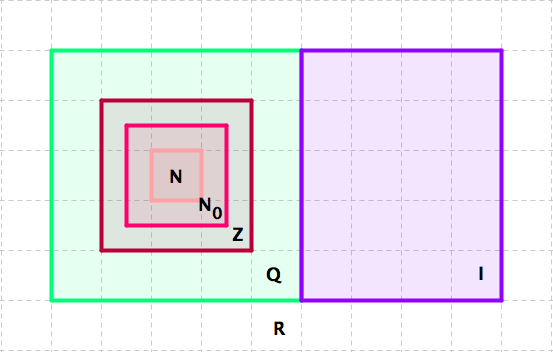
Understanding the different types of numbers and their relationships is foundational in mathematics. The main sets of numbers are:
Natural Numbers (N): The counting numbers, N = {1, 2, 3, ...}
Whole Numbers (N0): Natural numbers including zero, N0 = {0, 1, 2, 3, ...}
Integers (Z): All positive and negative whole numbers, including zero, Z = {..., -3, -2, -1, 0, 1, 2, 3, ...}
Rational Numbers (Q): Numbers that can be expressed as a fraction p/q where p and q are integers and q ≠ 0
Irrational Numbers (I): Numbers that cannot be written as a ratio of two integers (e.g., √2, π)
Real Numbers (R): All rational and irrational numbers
Key Properties:
Every natural number is a whole number, every whole number is an integer, every integer is a rational number, and every rational and irrational number is a real number.
Rational and irrational numbers are disjoint sets: Q ∩ I = ∅.
The set of real numbers is the union of rational and irrational numbers: R = Q ∪ I.
Variables and Mathematical Objects
What is a Variable?
A variable is a symbol or object that represents elements of a certain set. For example, in mathematics, x can represent any real number, while in real life, a passport can represent a Canadian citizen.

Intervals and Inequalities
Interval Notation
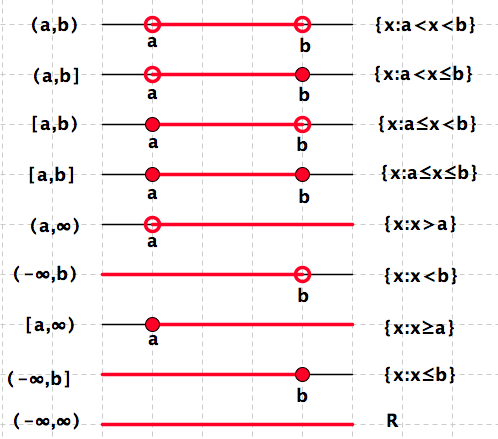
Intervals are used to describe sets of numbers between two endpoints. The notation and corresponding set-builder forms are:
Interval | Set-Builder Notation |
|---|---|
(a, b) | {x : a < x < b} |
(a, b] | {x : a < x ≤ b} |
[a, b) | {x : a ≤ x < b} |
[a, b] | {x : a ≤ x ≤ b} |
(a, ∞) | {x : x > a} |
(−∞, b) | {x : x < b} |
[a, ∞) | {x : x ≥ a} |
(−∞, b] | {x : x ≤ b} |
(−∞, ∞) | ℝ |
Functions: Definitions and Examples
What is a Function?
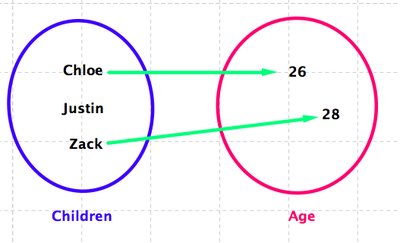
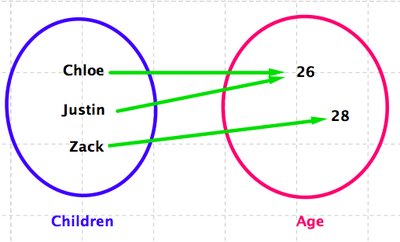
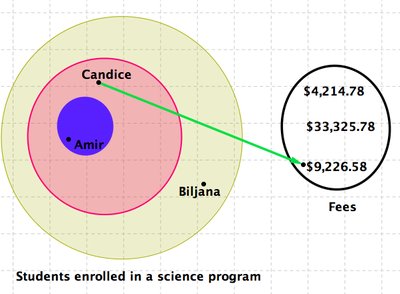
A function is a rule that assigns to each element in a set A exactly one element in a set B. This concept is crucial for avoiding ambiguity in mathematical relationships.
Example: Assigning each child to their unique age is a function, but assigning a person to a city (if there are multiple cities with the same name) may not be.
Function Notation and Representation
Notation: If f is a function from set A to set B, we write f: A → B.
Domain: The set A (inputs for the function)
Range: The set of all possible outputs f(x) as x varies over the domain
Example: f(x) = x^2 for x ∈ {−2, −1, 0, 1, 2}
Piecewise Defined Functions
Some functions are defined by different expressions over different parts of their domain. These are called piecewise defined functions.
Example: The total annual fee for students in a science program depends on their residency status, with different formulas for Quebec residents, other Canadian residents, and international students.
Summary Table: Number Sets
Set | Definition | Example Elements |
|---|---|---|
Natural Numbers (N) | Counting numbers | 1, 2, 3, ... |
Whole Numbers (N0) | Natural numbers + 0 | 0, 1, 2, ... |
Integers (Z) | Positive and negative whole numbers | ..., -2, -1, 0, 1, 2, ... |
Rational Numbers (Q) | Numbers as fractions | 1/2, -3/4, 5 |
Irrational Numbers (I) | Not expressible as fractions | √2, π |
Real Numbers (R) | All rational and irrational numbers | All above |
