 Back
BackProbability and Probability Distributions: Core Concepts for Statistics
Study Guide - Smart Notes
 Tailored notes based on your materials, expanded with key definitions, examples, and context.
Probability and Probability Distributions
Basic Definitions of Probability
Probability theory is fundamental in statistics and decision-making, especially in business and finance. It quantifies uncertainty and helps managers make informed decisions under risk. Probability is used to analyze sales trends, customer behavior, inventory levels, and more.
Probability: A numerical measure (between 0 and 1) of the likelihood that an event will occur.
Experiment: Any process of observation or measurement that generates well-defined outcomes (e.g., tossing a coin, rolling a die).
Sample Space (S): The set of all possible outcomes of an experiment.
Event: A subset of the sample space; a statement about one or more outcomes.
Outcome: The result of a single trial of an experiment.
Example: Rolling a die: S = {1,2,3,4,5,6}. Event A (odd numbers) = {1,3,5}.
Key Probability Concepts
Equally Likely Events: Events with the same chance of occurring.
Mutually Exclusive Events: Events that cannot occur simultaneously.
Complement of an Event (A'): All outcomes in the sample space not in event A.
Elementary Event: An event with only one outcome.
Compound Event: An event with more than one outcome.
Intersection (A ∩ B): Outcomes common to both events A and B.
Union (A ∪ B): Outcomes in A, B, or both.
Independent Events: The occurrence of one does not affect the probability of the other.
Dependent Events: The occurrence of one affects the probability of the other.
Approaches to Measuring Probability
Classical Approach: Used when all outcomes are equally likely. , where n(A) is the number of favorable outcomes and N is the total number of outcomes.
Relative Frequency Approach: Probability is the long-run proportion of times an event occurs in repeated trials.
Axiomatic Approach: Probability is defined by axioms:
If A and B are mutually exclusive:
General addition rule:
Subjective Approach: Probability is based on personal judgment or prior knowledge.
Conditional Probability and Independence
Conditional probability measures the likelihood of event A given that event B has occurred:
, provided
For independent events:
Example: If , , , then A and B are independent because .
Random Variables and Probability Distributions
Random Variables
A random variable assigns a real number to each outcome in the sample space. There are two types:
Discrete Random Variable: Takes countable values (e.g., number of customers).
Continuous Random Variable: Takes any value within an interval (e.g., time, height).
Probability Distributions
Discrete Probability Distribution: Lists all possible values of a discrete random variable and their probabilities.
Continuous Probability Distribution: Described by a probability density function (pdf) , where:
for all x
Expectation and Variance
Expected Value (Mean):
Discrete:
Continuous:
Variance:
Discrete:
Continuous:
Common Discrete Probability Distributions
Binomial Distribution
The binomial distribution models the number of successes in n independent trials, each with probability p of success.
Probability mass function: , for
Mean:
Variance:
Example: Probability of 3 successes in 10 trials with :
Poisson Distribution
The Poisson distribution models the number of events in a fixed interval of time or space, given the average rate λ.
Probability mass function: , for
Mean and Variance:
Example: Probability of 1 customer arriving in a minute when λ = 4:
Common Continuous Probability Distributions
Normal Distribution
The normal distribution is a continuous, symmetric, bell-shaped distribution defined by its mean (μ) and standard deviation (σ):
Probability density function:
Total area under the curve is 1.
Mean = Median = Mode = μ
Standardization: , where Z follows the standard normal distribution
Probabilities are found using the area under the curve between two points, often with the help of Z-tables.
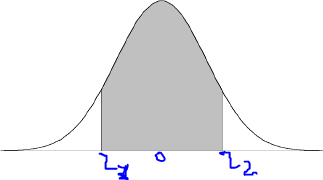
Example: Probability that Z is between z1 and z2 is the shaded area under the curve between those points.
Properties of the Standard Normal Distribution
Mean = 0, Standard deviation = 1
Symmetrical about the mean
Area to the left of Z = 0 is 0.5
Probabilities for any interval can be found using standard normal tables
Applications of the Normal Distribution
Finding probabilities for intervals (e.g., )
Calculating probabilities for real-world scenarios (e.g., investment returns, heights, test scores)
Standardizing values to compare different normal distributions
Example: If returns are normally distributed with mean 10% and standard deviation 5%, the probability of a negative return is .
