 Back
BackProbability and Statistics Study Guidance – Ch. 3
Study Guide - Smart Notes
 Tailored notes based on your materials, expanded with key definitions, examples, and context.
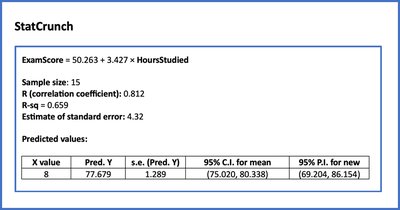
Q1. What is the predicted exam score for a student who studied for 8 hours?
Background
Topic: Simple Linear Regression
This question tests your ability to use a regression equation to predict an outcome (exam score) based on an explanatory variable (hours studied).
Key Terms and Formulas
Regression Equation:
Predicted Value (): The value calculated from the regression equation for a given input.
Step-by-Step Guidance
Identify the regression equation and the value for HoursStudied: , with .
Substitute 8 for HoursStudied in the equation: .
Calculate to find the contribution from hours studied.
Add this value to 50.263 to get the predicted exam score.
Try solving on your own before revealing the answer!
Final Answer: 77.679
The regression equation predicts an exam score of 77.679 for a student who studied 8 hours.
Q2. What is the sample space and number of possible outcomes for a computer program that randomly generates a digit from 0 to 9?
Background
Topic: Basic Probability – Sample Space
This question tests your understanding of sample spaces and counting possible outcomes in a random experiment.
Key Terms and Formulas
Sample Space (): The set of all possible outcomes.
Number of Outcomes: The count of elements in the sample space.
Step-by-Step Guidance
List all possible digits the program can generate: 0, 1, 2, ..., 9.
Write the sample space as a set: .
Count the number of elements in the set to determine the number of possible outcomes.
Try solving on your own before revealing the answer!
Final Answer: Sample space is {0, 1, 2, 3, 4, 5, 6, 7, 8, 9}; Number of possible outcomes is 10.
There are 10 possible outcomes, one for each digit from 0 to 9.
Q3. Are the events "being a nurse" and "having completed advanced training" independent?
Background
Topic: Probability – Independence of Events
This question tests your ability to determine whether two events are independent using probability concepts.
Key Terms and Formulas
Independent Events: Two events A and B are independent if .
Conditional Probability:
Step-by-Step Guidance
Find the total number of nurses and doctors: 3,200 nurses and 1,800 doctors.
Find the number of nurses and doctors who completed advanced training: 480 nurses and 720 doctors.
Calculate the probability of being a nurse: .
Calculate the probability of having completed advanced training: .
Calculate the probability of being a nurse and having completed advanced training: .
Compare to to check independence.
Try solving on your own before revealing the answer!
Final Answer: No, the events are not independent.
The calculated probabilities do not satisfy the independence condition.
Q4. What is the probability that all four items are non-defective if the probability that an item is defective is 0.474?
Background
Topic: Probability – Complements and Multiplication Rule
This question tests your ability to use the complement rule and multiplication rule for independent events.
Key Terms and Formulas
Complement Rule:
Multiplication Rule for Independent Events:
Step-by-Step Guidance
Find the probability that an item is non-defective: .
Since the items are selected randomly and independently, raise the probability to the fourth power: .
Calculate the value of .
Set up the expression for .
Try solving on your own before revealing the answer!
Final Answer: 0.0765
The probability that all four items are non-defective is 0.0765.
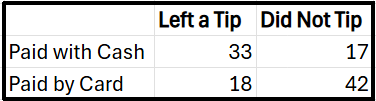
Q5. What is the probability that a customer did not tip, given that the customer paid by card?
Background
Topic: Conditional Probability
This question tests your ability to calculate conditional probabilities using a contingency table.
Key Terms and Formulas
Conditional Probability:
"Did Not Tip" given "Paid by Card":
Step-by-Step Guidance
Identify the number of customers who paid by card: .
Identify the number of customers who did not tip and paid by card: $42$.
Set up the conditional probability formula: .
Simplify the fraction to get the probability.
Try solving on your own before revealing the answer!
Final Answer: 0.70
70% of customers who paid by card did not tip.
Q6. If the probability that event E will not occur is 0.86, what is the probability that event E will occur?
Background
Topic: Probability – Complements
This question tests your understanding of the complement rule in probability.
Key Terms and Formulas
Complement Rule:
Step-by-Step Guidance
Identify the probability that event E will not occur: .
Use the complement rule: .
Set up the calculation for .
Try solving on your own before revealing the answer!
Final Answer: 0.14
The probability that event E will occur is 0.14.
Q7. What is the probability that a randomly selected student either sped regularly or used a phone while biking, but not both?
Background
Topic: Probability – Addition Rule (Excluding Overlap)
This question tests your ability to use the addition rule for probabilities, excluding the overlap (students who did both).
Key Terms and Formulas
Addition Rule:
Probability of "either but not both":
Step-by-Step Guidance
Identify the total number of students: $800$.
Identify the number who sped regularly: $280; did both: $60$.
Calculate the probability for each group: , , .
Apply the formula for "either but not both": .
Set up the calculation for the probability.
Try solving on your own before revealing the answer!
Final Answer: 0.4375
The probability is 0.4375 for a student who either sped regularly or used a phone while biking, but not both.
Q8. If the probability of event A is 0.2 and the probability of event B is 0.3, what is the probability of either event A or event B occurring if they are mutually exclusive?
Background
Topic: Probability – Addition Rule for Mutually Exclusive Events
This question tests your understanding of the addition rule for mutually exclusive events.
Key Terms and Formulas
Mutually Exclusive Events: Events that cannot occur at the same time.
Addition Rule: for mutually exclusive events.
Step-by-Step Guidance
Identify the probabilities: , .
Since the events are mutually exclusive, use the addition rule: .
Set up the calculation for .
Try solving on your own before revealing the answer!
Final Answer: 0.5
The probability of either event A or event B occurring is 0.5.
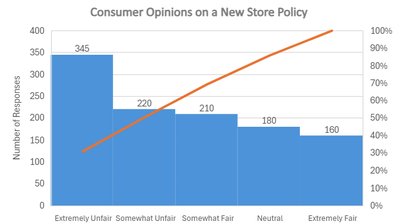
Q9. What is the probability of selecting a shopper who believes the policy is extremely unfair?
Background
Topic: Probability – Empirical Probability from Frequency Data
This question tests your ability to calculate probability from frequency data (Pareto chart).
Key Terms and Formulas
Empirical Probability:
Step-by-Step Guidance
Identify the number of shoppers who believe the policy is extremely unfair: $345$.
Identify the total number of shoppers surveyed: $1115$.
Set up the probability formula: .
Simplify the fraction to get the probability.
Try solving on your own before revealing the answer!
Final Answer: 0.31
The probability is 0.31 for selecting a shopper who believes the policy is extremely unfair.
