 Back
BackProbability and the Addition Rule: Mutually Exclusive Events
Study Guide - Smart Notes
 Tailored notes based on your materials, expanded with key definitions, examples, and context.
Probability
The Addition Rule and Mutually Exclusive Events
The concept of probability is fundamental in statistics, allowing us to quantify the likelihood of events occurring. This section focuses on the Addition Rule for probability and the identification of mutually exclusive events, which are essential for calculating probabilities of combined events.
Mutually Exclusive Events
Definition: Two events A and B are mutually exclusive if they cannot occur at the same time. That is, they have no outcomes in common.
Example: Rolling a 3 and rolling a 4 on a single die are mutually exclusive events, since a single roll cannot result in both outcomes.
Non-Mutually Exclusive Events: Events that can occur together, such as selecting a male student and selecting a nursing major, are not mutually exclusive because a student can be both.
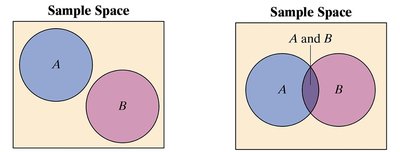
Recognizing Mutually Exclusive Events
Example 1: Roll a 3 on a die (Event A) and roll a 4 on a die (Event B). These are mutually exclusive.
Example 2: Select a male student (Event A) and select a nursing major (Event B). These are not mutually exclusive.
Example 3: Select a blood donor with type O blood (Event A) and select a female blood donor (Event B). These are not mutually exclusive.
The Addition Rule for Probability
The Addition Rule allows us to find the probability that at least one of two events occurs. The rule differs depending on whether the events are mutually exclusive.
General Addition Rule: For any two events A and B:
Mutually Exclusive Events: If A and B are mutually exclusive:
Extension: This rule can be extended to any number of mutually exclusive events.
Examples of the Addition Rule
Example 1: Selecting a card from a standard deck. Find the probability that the card is a 4 or an ace.
There are 4 cards of each type in a deck of 52 cards.
Events are mutually exclusive.
Calculation:
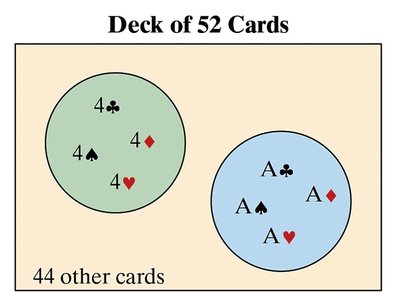
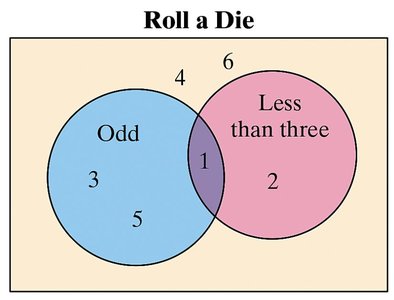
Example 2: Rolling a die. Find the probability of rolling a number less than 3 or rolling an odd number.
Events are not mutually exclusive (1 is both less than 3 and odd).
Sample space: S = {1, 2, 3, 4, 5, 6}
E = less than 3 = {1, 2}; F = odd number = {1, 3, 5}; E and F = {1}
Calculation:
Application: Probability from Frequency Distributions
Probability can also be calculated using frequency distributions, which summarize the number of occurrences of different outcomes.
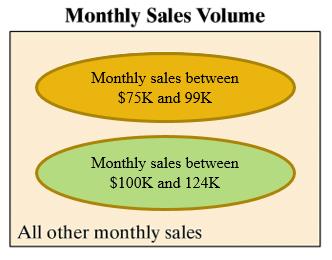
Example: Monthly sales volumes and number of months at each sales level.
Find the probability that the sales representative will sell between $75K and $124K next month.
Events: A = sales between $75K and $99K (7 months), B = sales between $100K and $124K (9 months). Mutually exclusive.
Calculation:
Application: Probability from Categorical Data Tables
Probability can be determined from categorical data tables, such as blood type distributions.
Example 1: Find the probability a donor has type O or type A blood.
Type O: 184 donors; Type A: 164 donors; Total: 409 donors.
Events are mutually exclusive.
Calculation:
Example 2: Find the probability a donor has type B or is Rh-negative.
Type B: 45 donors; Rh-negative: 65 donors; Type B and Rh-negative: 8 donors; Total: 409 donors.
Events are not mutually exclusive.
Calculation:
Summary Table: Addition Rule for Probability
Type of Events | Addition Rule Formula | Example |
|---|---|---|
Mutually Exclusive | Card is a 4 or an ace | |
Not Mutually Exclusive | Roll less than 3 or odd number |
