 Back
BackProbability Concepts and Discrete Probability Distributions: Study Notes
Study Guide - Smart Notes
 Tailored notes based on your materials, expanded with key definitions, examples, and context.
Probability Concepts
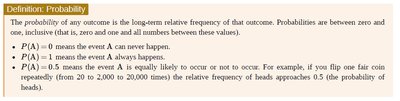
Definition of Probability
Probability quantifies the likelihood of an event occurring, expressed as a value between 0 and 1. It is interpreted as the long-term relative frequency of an outcome after many repetitions of an experiment.
P(A) = 0: Event A can never happen.
P(A) = 1: Event A always happens.
P(A) = 0.5: Event A is equally likely to occur or not occur (e.g., flipping a fair coin).
Random Variables
A random variable is a numerical value associated with each outcome of a probability experiment. Random variables can be:
Discrete: Take on a finite or countable number of values (e.g., number of heads in coin tosses).
Continuous: Take on an uncountable number of values, typically intervals on the real number line (e.g., height, weight).
Discrete Probability Distributions
Definition and Properties
A discrete probability distribution lists all possible values of a discrete random variable and the probability associated with each value. The distribution must satisfy:
For each value x,
The sum of all probabilities is 1:
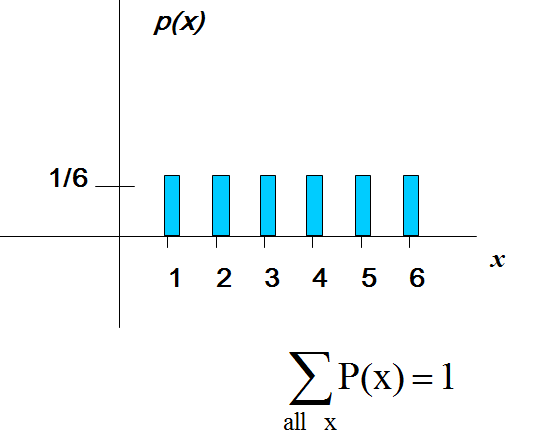
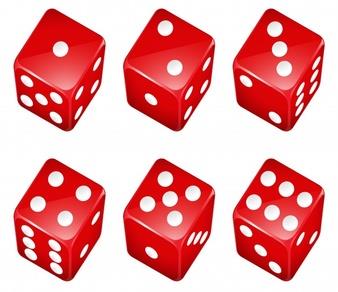
Example: Rolling a fair six-sided die. Each outcome (1 through 6) has probability .
Sample Space and Events
The sample space is the set of all possible outcomes of an experiment. An event is a subset of the sample space.
Simple event: Contains only one outcome.
Compound event: Contains more than one outcome.
Mutually Exclusive and Collectively Exhaustive Events
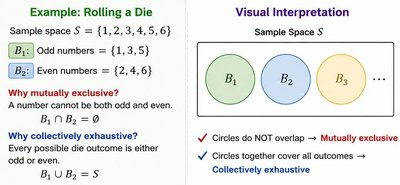
Events are mutually exclusive if they cannot occur at the same time (no overlap). Events are collectively exhaustive if together they include all possible outcomes in the sample space.
Example: When rolling a die, the events "odd" and "even" are mutually exclusive and collectively exhaustive.

Calculating Probabilities
Simple (Marginal) Probability
The probability of a single event occurring is called the marginal probability. For equally likely outcomes:
Joint Probability
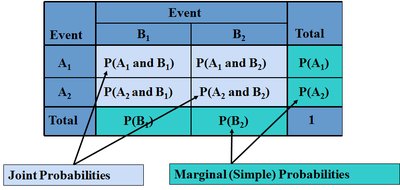
The probability that two events A and B both occur is the joint probability:

Contingency Tables
Contingency tables organize data to show the frequency or probability of combinations of events. They help compute joint and marginal probabilities.
Conditional Probability
Definition and Calculation
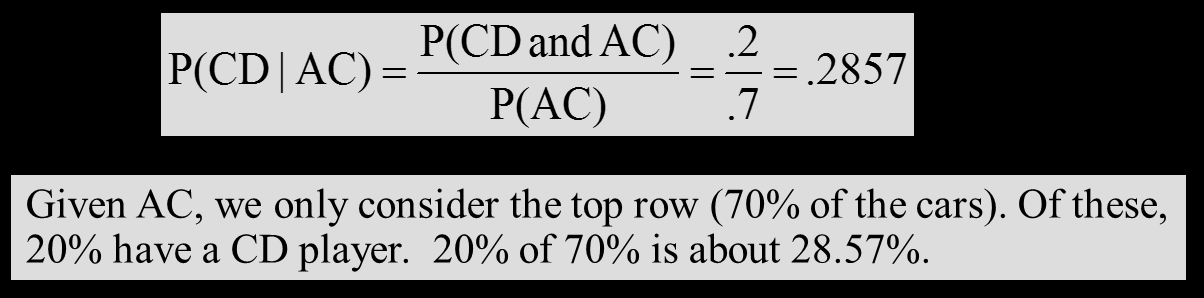
Conditional probability is the probability of event A occurring given that event B has occurred:
Example: If 70% of cars have air conditioning (AC), and 20% have both AC and a CD player (CD), then the probability a car has a CD player given it has AC is:
Independence of Events
Definition
Two events A and B are independent if the occurrence of one does not affect the probability of the other. Mathematically:

Example: Gender and Beer Drinking
Consider the following joint probability table for gender and beer drinking:
M (male) | F (female) | Total | |
|---|---|---|---|
B (beer drinker) | 0.225 | 0.175 | 0.40 |
B' (not a beer drinker) | 0.225 | 0.375 | 0.60 |
Total | 0.45 | 0.55 | 1.00 |
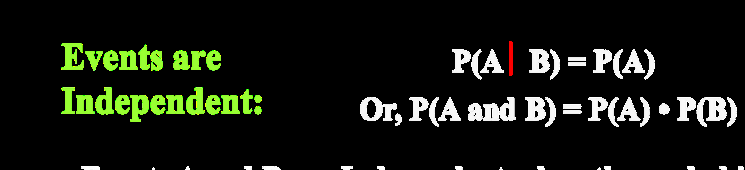
To check independence, compare to . If not equal, the events are not independent.
Summary
Probability measures the likelihood of events, ranging from 0 to 1.
Random variables can be discrete or continuous.
Discrete probability distributions list all possible values and their probabilities.
Events can be mutually exclusive and/or collectively exhaustive.
Simple, joint, and conditional probabilities are foundational concepts.
Independence means the occurrence of one event does not affect the probability of another.
