 Back
BackProbability Concepts and Rules: Study Notes for Statistics Students
Study Guide - Smart Notes
 Tailored notes based on your materials, expanded with key definitions, examples, and context.
Probability Fundamentals
Experiments, Sample Spaces, and Events
Probability theory begins with the definition of an experiment, which is any random activity that produces a definite outcome. The sample space (denoted by S) is the set of all possible outcomes of an experiment. An event is a collection of one or more outcomes from the sample space, often denoted by capital letters other than S. A simple event consists of a single outcome.
Experiment: Rolling a fair die.
Sample Space: S = {1, 2, 3, 4, 5, 6}
Event Example: A = rolling an even number = {2, 4, 6}
Simple Event: Rolling a 3.
Rules of Probabilities
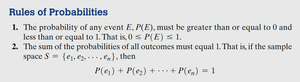
Probability is a numerical measure of the likelihood that an event will occur. The probability of any event A is denoted by P(A) and must satisfy certain rules:
Rule 1: The probability of any event must be between 0 and 1, inclusive:
Rule 2: The sum of the probabilities of all outcomes in the sample space must equal 1:
Approaches to Probability
There are several ways to determine probabilities:
Empirical (Relative Frequency) Approach: Probability is estimated by the relative frequency of an event in a sample.
Classical Approach: Used when all outcomes are equally likely.
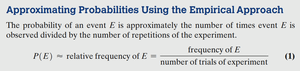
Law of Large Numbers: As the sample size increases, the relative frequencies of outcomes approach the theoretical probabilities.
Tree Diagrams and Sample Spaces
Tree diagrams are useful for visualizing all possible outcomes in experiments with multiple steps. For example, the possible gender combinations for three children can be represented as follows:
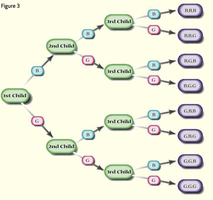
Example: The sample space for three children is S = {BBB, BBG, BGB, BGG, GBB, GBG, GGB, GGG}. The event of having two girls and one boy in any order is E = {BGG, GBG, GGB}.
Types of Events and Venn Diagrams
Disjoint (Mutually Exclusive) Events
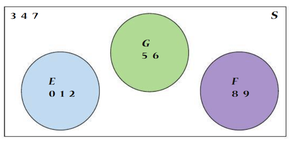
Two events are disjoint or mutually exclusive if they have no outcomes in common. Their intersection is the empty set.
Example: Selecting chips labeled 0-9. E = {0, 1, 2}, F = {8, 9}, G = {5, 6}. These events are disjoint.
Intersection and Union of Events
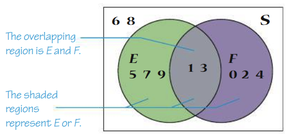
The intersection of two events (E and F) is the set of outcomes that occur in both events. The union is the set of outcomes that occur in either event or both.
Intersection: E and F = outcomes in both E and F.
Union: E or F = outcomes in either E or F or both.
Addition Rules
Addition Rule for Disjoint Events: If E and F are disjoint,
General Addition Rule: For any two events,
Complement of an Event
The complement of event E (denoted Ec) consists of all outcomes in the sample space that are not in E. The complement rule states:
Independence and Conditional Probability
Independent and Dependent Events
Two events E and F are independent if the occurrence of one does not affect the probability of the other. Otherwise, they are dependent.
Multiplication Rule for Independent Events:
Conditional Probability
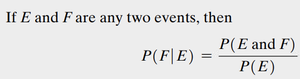
Conditional probability is the probability of event F occurring given that event E has already occurred. The notation is P(F|E), and the formula is:
General Multiplication Rule:
Counting Principles, Permutations, and Combinations
Multiplication Rule of Counting
If a task consists of a sequence of choices, the total number of ways to complete the task is the product of the number of choices for each step.
Example: 4 types of bread × 5 types of meat × 3 types of cheese = 60 sandwiches.
Factorials
The factorial symbol n! is defined as with .
Permutations
A permutation is an ordered arrangement of r objects chosen from n distinct objects, with no repetition. The number of permutations is denoted by nPr.
Formula:
Combinations
A combination is a selection of r objects from n distinct objects, where order does not matter and no repetition is allowed. The number of combinations is denoted by nCr.
Formula:
Combining Probability with Counting
Counting techniques are often used to calculate probabilities in situations involving selection or arrangement.
Example: Probability of selecting exactly two defective items from a box of 12 transistors (3 defective).
Formula:
Additional info: These notes cover foundational probability concepts, including rules, types of events, conditional probability, and counting principles, which are essential for statistics students preparing for exams.
