 Back
BackProbability: Concepts, Rules, and Counting Methods
Study Guide - Smart Notes
 Tailored notes based on your materials, expanded with key definitions, examples, and context.
Probability: Concepts, Rules, and Counting Methods
Section 3.1: Basic Concepts of Probability
This section introduces foundational terms and concepts in probability, including the structure of probability experiments, sample spaces, events, and the calculation of probabilities.
Probability Experiment: An action or trial that produces specific results, such as counts, measurements, or responses.
Outcome: The result of a single trial in a probability experiment.
Sample Space: The set of all possible outcomes of a probability experiment.
Event: A subset of the sample space; may consist of one or more outcomes.
Simple Event: An event that consists of a single outcome.
Example: Rolling one die produces a sample space: {1, 2, 3, 4, 5, 6}.
Example: Rolling a die and flipping a coin produces a sample space of 12 outcomes, such as (1, Heads), (1, Tails), ..., (6, Heads), (6, Tails).
Fundamental Counting Principle: If one event can occur in m ways and a second event in n ways, the number of ways both can occur in sequence is m × n. This extends to any number of events.
Example: Choosing a car from 3 manufacturers, 2 sizes, and 4 colors: 3 × 2 × 4 = 24 possible combinations.
Probability of an Event:
Probability Range: ; probabilities ≤ 0.5 are considered unusual.
Example: Probability of rolling at least 5 on a six-sided die: Outcomes are 5 and 6, so .
Example: Probability of drawing a Jack from a standard deck: .
Complementary Events: The set of all outcomes not included in event E, denoted as E'.
Complement Rules:
Example: Probability of not choosing an employee aged 25-34 from a sample of 1000:
Employees aged 25-34: 366
Probability:
Complement:
Probability Using a Tree Diagram: Tree diagrams help visualize all possible outcomes, especially when combining multiple events (e.g., tossing a coin and spinning a spinner).
Probability Using the Fundamental Counting Principle: For an 8-digit college ID (digits 0-9, repeated): possible IDs.
Section 3.2: Conditional Probability and the Multiplication Rule
This section covers conditional probability, the distinction between independent and dependent events, and the multiplication rule for calculating joint probabilities.
Conditional Probability: The probability of event B occurring given that event A has already occurred, denoted .
Formula:
Example: Probability that the second card is a queen, given the first card is a king (without replacement):
After removing a king, 51 cards remain, 4 are queens.
Conditional Probability Using a Table: Given a table of children’s IQ and gene presence:
Gene Present | Gene Not Present | Total | |
|---|---|---|---|
High IQ | 33 | 19 | 52 |
Normal IQ | 39 | 11 | 50 |
Total | 72 | 30 | 102 |
Probability a child has high IQ given the gene:
Independent Events: Occurrence of one event does not affect the probability of the other. or .
Dependent Events: Occurrence of one event affects the probability of the other.
Multiplication Rule:
If A and B are independent:
If A and B are dependent:
Example: Probability of three successful knee surgeries (each with probability 0.85):
Example: Probability that none are successful:
Example: Probability that at least one is successful:
Example: Probability a medical student is matched to a residency and it is one of their top two choices: , , so
Section 3.3: Addition Rule
This section explains how to calculate the probability of the union of two events, distinguishing between mutually exclusive and non-mutually exclusive events.
Mutually Exclusive Events: Events that cannot occur at the same time.
Addition Rule for Mutually Exclusive Events:
Addition Rule for Non-Mutually Exclusive Events:
Example: Probability of selecting a card that is a 4 or an ace: , , , so
Example: Probability of rolling a number less than 3 or an odd number on a die:
Numbers less than 3: 1, 2
Odd numbers: 1, 3, 5
Overlap: 1
Example: Probability a blood donor has type O or type A:
Type O | Type A | Type B | Type AB | Total | |
|---|---|---|---|---|---|
Rh- Positive | 156 | 139 | 37 | 12 | 344 |
Rh- Negative | 28 | 25 | 8 | 4 | 65 |
Total | 184 | 164 | 45 | 16 | 409 |
Probability:
Example: Probability a donor has type B or is Rh-negative:
Type B: 45
Rh-negative: 65
Type B and Rh-negative: 8
Section 3.4: Additional Topics in Probability and Counting
This section covers permutations, combinations, and their application in probability calculations.
Permutation: An ordered arrangement of n objects.
Permutation Formula:
Distinguishable Permutations:
Combination: Selection of items without regard to order.
Example: Number of ways to form a four-digit code with no repeated digits:
Example: Number of ways to pick first, second, and third activity from 8:
Example: Number of ways to form a three-person committee from 20 employees:
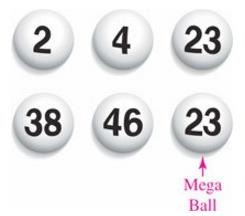
Example: Probability of winning the Mega Millions lottery (choose 5 numbers from 1-56, one Mega Ball from 1-46):
Number of ways to choose 5 numbers:
Number of ways to choose Mega Ball: 46
Total possible tickets:
Probability of winning:
Example: Probability that exactly one of four randomly selected corn kernels contains a dangerously high toxin level (from a sample of 400, 3 are dangerous):
Number of ways to choose 1 dangerous kernel:
Number of ways to choose 3 safe kernels:
Total ways to choose 4 kernels:
Probability:
