 Back
BackProbability: Concepts, Rules, and Counting Principles
Study Guide - Smart Notes
 Tailored notes based on your materials, expanded with key definitions, examples, and context.
Probability: Concepts, Rules, and Counting Principles
Section 3.1: Basic Concepts of Probability
Probability is the study of uncertainty and chance, providing a mathematical framework for quantifying the likelihood of events. This section introduces foundational terms and principles used in probability experiments.
Probability Experiment: An action or trial that produces specific results, such as counts, measurements, or responses.
Outcome: The result of a single trial in a probability experiment.
Sample Space: The set of all possible outcomes of a probability experiment.
Event: A subset of the sample space; may consist of one or more outcomes.
Simple Event: An event consisting of a single outcome.
Example: Rolling one die produces the sample space {1, 2, 3, 4, 5, 6}.
Fundamental Counting Principle: If one event can occur in m ways and a second event in n ways, the number of ways both events can occur in sequence is m × n. This principle extends to any number of events.
Example: If you select one manufacturer (3 options), one car size (2 options), and one color (4 options), the total number of combinations is 3 × 2 × 4 = 24.
Probability of an Event: The probability of event E is given by:
Probability Range: ; probabilities ≤ 0.5 are considered unusual.
Complementary Events: The set of all outcomes not included in E, denoted as E'.
Example: If 366 out of 1000 employees are aged 25–34, the probability of randomly choosing an employee not in this age range is:
Section 3.2: Conditional Probability and the Multiplication Rule
Conditional probability quantifies the likelihood of an event occurring given that another event has already occurred. The multiplication rule helps determine the probability of two events both occurring.
Conditional Probability: The probability of event B occurring given that event A has occurred is denoted .
Independent Events: Events where the occurrence of one does not affect the probability of the other.
Dependent Events: Events where the occurrence of one affects the probability of the other.
Multiplication Rule:
If A and B are independent: If A and B are dependent:
Example: The probability that three knee surgeries are successful, given each has a probability of 0.85:
Section 3.3: Addition Rule
The addition rule is used to find the probability that at least one of several events occurs. It distinguishes between mutually exclusive and non-mutually exclusive events.
Mutually Exclusive Events: Events that cannot occur at the same time.
Addition Rule for Mutually Exclusive Events:
Addition Rule for Non-Mutually Exclusive Events:
Example: Probability of selecting a card that is a 4 or an ace from a standard deck:
Section 3.4: Additional Topics in Probability and Counting
This section covers advanced counting techniques, including permutations and combinations, which are essential for calculating probabilities in complex scenarios.
Permutation: An ordered arrangement of n objects.
Permutation Formula:
Distinguishable Permutations:
Combination: An arrangement without regard to order.
Example: The number of ways to form a three-person committee from 20 employees:
Finding Probabilities in Complex Scenarios
Probability calculations often require the use of permutations and combinations, especially in lottery or sampling contexts.
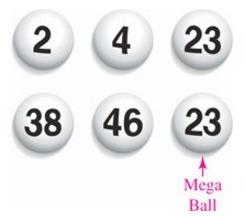
Example: Mega Millions lottery: Five numbers are chosen from 1 to 56, and one Mega Ball from 1 to 46. The probability of winning the jackpot with one ticket is:
Number of ways to choose 5 numbers from 56 (order does not matter): Number of ways to choose 1 Mega Ball from 46: 46 Total combinations: Probability:
Example: Probability of selecting exactly one kernel with a dangerously high toxin level from four randomly selected kernels out of 400, where three kernels are dangerous:
Number of ways to choose 1 dangerous kernel: Number of ways to choose 3 safe kernels: Total ways to choose 4 kernels: Probability:
Additional info: Academic context and examples have been expanded for clarity and completeness. All formulas are provided in LaTeX format for exam preparation.
