 Back
Probability: Definitions, Types, Complements, Odds, and Addition Rule
Study Guide - Smart Notes
 Tailored notes based on your materials, expanded with key definitions, examples, and context.
Probability Fundamentals
Definition of Probability
Probability is a measure of how likely an event is to occur, expressed as a number between 0 and 1. It is foundational in statistics for quantifying uncertainty and making predictions about random phenomena.
Sample Space (S): The set of all possible outcomes of an experiment.
Event: Any subset of the sample space. A simple event contains a single outcome, while a compound event contains more than one outcome.
Chain of Events: A sequence of events that may be dependent or independent.
Types of Probability
Relative Frequency (Empirical) Probability: Probability based on observations or experiments.
Classical Probability: Used when all outcomes are equally likely.
Subjective Probability: Based on personal judgment, intuition, or experience rather than precise calculation.
Complements and Odds
Complements
The complement of an event A, denoted as , consists of all outcomes in the sample space that are not in A.
Formula:
Odds
Odds Against: The ratio of the probability that an event does not occur to the probability that it does occur.
Odds in Favor: The ratio of the probability that an event occurs to the probability that it does not occur.
Payoff Odds: The ratio of net profit to the amount bet (used in gambling and risk analysis).
Addition Rule for Probability
General Addition Rule
The addition rule is used to find the probability that at least one of two events occurs.
Formula:
This formula accounts for the overlap between events A and B, ensuring that outcomes in both are not double-counted.
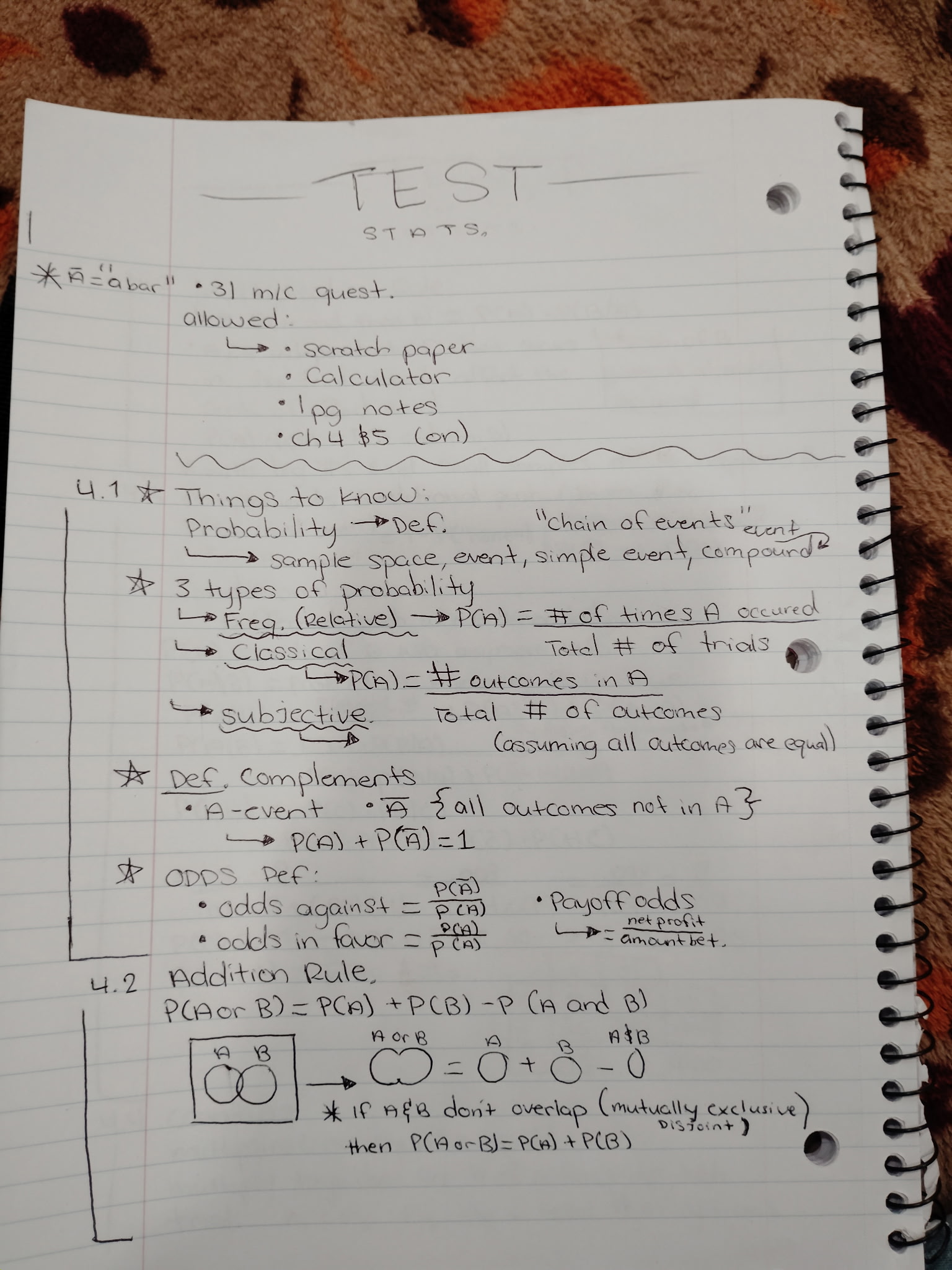
Mutually Exclusive (Disjoint) Events: If events A and B cannot both occur (i.e., ), then , so:
Example: If the probability of drawing a heart from a deck of cards is 1/4 and the probability of drawing a king is 1/13, and these events are not mutually exclusive (since the king of hearts is both), use the general addition rule to avoid double-counting.
Additional info: The notes reference 'chain of events' and 'compound events,' which are important in understanding dependent and independent events, but are not elaborated here. The addition rule is foundational for understanding probability with overlapping events.
